
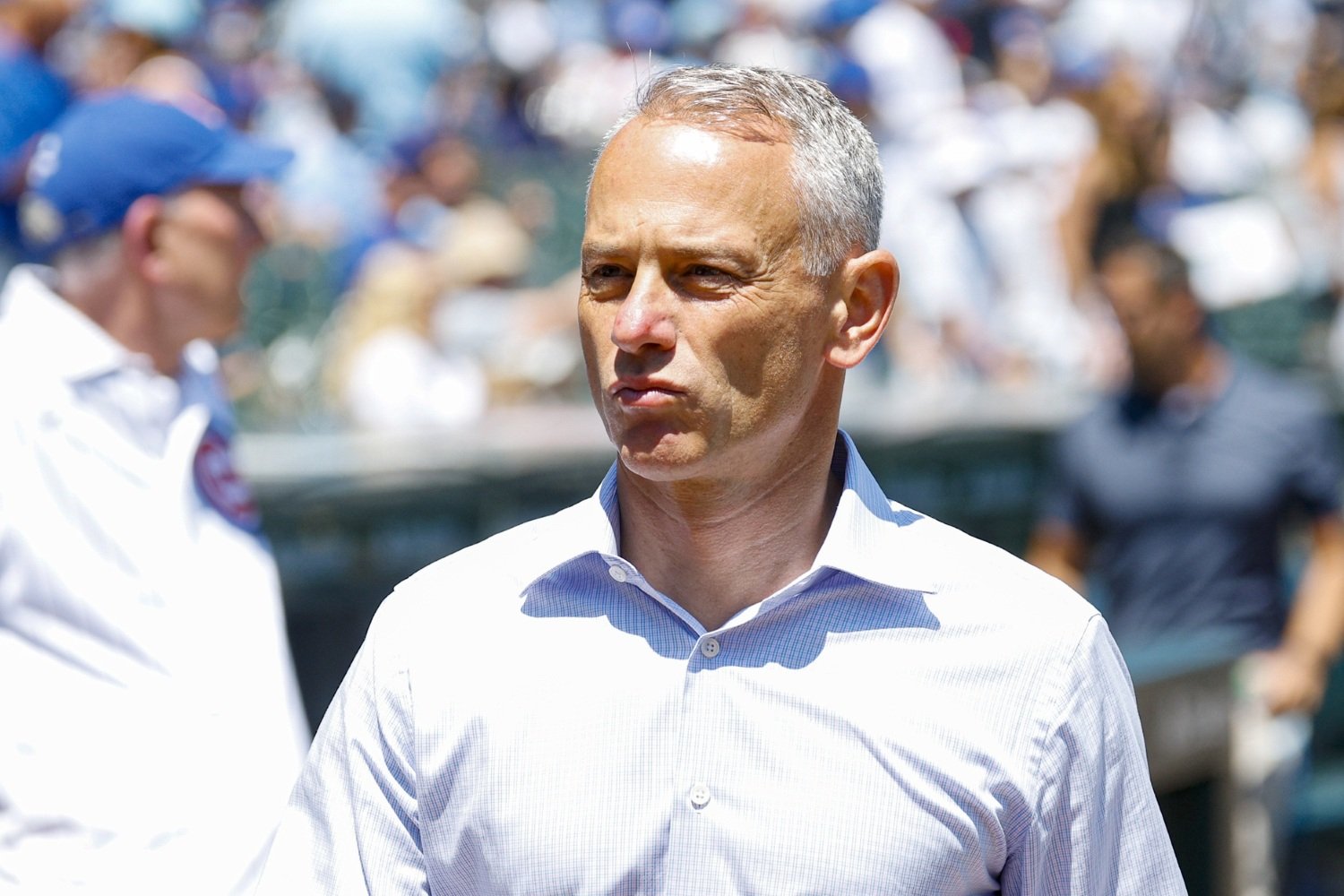
As the MLB trade deadline concluded on Thursday, the Cubs’ efforts kind of landed with a thud. I don’t mean to sound fully negative. In fact, if you want my honest opinions up front, I don’t think the Cubs made any bad trades leading up to the deadline at 5 PM Central. But regardless of how I feel about every trade individually, Jed Hoyer is likely to face a lot of criticism in the following days (and perhaps weeks, months, maybe years) for how the Cubs handled themselves. There will be articles (such as this one) written. There will be reddit posts, blogs, posts on our forums at North Side Baseball… it won’t go unnoticed, to say the least. For better or worse, this was a microcosm of the Jed Hoyer experience. The man is who he is.
“Jed Hoyer never orders delivery, he always picks up his pizza.” I sincerely wish this was my own pithy turn of phrase, but one of our other, more clever writers (aye @matto1233) at NSBB mentioned it as the clock struck midnight on the deadline, and I think it’s the perfect way to explain what happened. Hoyer is nothing if not a pragmatist. If he can drive himself to Domino’s and avoid a $3 charge for delivery and a further $4 for a tip, the man will make that drive in rain, sleet, snow or sun. To Hoyer, $7 is $7 ,and his gas spent will total far less than $7. He does that math regardless of anything else about the situation. Value is value, afterall.
To put it in baseball terms, Hoyer is someone who fervently sticks to his own valuations and does not budge. This can be a good quality. For example, as I have mentioned already, I liked every trade that occurred this deadline. The highest-ranked prospect the Cubs lost profiles as a fourth or fifth outfielder (Christian Franklin), and the closest thing to a real organizational loss was someone who hasn’t blown out the candles on their 18th birthday cake quite yet (Wilfri De La Cruz, the cost for Andrew Kittredge). And in return for that smattering of prospects ranked 10th and beyond organizationally, the Cubs received four players who undoubtedly make their roster better, in utility man Willi Castro, starting pitcher Mike Soroka, and relievers Taylor Rogers and Andrew Kittredge. The Cubs knew what each player was worth, and they paid a pretty fair price for them. On the surface, this is nothing but a good thing.
This is Hoyer’s best trait as a leader of an organization; he really gets it when it comes to valuation. Hoyer will rarely, if ever, be fleeced on any trade, or in any free agent negotiation. His biggest misses have been short-term deals or small overpays. To date, I don’t think he’s made a single disaster of a move. You may quibble with a valuation here or there, but quibble is really all you can do. We can nitpick, but never truly find massive fault or a move that feels illogical or emotional.
Arguably, though, Hoyer’s pragmatism runs so deep that it sometimes becomes a problem. He’s so principled in his approach that it sometimes becomes untenably rigid. Driving to Domino’s is fine if it’s nice out and you have the time. Paying the delivery fee makes sense when you’re on a time crunch. We can see these issues play out during the deadline. The Cubs definitely needed an upgrade in the starting rotation, and while I like Michael Soroka as a neat little buy-low type, there were obviously bigger fish in the water that were ultimately passed on—despite the Cubs’ unique situation, in being both a team of needs and means to acquire. Why is that? Almost assuredly, it’s because Hoyer felt the value proposition of trading the prospects required outweighed the return.
The deadline is a pressure cooker by nature, made only more intense with the expanded playoff system. Nowadays, more teams are in the thick of the chase and fewer teams are obvious sellers. It creates an even more difficult dynamic; it’s almost always going to be a seller’s market. It forces those who aren’t obviously selling to decide if they truly have the guts to go for it—if they can stomach the price of admission to the playoffs and potentially, the World Series. While pragmatism may win the day as a seller (the Cubs came away with Pete Crow-Armstrong and Kevin Alcántara for rental hitters in 2021 under Hoyer), it makes life very difficult for the buyer, because it requires the pragmatist to go beyond their beliefs many times to make the big swing occur. If you want to truly make your team better, you have to be a bit irrational.
On one hand, none of the exciting, controllable starting pitching was traded today, and if you want to suggest that prices were just too high, that’s entirely your prerogative. Hell, Hoyer said as much in his press conference. It is true that MacKenzie Gore, Joe Ryan, Edward Cabrera, and even Sandy Alcantara all remained with their organizations. The Cubs were asked for Matt Shaw and/or Cade Horton in specific trades, which sounds egregious. You can also point to Dylan Cease, potentially the best rental who was tenuously available, not being traded, if you so will. But regardless of these players not being traded, there remained the potential for each to have been traded, had the Cubs been just a bit more irrational than the rest. Would it have required the Cubs paying a premium? Probably, but the Cubs could have afforded that premium, if we are being honest with ourselves.
As it stands, the Cubs kept many prospects who have no clear path to a big-league role. Even if they do not retain Kyle Tucker in the offseason, there would be only one starting position obviously available for the quartet of Owen Caissie, Moisás Ballesteros, Jonathon Long and Alcántara. That’s too many names, all of whom will be ready for the next step in their development. If the Cubs re-sign Tucker, well, it’s even harder to figure out where they will all go. I understand not wanting to gut the system, but prospects have depreciating value. Is Caissie ever going to have more value than he did today? What could he possibly do between now and December to raise that profile? It’s probable that any one of these names will have less value moving forward than they did today, so while the cost of acquisition may be high now, if each prospect is less valuable, are you really saving anything?
What Hoyer needed to do at this deadline was become just a little irrational. Sure, $7 is $7, but it’s raining outside, Jed, and you’re really tired. Let someone bring you the pizza this one time. Splurge a little. I can hear Donna Meagle and Tom Haverford from the great sitcom Parks and Recreation, screaming at Hoyer to “Treat Yo’self!” Would a controllable starting pitcher have cost 15-20% more than they should? Maybe it would have, and yes, that would be (on paper) a “bad” trade from a value standpoint, but you pay that premium now and you worry about that overage in a few years. I’m not asking Hoyer to become A.J. Preller (who, in this instance, is likely ordering DoorDash at peak hours from McDonald’s, despite living literally right next to the establishment), but only to step out of his shell once or twice and be just a little irrational.
Ultimately, I don’t think the deadline was a disaster. Each individual trade was fine. The Cubs didn’t get taken to the woodshed in valuation by the Twins, the Pirates, the Nationals or the Orioles. But they also didn’t address their most glaring need, which was to lift the ceiling by improving the front end of the rotation. Instead of having a Ryan or a Cabrera, the Cubs will hope that Soroka will be better the third time through the lineup, and that there are no more injuries of consequence. They will continue to lean on Colin Rea and need to hope that Jameson Taillon comes back healthy and ready to go right away. Being a little irrational would have solved that issue.
Had the Cubs gone too far, even if it was an “overpay” by some dumb model like Baseball Trade Values, that irrationality would still have provided the 2025 Cubs (and beyond, considering the pitcher was controllable) a better foundation to make the playoffs and continue to win baseball games. They would have paid too hefty a price on paper, but also would be a better baseball team—now and, probably, over the next few years. The Cubs draft fairly well; they develop players fairly well. It’s possible they would have replaced that added fee on their own. The Padres and Dodgers live on this mantra, with an unfettered confidence that they will just recreate what they sell. Perhaps the Cubs should believe in themselves just a little more this way, too.
This was Hoyer’s trade deadline, for better or worse, and for better or worse, this is who Hoyer is. He will never be the guy to get egg on his face at the deadline, but he’s unlikely to ever be the guy who makes it (whatever it is at that specific time) happen. This is who he is, and will continue to be; it’s both a blessing and a curse. So while I may not hate anything he did individually, this deadline feels like a missed opportunity. Hoyer will tell us that the prices were too high (in fact, he already has), and I’ll probably believe him. They probably were too high, from a pure value standpoint. But sometimes, it’s just nice to have a delivery pizza, and I wish Hoyer was willing to treat himself to a Gore or a Ryan. Just once.
What did you think of the Cubs deadline in 2025? Do you think the Cubs will be able to hold up the rest of the year? Should they have spent more for a controlled starter? Let us know in the comment section below.