
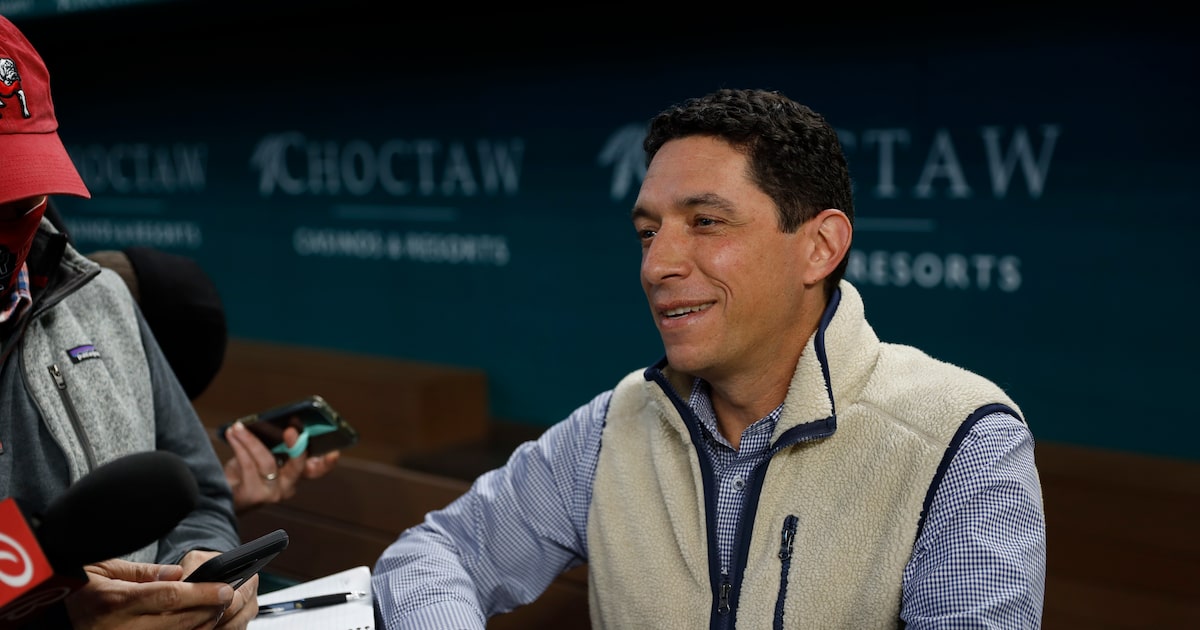
Former Texas Rangers general manager Jon Daniels joined The Dallas Morning News’ SportsDay Rangers podcast with longtime beat reporter Evan Grant and Rangers senior advisor and team historian John Blake.
They discussed how the trade deadline has changed with the rise of social media, Daniels’ favorite and least favorite deals he made as the Rangers GM and more.
Here are some highlights of the conversation, edited lightly for clarity.
You can listen to the full conversation here.
Rangers
The trade deadline has become a frenzy for media and fans. How did you approach the deadline and how did you try to cut out those sorts of distractions?
Jon Daniels: I’ve always felt for the most part in-season, there’s not a ton that the front office can do, right? I mean, it’s mostly on the players and the staff. You know the game is going to be played at seven o’clock that night, whether you’re locked in or not. The offseason, I felt a lot more stress and pressure as a front office because that’s when we compete. That’s when, if we’re not going after that free agent or that trade, then Dave Dombrowski or Andrew Friedman, or whoever is going to beat you to it. You kind of feel that same way at the deadline, where it’s like you’ve got to really be on top of things. Things can move quickly, one phone call to the next, things can change with an injury or a few wins here and there for a different club. So really felt a lot of pressure to stay on top of things. Didn’t sleep a lot in the the month or so leading up to it. Now it’s kind of, the dynamics changed a little bit with the draft. The draft used to be in the middle of June, now it’s the middle of July at the All-Star break. So the whole trade window gets squeezed in a little bit, and it adds to that lifestyle, stress, pressure, whatever you want to call it.
Related:Cast your quarterfinals vote on the best moments in Rangers regular-season history here!
With the rise of social media and how the reporting of deals and negotations has changed over the years, how did that impact how the front office conducted business? Did it kill or interfere with deals?
Daniels: In some ways, it was a positive in that you’d almost get some idea generation out of it, right? You almost were able to, as reporters who do a really good job and have a good finger on the pulse of other organizations, they might put something out there on Twitter, and it might give us a lead for us to at least discuss in house, or at least maybe pick up the phone and says “Hey, I’m rumor chasing here. I’m headline chasing, saw you might be talking about Player X, and is that accurate?” And most often, it doesn’t lead anywhere. But sometimes it does.
I don’t remember an exact instance of [information getting out killing a deal]. Where I do think there was a real, tangible difference, was you have to be prepared for the information to get out, unbelievably quickly, right? When we made the Kyle Gibson trade with Philadelphia, I remember the way our offices were set up, we had this bank of TVs out there and so you could see the TVs. [Chris Young], Ross [Fenstermaker] and Josh [Boyd], these guys are in the office. [Young] was negotiating that one, mostly with with [Phillies executive] Sam Fuld at the time with Philly. [Young] was literally on the phone with Sam, we had not fully agreed on the details of the trade. John [Blake] was standing right there, and there’s Ken Rosenthal announcing the trade as being done. So I think knowing that the information was going to come out, literally sometimes before the deal was finished, as crazy as that sounds, we got a little bit more proactive with informing the players. Really never wanted players to find out about stuff off social media. Probably the worst instance of that happening in my tenure was when we traded Ian Kinsler to Detroit. I was on a plane, ultimately I think Price Fielder’s agent, I’m guessing, probably put that out. Jon Heyman reported it, and it was ugly and Ian deserved better than that. And so learning from that, that was all the way back in 2013, learning from that and what a bad experience it was and how unfair that was to Ian, we got ahead of it. With the Gallo trade at the deadline, we traded him to New York, we pulled him out of the lineup. The deal was not done. We pulled him out of the lineup and we sat him down, we told him, “Hey, this deal’s 90% of the way done, it’s likely to get done tonight. We don’t want to pull you off the field. We don’t want you reading about this, or walking through the clubhouse and seeing it on headlines or something like that.” And we had a hiccup with that deal, right? A medical issue with another player, and it ended up taking a little longer. So I’m glad we did, but that’s one of the big changes. You have to anticipate stuff getting out. It doesn’t mean there’s a leak in your front office or anything like that. There’s just so many people that know about these things at this point, between agents and the league and the Players Association that it’s better to get out ahead of it and not let the players be surprised.
What’s your favorite trade deadline deal and your least favorite deadline deal?
Daniels: Oh man, favorite deadline deal. I mean, it’s probably [Cliff Lee], it’s probably the deal with Seattle there in 2010. It felt like that was us getting over the hump, right? It was us like, to that point, ‘09 we were a very good team. I think in the current playoff format, we would have been in it. I think even in the previous format, before they fully expanded it, we would have made it, won about 87 or 88 games. We’re a good team, 2010, like we had really started coming of age as a club, and I think going out and getting this number one starter that can match us up with just about anybody, along with Colby [Lewis] and C.J. [Wilson] and that group. Just the energy that that injected into the clubhouse. I remember being downstairs in [Ron Washington’s] office. We’re talking through the dynamics of the trade, and you could literally hear down the hallway, Michael [Young] and [Ian] Kinsler and the guys like, “Holy crap! We got Cliff Lee!” The energy flowing through the place, it just felt it took us to a little bit of a different level organizationally. Obviously he performed at just a tip-top level there in the playoffs, and pitched us through the first two rounds. His Game 3 against the Yankees, against Andy Pettitte at Yankee Stadium, was just unbelievable.
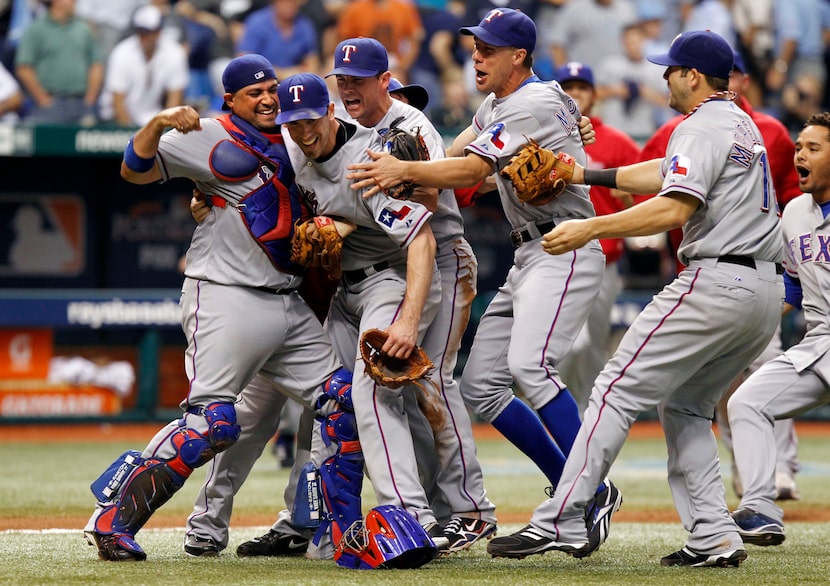
Texas Rangers Bengie Molina (11), Cliff Lee (33), Michael Young (10) David Murphy crowd Lee after defeating the Tampa Bay Rays in game 5 of the American League Divisional Series at Tropicana Field in St. Petersburg, Florida on October 12, 2010.
VERNON BRYANT/Staff Photographer
One of the other ones that I really enjoyed was 2006 and we were kind of in between. I’m not really sure we should have been buyers, but we thought Carlos Lee was a bat that could help put us over the top. The price with with Doug Melvin and Milwaukee was [Francisco] Cordero and [Kevin Mench], and it was too hefty of a price for us to pay for just a rental, because we were kind of sort of contenders. So really, we pushed hard to get a younger player back in the deal. We ended up having to expand the deal. We put Laynce Nix and Julian Cordero, a young left hander, and and we got [Nelson] Cruz in the deal. It took Nelson two or three more years to really establish himself, but obviously ends up being a critical part of our success and those great teams.
One of the ones that I regret, 2012. There’s a couple parts of this that I dislike. One was that we’re going really good again and then Colby Lewis hurts his arm, ends up having a torn flexor tendon, needs surgery, but we were in the middle of negotiating an extension with Colby. And I know you guys know Colby as well as I do. There’s nobody on this planet that doesn’t love Colby Lewis and that doesn’t root for Colby Lewis, so it really stunk. I felt terrible for him that we are in the middle of negotiating this deal, he gets this injury, and it was a big blow for us. So trying to backfill that, we ended up acquiring Ryan Dempster. Famously, or infamously I guess, we put Kyle Hendricks in the deal. He’s had a great career. I don’t know if it’s funny, but the irony of that is that’s not who the Cubs wanted initially. I remember talking to [Cubs executive Theo Epstein]. We agreed on Christian Villanueva at the time. We wouldn’t put Mike Olt in the deal. We put Villanueva in the deal. We had the two upper-level third basemen and then it was another pitcher. They asked for Justin Grimm. We said no. They asked for Neil Ramirez. We said no. They asked for Luke Jackson. We said no. They asked for Cody Buckel. We said no. With maybe 10 minutes to go before the deadline, he asked for Kyle Hendricks and we kind of reluctantly said yes. We felt like there was other guys that had better stuff than him, and obviously Kyle’s just had an unbelievable career. He ends up, a couple years later, is pitching the Cubs to a World Series. For a host of reasons, that one stings.
Did any trade deadline deals cause any personal anguish for you or was personally tough?
Daniels: The [Yu] Darvish one was tough. First of all, we were still like loosely in the mix, and so I hated pulling the rug out from the team. Secondly, I developed a really good relationship with Yu. We’ve stayed friendly. It was a big transition for this guy, right? I mean, he’d already made one huge transition, then he has surgery. It took him a while to get comfortable in Texas, now he’s going to L.A. and the media market and all that. We kept him pretty well apprised of everything the whole time, so I felt good about that part. But then the return, there were reasons to like the players at the time. We could have held on to him and got a draft pick, but it would have been a a draft pick between the second and third rounds, I think. We didn’t think that value was great, but it was above that line, but not significantly above the line. I think looking back, our best deal probably was with Houston in ’17. We could have had, I think, Joe Musgrove in a deal with Houston. He had some medical issues at the time, still the deal we probably should have made, but there was a feeling internally with ownership that like didn’t love trading him in the division to Houston. Anyhow, looking back, we would have been better off making the deal with Houston. We would have been better off probably holding him for the pick. But I think all those factors, the personal side of it too, knowing Yu and knowing what he’d been through, made that one tough.
You can listen to the full conversation here.
Find more Rangers coverage from The Dallas Morning News here.
Click or tap here to sign up for our Rangers newsletter.