
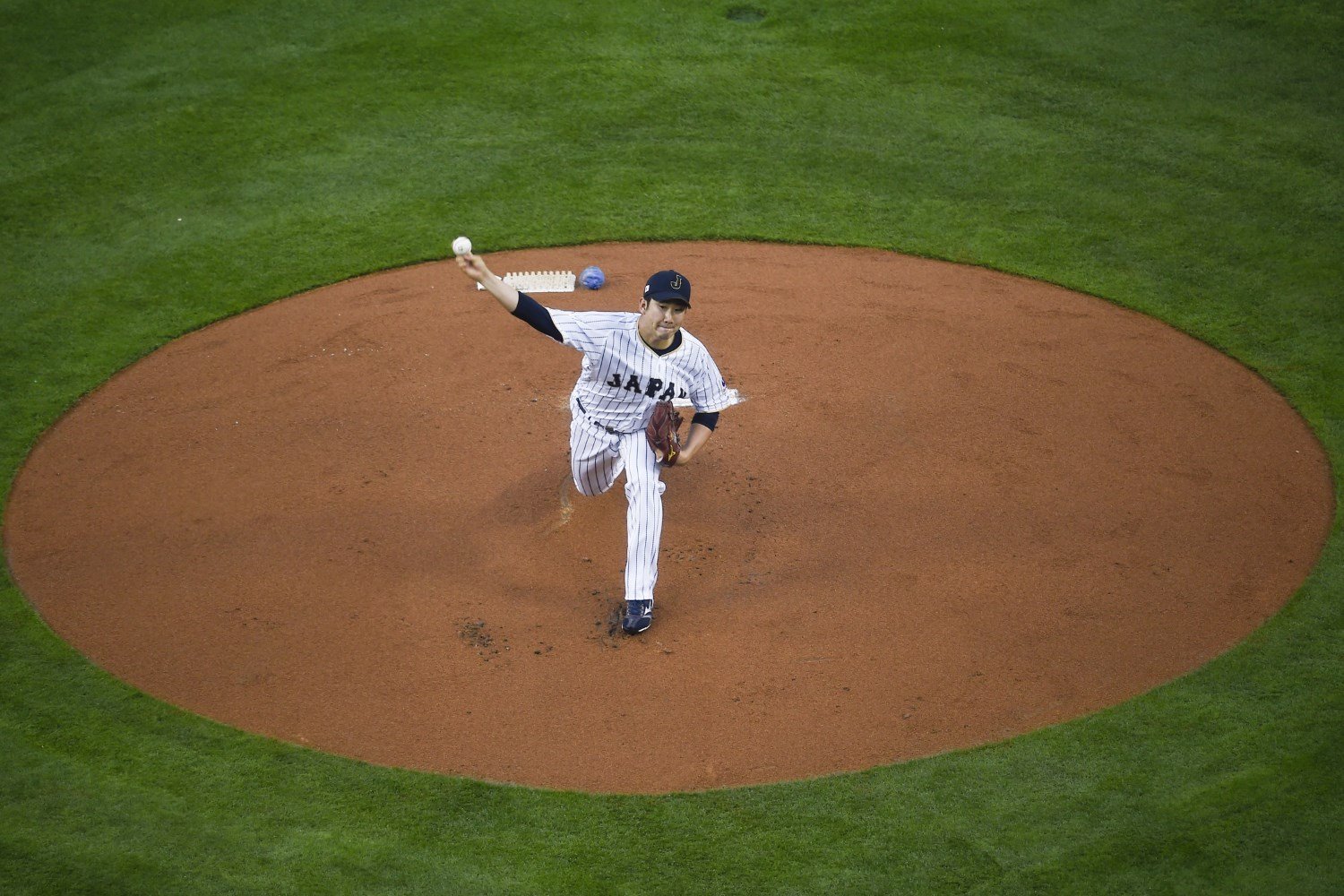
In an offseason that looks to be relatively rich with starting pitchers available in free agency, there will be less attention on aging Japanese righthander Tomoyuki Sugano than there might have been if he had come over two or three years ago. However, Sugano, 35, is likely to sign with an MLB team this year, after a decade and change as one of the top starters in NPB. Since he’s waited so long to cross the Pacific Ocean this way, he will be free of the posting system and clear to sign with a team for nothing more than cash.
Twitter user @bouno05, a top-flight Japanese sabermetrician, created an app that allows visitors to easily view summaries of pitchers’ skill sets and specific data about their arsenals, using NPB data. It’s a marvelous resource, and the only Japanese you need to decipher to use it is the name of the player in kanji characters. The rest is in English, although (blame George Washington) you’ll still have to do a small step of translation to use it comfortably: all the velocity readings given are in kilometers per hour.
This is a tremendous tool for us American fans hoping for insight on Japanese hurlers who might come over to the United States, for multiple reasons. Firstly, it’s much easier to grasp how a pitcher’s stuff might transfer between these two different leagues by studying their stuff directly, rather than going on imprecise scouting reports, video narrated in a language we don’t understand, and surface-level stats compiled against very different hitters than the ones these guys will encounter Stateside. (In general, we should make a broader effort to learn Japanese and Spanish; those are as much the languages of baseball as English is. For now, though, my Spanish lags far behind my English, and my Japanese is much worse even than my Spanish, so it’s immensely helpful to have a resource that meets me much more than halfway.)
Secondly, though, it’s instructive in the way it lets us see the changes a pitcher who has already come over from NPB to MLB made upon doing so. For instance, here’s Shota Imanaga‘s readout from the app for his time in NPB in 2023:
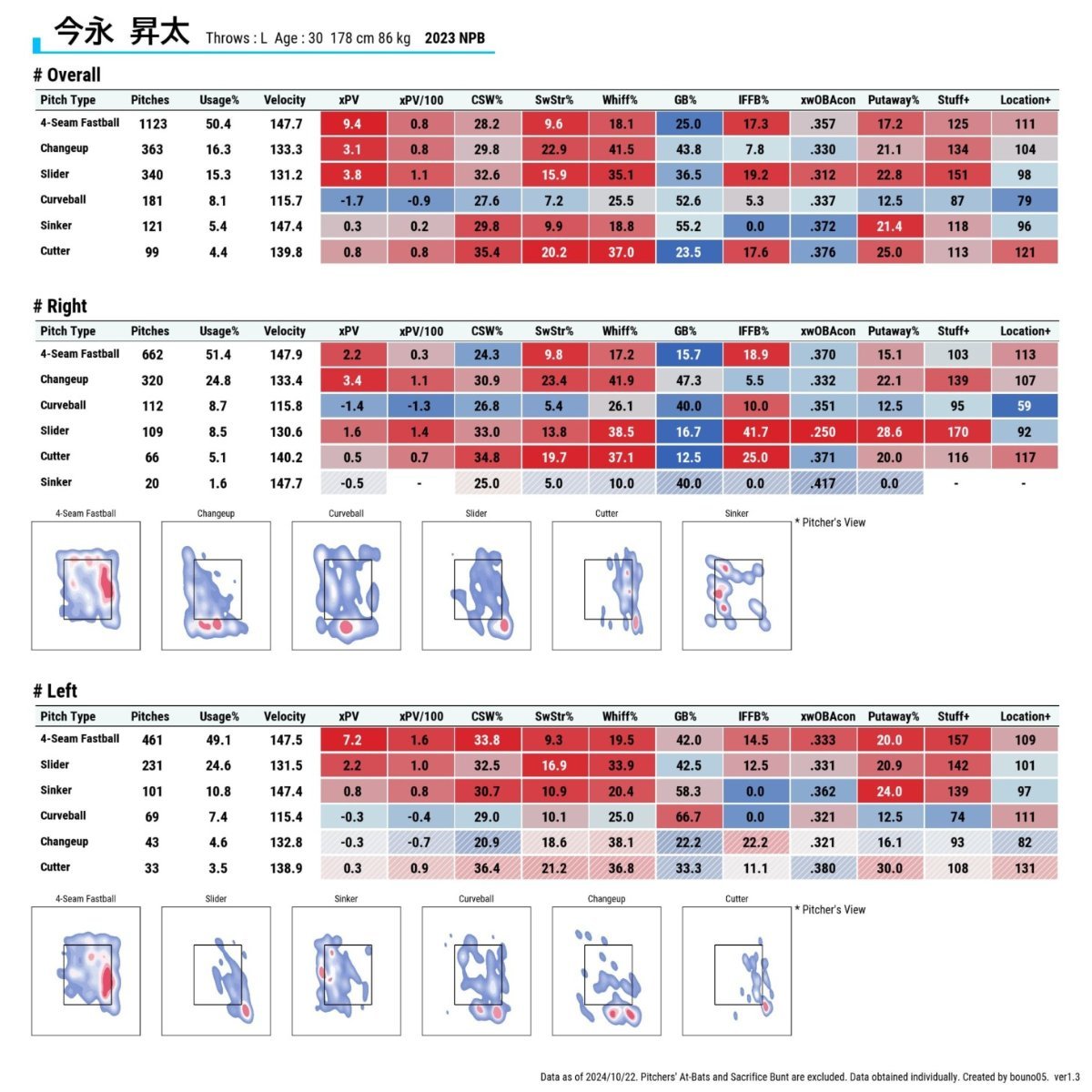
This dataset counts Imanaga’s formidable splitter as a changeup, but otherwise, this is easy to read and understand—and it tells us some unexpected things about Imanaga, vis-a-vis his rookie campaign with the Cubs. When he started facing American hitters, Imanaga lived basically as a two-pitch pitcher for a long time, but this shows that he varied his pitch mix considerably more than that in NPB, as he began to do later in his first season with the Cubs.
Imanaga threw his splitter much less against lefties in his last season in Japan than he did in 2024 for the Cubs. It’s not surprising, per se, that he would use such an unusual offering more often against a new and unfamiliar set of opponents, but it affirms the feeling you got when watching: that he was adapting a great deal as he went, and that that was the source of both some of his struggles and much of his success.
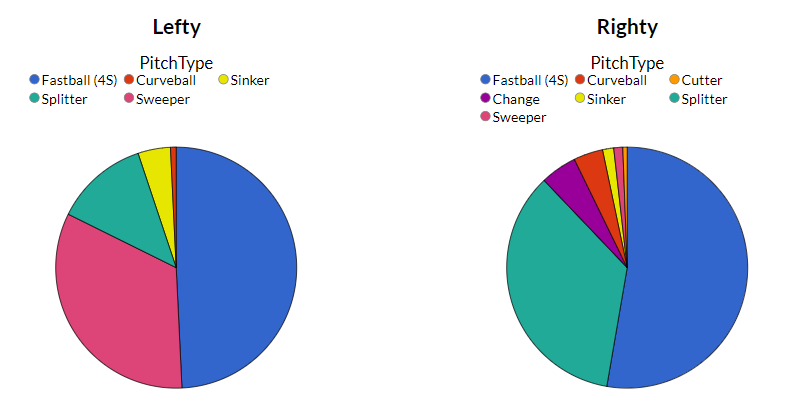
Having Imanaga’s pitch mix details from Japan as a template (with a year of MLB data to help us contextualize and translate that information) makes it easier to evaluate Sugano, even though the latter is four years older than Imanaga was when he made his change of league and even though he throws right-handed. Here’s Sugano’s 2024 data.
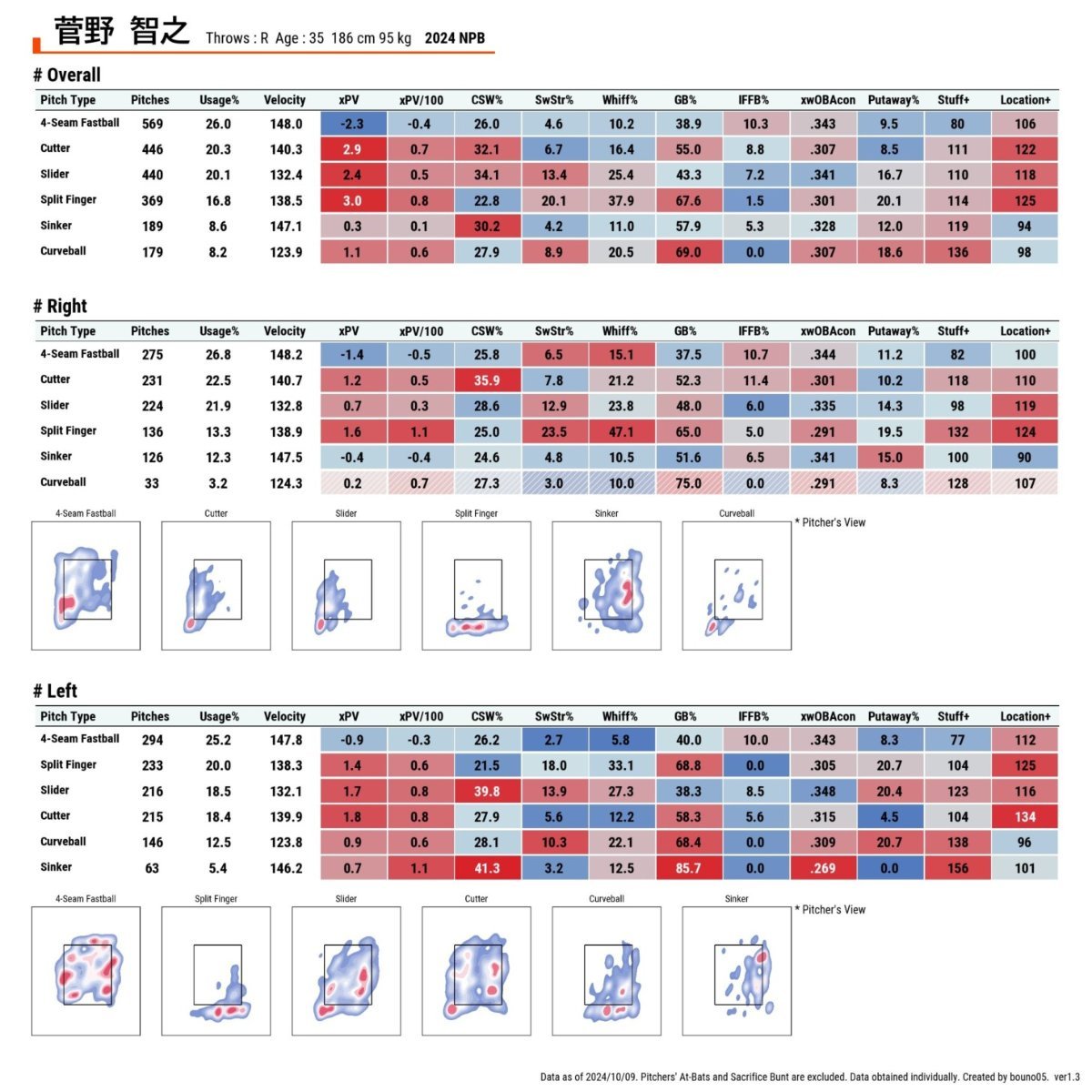
A bunch of things stand out right away. Sugano’s fastball averages around 92 miles per hour, which is underwhelming, and it’s pretty clear that it doesn’t have the same special characteristics as Imanaga’s—at least not the way he threw it this year. His Stuff+ grades are a bit less impressive than Imanaga’s, on balance, because those grades compare pitchers only to their NPB cohort. As currently constituted, Sugano’s fastball is far below an MLB standard, and the worry would be that it would be hit very, very hard.
Look at all his other offerings, though. He’s likely to streamline his arsenal a bit for each handedness of hitter as he moves to a new set of opponents, just as Imanaga did, and he has a wide selection of weapons from which to choose. Note, too, those little heat maps showing location on his stuff. These explain goergously how Sugano managed to walk 16 and allow only six home runs in 156 innings this year. Can he repeat that against MLB hitters? No. But his command is so good that he can almost certainly outpitch his raw stuff grades.
Whichever team signs Sugano will also feel out the 35-year-old on some late-career changes of approach that could help his arsenal play up. Look at where he threw his fastballs to right-handed batters last year. It sets up his cutter and slider there nicely, but it’s no wonder he gets bad Stuff+ returns and low whiff rates when trying to do the old 1990s thing, dotting the outside corner at the knees as many times as possible. If he’s amenable to it, some MLB club will have him start pitching to the upper third of the zone with that heater, and his strikeout rate will tick up, even if he gives up a few homers in the process.
Imanaga’s success is just the latest in a string of veteran Japanese hurlers doing very well upon coming to the States, and it’s proof that the control-over-power hurler can port their success to this side of the ocean. Sugano doesn’t profile as an ace, and he figures to be in line for a shorter deal than the ones signed by Imanaga and Kodai Senga in recent years, but he has real upside as an undervalued mid-rotation starter. He looks, in fast, a lot like Javier Assad with an extra grade of command. That’s a very, very good pitcher.
With Seiya Suzuki and Imanaga already in the fold, the Cubs have another incentive to seriously consider signing Sugano, as long as his price tag remains reasonable. They won’t surpass the Dodgers as the MLB team of the moment in Japan, but there’s no reason they can’t firmly and semi-permanently establish themselves as the secondary club of Japanese MLB fans across that country. If Imanaga and Sugano could start opposite Yoshinobu Yamamoto and Shohei Ohtani when the Cubs and Dodgers open next season in Tokyo, it could take what will already be an incredible moment for the league and its international fan base to a new level.
In a perfect world, the Cubs might add two starters this winter: one who would slot in at or near the front of their rotation, and one who could slide into the back end. Sugano profiles better as the latter, but signing him might also make it easier to acquire the former. We can talk more about why that might be later this week. For now, the important takeaway is that specific data on Sugano’s stuff paints a picture of him as a very good command artist, albeit without as clear a niche in MLB as Imanaga had. If he can adjust as well as Imanaga did this season, he could be hugely valuable—and a rare bargain.