
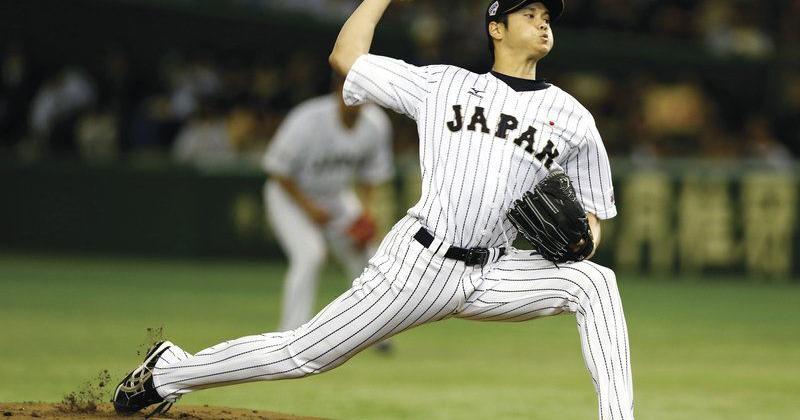
While JD Martinez makes headlines as “The King Kong of Slug,” and Giancarlo Stanton’s will-he-or-won’t-he-be-dealt scenario nears a crescendo, one of the best players in the world has still yet to hit the market.
Shohei Ohtani is viewed as a generational talent, but he’s stuck in limbo.
The 23-year-old superstar would project as an ace on just about any major league staff. And he can hit.
Ohtani wants to come to the major leagues, but hasn’t been able to yet. It’s a complicated situation, but we can simplify it.
First things first:
Who the heck is Ohtani?
Probably the best player in the world that’s not currently in the major leagues. He’s the reigning Pacific League MVP, and he’s hit 102.5 on the radar gun, the fastest pitch in Nippon Professional Baseball history.
Ohtani been playing in the world’s second-best league since he was 18, but this it isn’t a buyer beware situation. Ohtani’s Pacific League team has managed his electric arm wisely; he’s never thrown more than 170 innings in a season.
Compare that to Masahiro Tanaka, who eclipsed the 170 mark six times before signing with the Yankees, and is already dealing with elbow problems in his late 20’s.
And Ohtani is a true dual threat.
Despite an ankle injury, Ohtani hit .332 this season with a .942 OPS. He’s smashed 500-foot home runs, and could pitch and act as a designated hitter for an American League team.
A flamethrowing right-hander that’s also a lefty power bat? He’s sure to cost a fortune, right?
Not exactly.
Ohtani won’t break the bank
Because of the international signing rules in the new collective bargaining agreement, Ohtani is considered an amateur, and his contract will be capped at less than $4 million. If he waited two more years, he could come over as an unrestricted free agent and command a massive pay day, but Ohtani wants to play major-league ball now.
For Ohtani to become available, his Japanese team must “post” him. Under the 2017 posting agreement between the MLB and the NBP, whichever team signed Ohtani would pay a one-time fee of $20 million to his old team (the Nippon Ham Fighters), essentially buying him from them.
He’d make a league minimum salary of $545,000. So in all, Ohtani would cost a major league team less than $25 million and wouldn’t be eligible for salary arbitration until 2020.
So what’s holding things up?
It’s a deal that sounds too good to be true, so the MLBPA is arguing that it must be.
The MLB and the NPB reportedly agreed to extend the posting agreement, but the players association has not. There hasn’t been a formal statement from the MLBPA, but it’s pretty easy to read between the lines here.
The players association sees the scenario as unfair because a team will pay upwards of $20 million and Ohtani only sees a small fraction of that. If nothing else, putting up a fight now will aid future players caught in Othtani’s shoes.
What can they do to alter the system? Who knows, but the MLBPA has set a deadline tomorrow to resolve it.
Are the Red Sox interested in him?
Of course. They’ve scouted Ohtani extensively and could certainly use the starting pitching.
While Dave Dombrowski can’t address Ohtani because he’s not technically a free agent yet, he did speak to the hypothetical possibility of a dual-threat at the general manager meetings.
“Well, Babe Ruth did it, right? So, he was pretty good,” Dombrowski said. “I would say that it’s possible. I’ve been involved with guys like that at the minor league level, and there’s a couple of guys now like (Brendan) McKay with Tampa that was drafted last year. I originally – many, many years ago – I had Bobby Thigpen, who was a reliever at that time and also played some. Now, most players aren’t that talented to continue to do it, but if you had somebody that was talented enough, why not? Like, I said, the Babe did it.”
What are the chances the Red Sox actually land him?
It’s an uphill climb.
While teams like the Rangers and Yankees can offer Ohtani upwards of $3 million, the Red Sox only have $462,000 remaining in bonus money to offer him. The league has an $8.3 million cap on international signing bonuses, and the Sox have already used up $7.85 million.
Still, that isn’t a death sentence.
Ohtani is already leaving perhaps $100 million on the table by coming to the MLB now instead of in two years. What’s another couple million?
The greatest challenge lies in convincing Ohtani that the Red Sox are a better fit than 29 other suitors.
The Sox don’t look like frontrunners, and Ohtani still needs to get here first, but stranger things have happened.
Chris Mason is a Red Sox beat writer for CNHI Sports Boston. Email him at cmason@northofboston.com, and follow him on Twitter at @ByChrisMason.