

By Jayson Stark, Ken Rosenthal and Eno Sarris
Last winter, Major League Baseball negotiated a seemingly simple change in how home-plate umpires are graded and evaluated. But now, a month into the season, its impact on balls and strikes has players asking questions about what they believe is a tightened strike zone — and searching for ways to adjust to a new wrinkle they say caught them by surprise.
That change, which was part of a new labor agreement with the Major League Umpires Association, significantly decreased the margin of error for umpires in their evaluations — and has resulted in fewer called strikes off the edges of the plate through the same point as last season.
“Everybody’s zone has shrunk,” Angels catcher Travis d’Arnaud told The Athletic. “Every (umpire) across the league.”
The actual number of pitches affected is relatively small. But the reaction — from pitchers, catchers, pitching coaches and analytics-driven front offices — has been anything but. They say the shift in how balls and strikes are now called is already having an impact on game planning, pitch sequencing, pitch framing techniques, evaluation models and even roster construction.
For the past two decades, umpires were working with a “buffer zone” that gave them 2 inches of leeway — on all sides of the plate, inside and outside the strike zone — when they were graded on how accurately they called balls and strikes.
Now, however, that buffer zone has shrunk, from 2 inches on all sides to just three-quarters of an inch on all sides, inside and outside the strike zone, according to league sources briefed on the change but not authorized to discuss the matter publicly. An MLB official confirmed that the buffer zone had decreased in size.
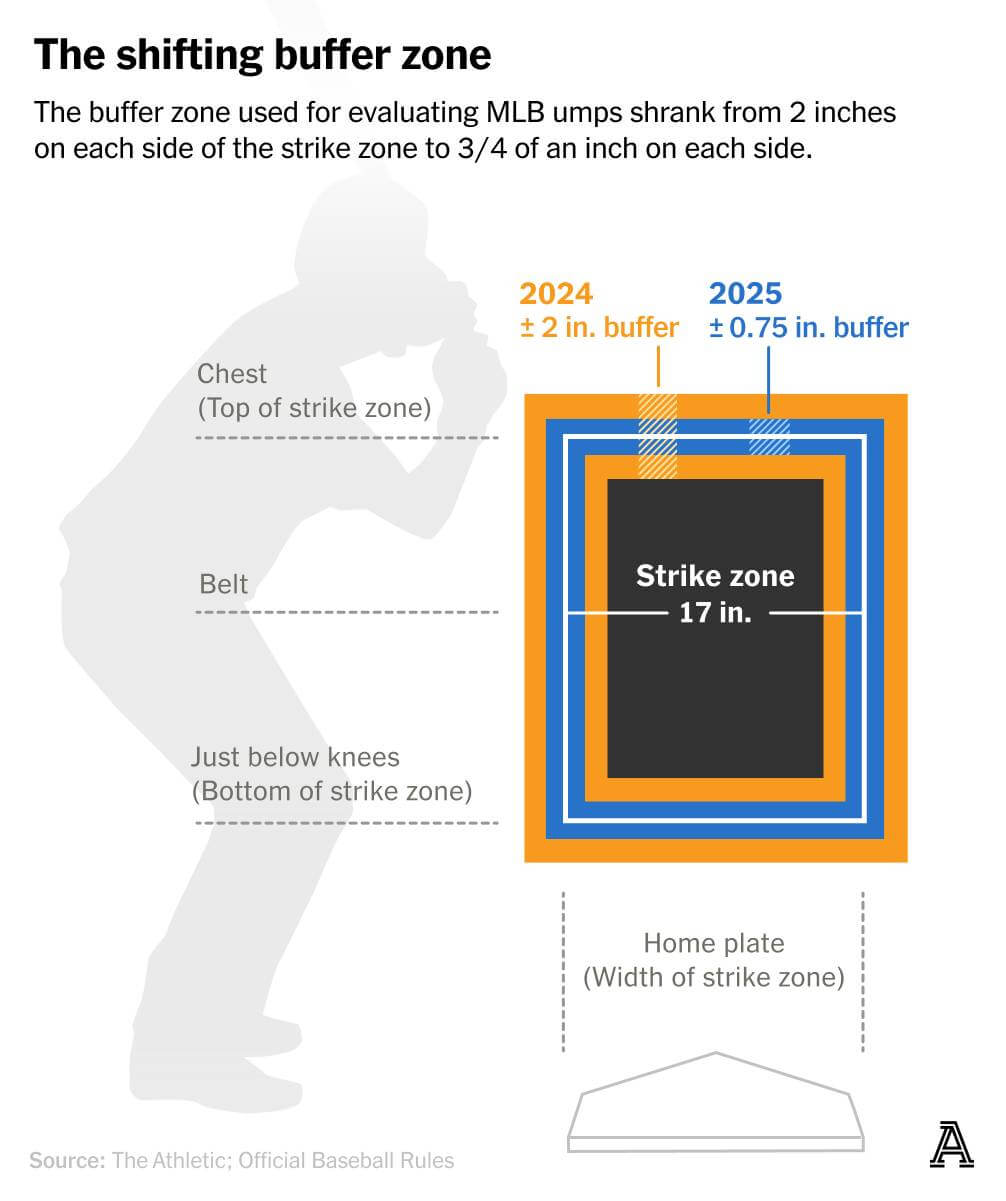
The intent of the buffer zone change is simple: to call the rulebook strike zone more accurately. But the real-life impact seems to have caught pitchers and catchers in particular off guard, even though the definition of the actual strike zone remains the same.
“I was unaware of that,” Phillies reliever Matt Strahm said of the change. “I thought everything was going to be normal after spring (training, when MLB tested an electronic ball-strike challenge system). Go back to what we’ve been doing. I guess I wasn’t aware that the (buffer zone) has shrunk.”
An MLB official said, “The rulebook strike zone has not changed and we have not instructed umpires to call a different strike zone. In response to consistent player and club desire to have umpires evaluated more closely to the rulebook strike zone, we agreed with the MLB Umpires Association in their new CBA to reduce the size of the ‘buffer’ around the border of the strike zone, which essentially protects an umpire from being graded ‘incorrect’ on extremely close misses.
“We informed the GMs and Field Managers that we were seeking this change during the offseason,” the official said, “and again informed the Clubs when the umpire CBA was ratified. Overall ball-strike accuracy in 2025 is the highest it has ever been through this point in the season.”
The data shows that this season’s strike calls are the most accurate since Statcast began tracking pitches in 2015.
ACCURACY PERCENTAGE OF MARCH-APRIL BALL-STRIKE CALLS
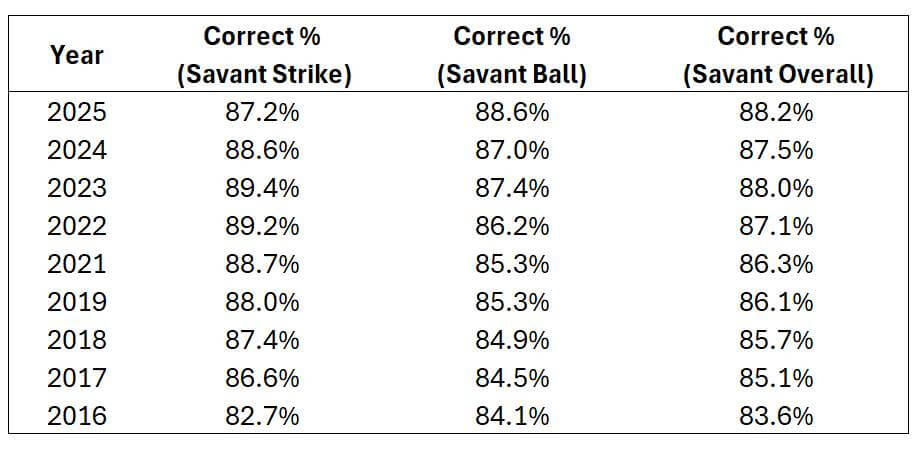
(Source: Baseball Savant)
Nevertheless, players interviewed about this change say the strike zone feels noticeably smaller.
The Athletic polled 15 MLB players, as well as more than a dozen coaches, executives and analysts, in the past week to get their impression of how balls and strikes are now being called — and to ask when they learned about the umpiring changes. No players interviewed could recall being informed before the season that this was coming — by their teams, the MLB Players Association or the league.
Many of those players, especially the pitchers, found it puzzling that no one had communicated more details about this new approach to the strike zone before the season started. Instead, they say they found themselves dealing with the change in real time.
“If it is smaller, I do think we should be told that it’s smaller, and that the buffer zone might be smaller,” Giants pitcher Logan Webb said.
Several players relayed conversations they’ve had with umpires in the early going. One catcher, who like some other players and team employees requested anonymity in order to speak freely, said an umpire asked him early this season: “What do you think of the new strike zone?” His response: “What new strike zone?”
In truth, this strike zone is not “new.” Its dimensions remain the same as described in baseball’s official rules. But pitchers told The Athletic the impact of the smaller buffer zone has affected at-bats, game-planning and results — because, they say, umpires know how they’re now being evaluated.
Umpires are continually graded by the league on the accuracy of their calls — particularly when working the plate. Those grades affect whether they’re given postseason assignments, and could even result in termination if their scores are low enough.
So, awareness of the buffer zone has always had an impact on ball-strike calls. If an umpire calls a pitch a strike that misses the plate but hits that buffer zone, the buffer means he isn’t penalized for an incorrect call. As umpires adjust to a narrower buffer zone, the practical effect has been fewer strikes in that area that shadows the plate.
Those pitches are not technically strikes, but before this season they had regularly been called strikes.
There are other reasons this year’s zone feels to players as if it’s gotten tighter. One is the addition of younger umpires, who have more experience calling the rulebook strike zone while working with the Automated Ball-Strike System (ABS) in the minor leagues. The other is MLB’s experiment this spring with the ball-strike challenge system, which veteran umpires have told players caused their zones to tighten as the spring went along.
The result is that pitchers and catchers said they noticed so many pitches just off the plate being called balls, when they were often strikes in the past, that they did their own research.
“We pulled the numbers of strikes that were called balls in the first week of the season, this year versus last year,” d’Arnaud said. “Last year, there were like 300 or so. This year, (we found) like 550 at the same point in time, with strikes that are called balls.”
The Athletic wasn’t able to replicate d’Arnaud’s exact query in a Statcast search, but results showed this April had the most called balls on pitches inside the strike zone since 2017 — which isn’t surprising, given the reduction of the buffer zone.
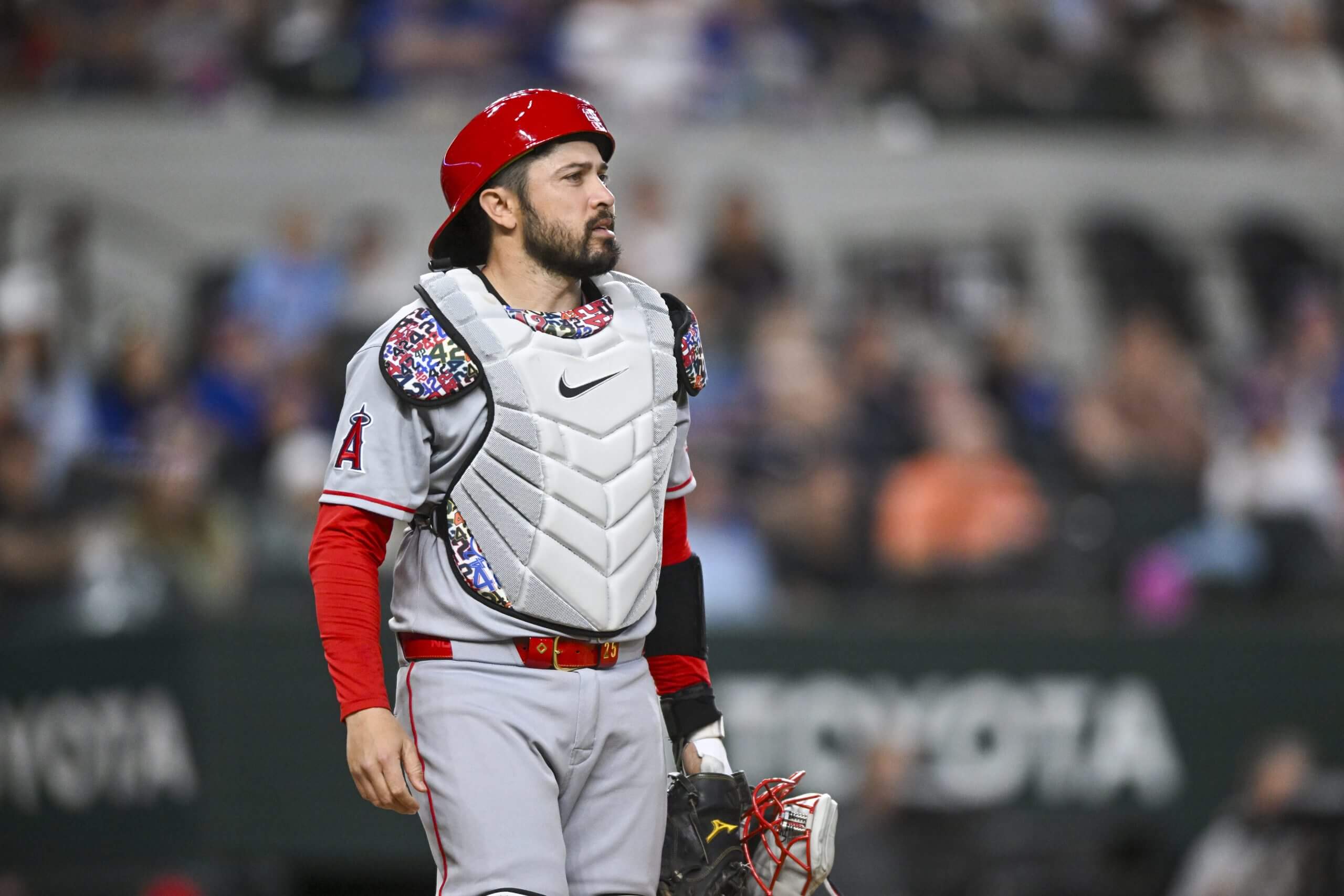
“Everybody’s zone has shrunk,” Angels catcher Travis d’Arnaud said. “Every (umpire) across the league.”(Albert Pena / Associated Press)
Major League Baseball’s position is that it was players who told the league that they would like to see the strike zone be called more closely, to conform with the rulebook zone. Players The Athletic spoke with did not share the view that the impetus for this change came from their side.
Baseball’s big-picture offensive numbers so far would suggest that the change to the buffer zone has not had a major statistical impact. League batting average is up compared with March/April of 2024. The strikeout rate is down. And while the walk rate is up slightly, it’s within the range of common year-to-year fluctuations. All of those developments are positives for a sport in which it has gotten tougher than ever to hit.
However, players, coaches and data-driven front offices say the change in how balls and strikes are being called has been felt inside clubhouses and analytics departments throughout the game.
A high-ranking executive in one front office, who requested anonymity to speak freely, told The Athletic that for the last two weeks his team has been “trying to figure out what’s going on.”
He said his team believes the decrease in called strikes on the edges will have ripple effects that include “personnel decisions, philosophies, everything.” If he had known this was coming, he said, maybe his club would have adjusted and built a more patient lineup — since in a world with fewer called strikes, patience would seem to be more valuable than ever.
Not surprisingly, hitters surveyed by The Athletic had far fewer issues with the change than pitchers, even though they consistently said they had no idea this new, more hitter-friendly buffer zone was coming.
Asked if this is what hitters want — for the strike zone to be called more like the rulebook strike zone — Astros first baseman Christian Walker replied, “Always.”
“That’s what we’re doing out there,” he said. “As a hitter, is it over the plate or not? We all get frustrated when we feel calls don’t go our way. But give those (umpires) credit. It’s a tough job, man. These guys are throwing nasty pitches at nearly 100 mph, so I think some forgiveness around the zone is totally understandable.”
What is less clear-cut is why all the players The Athletic interviewed said they were caught off guard by this change.
The league is adamant that the managers and front-office execs were informed, that front offices were updated on the specifics of the umpires’ labor agreement in writing and that there was no intent to keep anyone in the dark.
According to league sources briefed on the matter, MLB officials spoke to all 30 managers about the change at last December’s Winter Meetings. Those sources also said that MLB talked about this change with all 30 club front offices at the general managers’ meetings in November – and then distributed a memorandum to every team in mid-December, after the agreement with the umpires was completed. They said the league has had regular communication with the players’ union as well. Since this was not a formal rule change, they said MLB normally relies on clubs and the union to keep players updated on such matters.
But more than two dozen people from all of those groups — managers, front-office executives and sources with ties to the union — told The Athletic they had no recollection of the league briefing them on this change.
Sources tied to the players’ union dispute the notion that the league briefed them on the buffer zone changes before the season. A spokesperson for the Players Association declined to comment further, and instead released a statement: “We’ve heard from players on the topic, and we’re closely monitoring this year’s strike-zone trends, including via those discussions with players, the umpires and the commissioner’s office.”
Similarly, inquiries to seven club officials found none who said they had any prior knowledge of the tighter buffer zone until they began noticing a shift in ball-strike calls once the season started. And none of six managers interviewed could recall this change being communicated by MLB during the Winter Meetings, or at any time since.
“I don’t remember having any communication with anybody at any point in time saying, ‘Hey, we’re going to tighten it up,’” Padres manager Mike Shildt said. “Not at all. I try to pay attention during the meetings. … I would have thought it would grab my attention. I would probably share that with (his coaches).”
“No, I didn’t know that,” Dodgers manager Dave Roberts said.
Asked if he remembered being told about this at the Winter Meetings, Reds manager Terry Francona said: “I don’t believe so. I don’t remember that. That doesn’t mean they didn’t because I can barely remember yesterday. My understanding was … it wasn’t a secret, but I don’t remember them sharing it.”
Shildt said that if he’d known about this change, he would have made a point to prepare his players before the season.
“No question about it,” he said. “I would have spread the news.”
Most of the managers surveyed did say that they had no problem with any move intended to help umpires call a more consistent version of the strike zone.
“I think that’s a good thing,” Roberts said. “I think that there is just so much gray with the strike zone, with the buffer zone being so big. To be quite honest, whatever adjustments for the umpiring there’s been behind home plate, I’ve been really pleased with the consistency.”
League sources say that players and coaches have pushed for a smaller buffer zone and more consistent, accurate ball-strike calls for years – and have been in more agreement on that position than on any other on-field issue in the game.
Nevertheless, a player on baseball’s competition committee, who requested anonymity in order to speak freely, said that if there was a request from players, it didn’t come from players on the committee. And multiple sources connected to the committee, speaking anonymously because they were not authorized to discuss the matter publicly, said this was never a topic before the change was made, and that it never came up at a scheduled January meeting of the competition committee, the first after the umpires’ agreement was ratified.
“If (players were) going to make a proposal on changing the strike zone, it’s going to happen in the competition committee meeting,” one of those sources said. “That’s why that committee is there, so we can raise on-field concerns, and so can they.”
The competition committee’s next meeting is Friday, and it’s expected that there will be a deeper discussion of the change, and its impact.
According to Statcast data from Baseball Savant, the change in how balls and strikes are being called averages out to about one fewer called strike per game. But pitchers still believe that’s not an insignificant number.
“There are times in games,” said Webb, “when a call makes a difference in a win or loss.”
Players and clubs also have pointed to the number of pitches no longer being called strikes in what Baseball Savant refers to as “the shadow zone,” an area around the strike zone that is the width of a baseball. (The shadow zone is similar to the buffer zone, but not the same — Statcast uses the former, and umpires the latter.) The drop in called strikes in that area is the largest, at this point in the season, since Statcast began pitch tracking.
STRIKE PERCENTAGE IN THE “SHADOW ZONE”
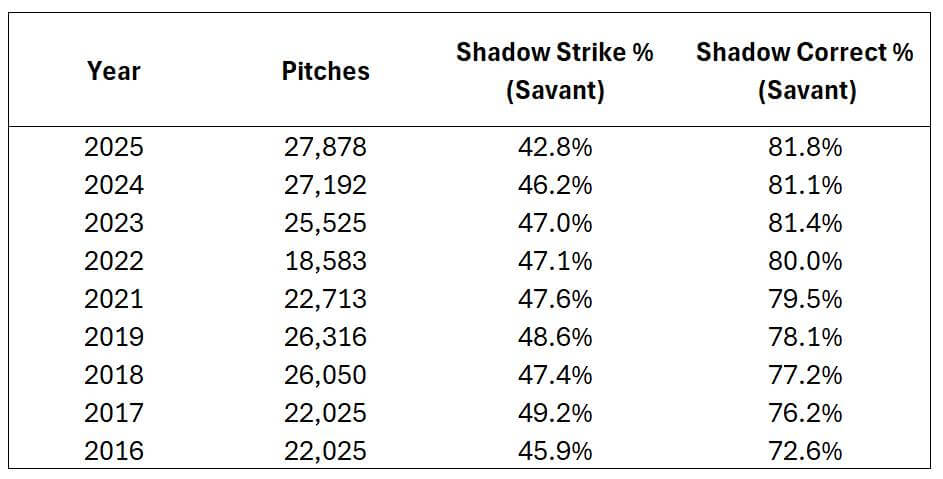
(Source: Baseball Savant)
While numerous players expressed frustrations over the lack of communication from the league, no one accused MLB of intentionally keeping players out of the loop. The biggest complaint, simply: If balls and strikes are going to be called differently, it puts pitchers at a disadvantage if they don’t know that going into the season.
“As a competitor … you just have to learn to deal with whatever the new goal posts are,” said one veteran pitcher. “But I would say that any time we choose to change the goal posts, just let us know so we can prepare for it.”
The Athletic’s Dennis Lin, Fabian Ardaya, C. Trent Rosecrans, Chandler Rome, Sam Blum and Chad Jennings contributed to this report.
(Top image: Dan Goldfarb / The Athletic; Photos: iStock)