
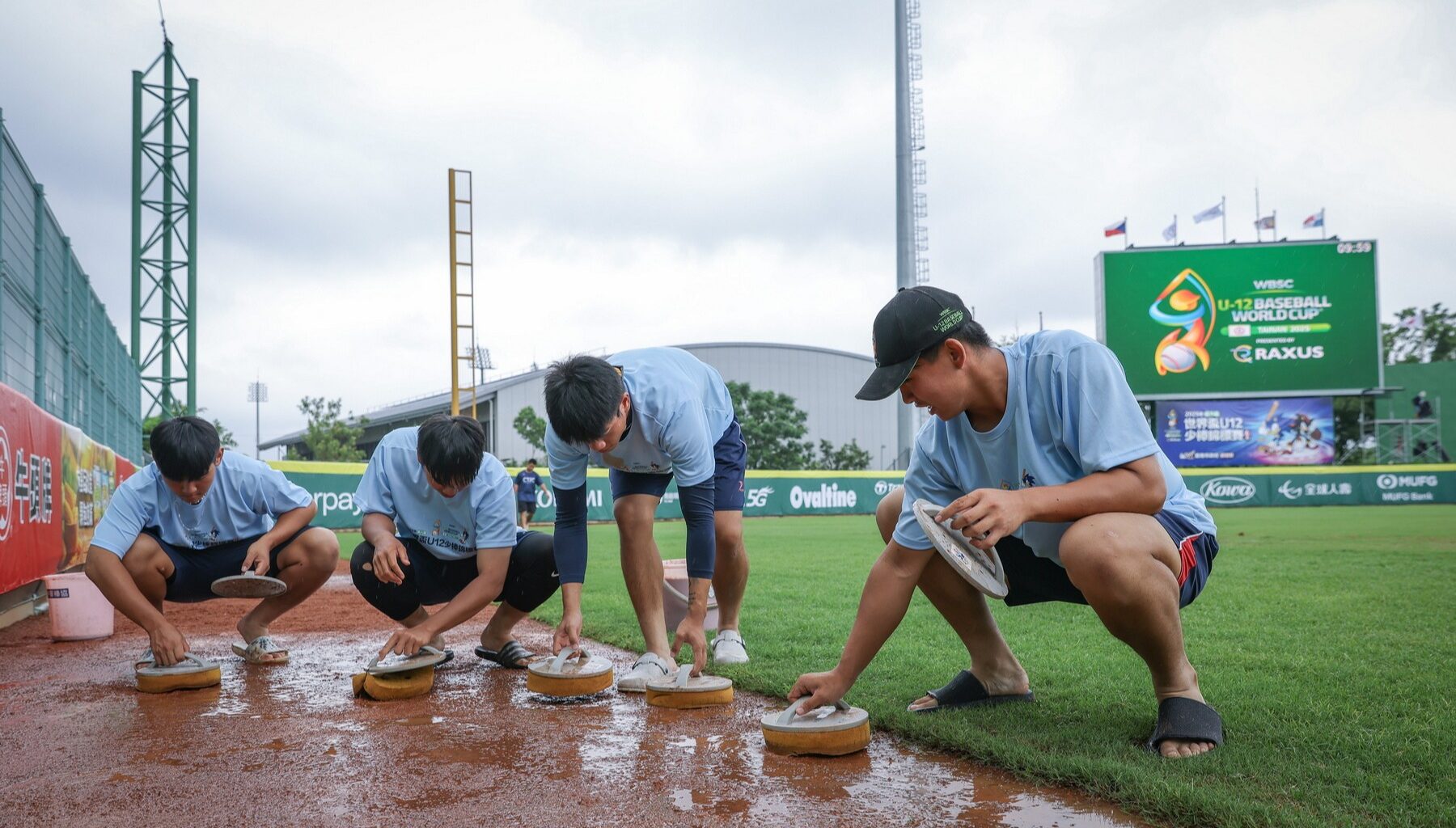
While the 12 teams participating in the WBSC U-12 Baseball World Cup 2025 presented by RAXUS have been concentrating on playing one game per day, following the official tournament schedule, another team, working on six games a day in two separate fields, was always at the stadium first before everyone else and the last to leave the venue with their baseball pants dirtier than anyone who had played that day.
They are the ground crew of the WBSC U-12 Baseball World Cup 2025, an army of 40 college baseball players from the CTBC University of Technology.
The leader of the ground crew for the tournament is Jou-Kai Yang, a former college baseball pitcher and now the coach of the CTBC University of Technology baseball team. Yang has extensive experience working as the ground crew at the Tainan Asia-Pacific International Baseball Stadiums.
“I was the bat boy when the WBSC U-12 Baseball World Cup came here for the first time in 2019,” said Yang.
His team, which consists mainly of the university’s baseball team players, has become a steady force as the ground crew for the WBSC U-12 Baseball World Cup and the minor league games of the Chinese Professional Baseball League since the inauguration of the venue.
“As baseball players, they would take care of their own field in college, and that is a start,” said Yang, referring to how the players learn to respect the equipment, the field, the facility and ultimately the game by first keeping the baseball field tidy. “It is natural for them to put themselves in others’ shoes when it comes to baseball.”
Racing against time and the weather
During this year’s tournament, the weather constantly disrupted the schedule due to typhoons and monsoons. Even Tainan City announced a work stoppage for one day due to concerns of possible dangerous torrential rain.
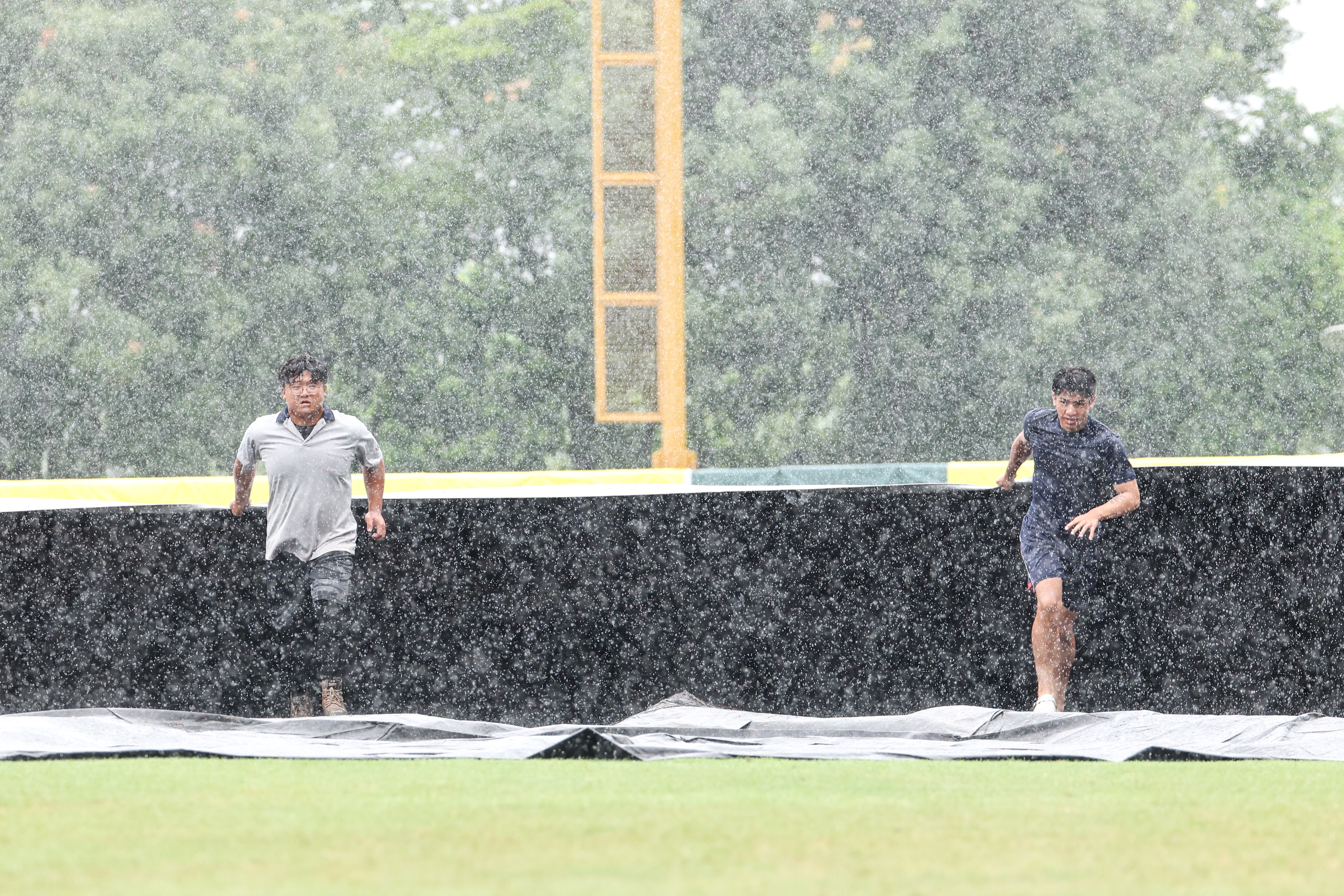
“We looked at the sky all the time,” said Yang. “As soon as I see the sky turning dark, I would alert our team to change to shorts (they were wearing baseball pants for the usual tasks such as bat boys) and sandals, and when it starts to pour, we were always ready and standing right next to the tunnel.
“Once the umpire waves players back to the dugout, we would rush out as if we were taking the field.”
And on such occasions, they do deserve an introduction – just like the teams player by player – as they race to the tarp, position and align it, unroll it, and secure it, all in a matter of minutes.
All these performances come from endless practice. “With the experiences we had working at the minor league games, we specifically practiced at all four fields again the day before the tournament started,” Yang said.
“In 2019, when I worked here as a bat boy, there was no roller to go with the tarp. We had to carry it out and unfold it many folds, and fold it back to get ready for the game,” he added remembering his bat boy days during the past U-12 tournaments.
After the tarp was rolled back to its position, the crew would immediately start to work on the field with sponges and buckets to remove the water from potholes before sand was used to refill any holes and make the field playable.
With the game resumed, the crew was dispatched to their other usual assignments. Some stay on the field as bat and ball boys and girls, some would go clean the equipment, some would remain in the stands to provide any needed service to the fans, and some would be stationed at the gates to help around.
“Treating your tasks seriously”
“It’s a tough task for them, more physically, but never underestimate the mental part of it,” Yang said. “They need to learn how to delegate assignments and how to support each other when needed. And on top of it, they have to fight through the weather conditions to carry out their tasks.
“I tell them to treat everything you do seriously, both on and off the field.”
Some of the senior players on the team would also encourage everyone by texting in their chat group. “The senior guys would share their own experience with the team and encourage the team to keep a positive attitude towards their tasks,” Yang added.
The ground crew’s work is not meant to be easy to begin with. “It requires knowledge, skills, and ultimate patience, too. And under circumstances like this, you need to be able to execute it with precision and at the right pace,” Yang said. “At the beginning of the tournament, as we encountered so many weather-related issues, I could field hundreds of questions from our guys coming through from my earphones, but now, as we approach the latter part of the tournament, I don’t get that many questions.
“They learned how to recognise the situations and came up with solutions,” Yang said proudly.
Mission Accomplished
Without any doubt, this is a highly physically demanding job. “We have 28 people in the Main Field, and another 12 in Field 2. Minutes after they all return to the nearby dormitory, they all sleep like babies.”
But come the next morning, they will be the first team to arrive at the stadium, making sure everything is in its position, ready for the first pitch, rain or shine.