
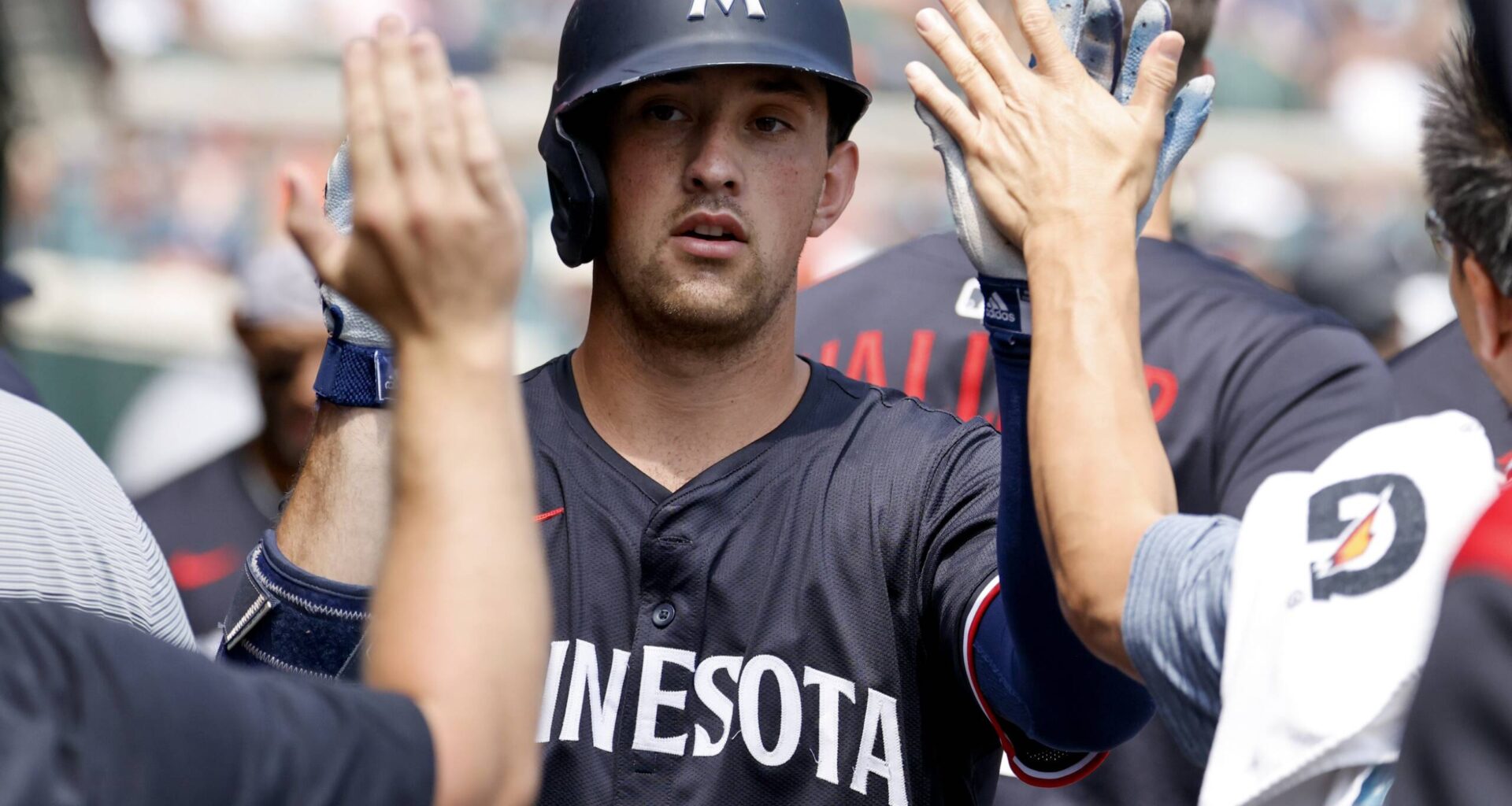
In the moments after the trade deadline, there were a lot of moving parts for the Minnesota Twins. They had just completed one of the biggest fire sales in MLB history, shipping out eight players on the day of the deadline and 11 players in total. But the biggest question on everybody’s mind was who they received in return for Carlos Correa.
The Twins made the biggest deadline deal when they sent Correa back to the Houston Astros. While multiple sources had reported the deal, nobody knew who the Twins had received in return.
Reports indicated that a prospect would be coming Minnesota’s way, later revealed to be left-hander Matt Mikulski. Armed with a 5.68 ERA in High-A ball, the southpaw may never make his way to Minneapolis. But while Twins fans may be fixated on the salary dump, the real return may have received something that wasn’t in the deal.
A Brooks Lee breakout.
The Twins don’t just like Lee as a ballplayer. They freaking love him. When he fell to the eighth overall pick in the 2022 draft, scouting director Sean Johnson admitted they were “ecstatic.”
Lee was college baseball’s best batter after he hit .357/.462/.664 with 15 homers and 55 RBI in his final season at Cal Poly. However, Johnson also mentioned his even-tempered demeanor as something that could help him reach the majors quickly.
“Brooks plays the same in front of 200 people as he does in front of 3,000 or 4,000,” Johnson said. “You can see the enthusiasm in his style of play, and he’s a winner. He’s a winning-type player, and that’s what we like the most about him.”
Those intangibles helped Lee reach the major leagues quickly, but something seemed amiss. While Correa once noted that Tyler Mahle had “a lot of red” on his Baseball Savant page, Lee’s is mostly blue. In many metrics, Lee is under the 25th percentile. His batting run value (minus-10) is in the ninth percentile. While he’s limited his strikeouts (18.9% strikeout rate), he hasn’t walked enough (4.9%) to truly take advantage.
It could be the struggles of a hitter who was fast-tracked through the organization and made his major league debut at 23 last season. Still, it’s worth considering that they moved him off shortstop, his natural position.
Correa was Minnesota’s incumbent shortstop when they acquired Lee. However, Correa told reporters shortly after Minnesota traded him to Houston that he was considering a move to third base. Meanwhile, the Twins were unlikely to move him there with Royce Lewis at the hot corner. Lewis could have moved to second base to accommodate that move, but it would have also blocked top prospect Luke Keaschall, creating a weird logjam.
Correa was also starting to decline at shortstop. He’s turned his offensive production up a notch in his first week back with the Astros. However, his defense was a major problem, logging a minus-11 at the position in 92 games with the Twins.
That turned Correa into an albatross on Minnesota’s books, but also on the diamond, where he was blocking Lee.
Lee hasn’t been Gold Glove caliber like Correa was at shortstop, but it’s his best position on the field. Although he logged 43 games at third base, he logged a minus-5 in defensive runs saved. He had a minus-2 in 37 games at second base but was only a minus-1 when he played at short. There’s also something to be said for developing a routine at one position, which is something that Lee couldn’t do when Correa was in Minnesota.
So what does this mean for Lee moving forward? Right now, he has to break out of a slump. He’s only hitting .143/.207/.226 with two homers and 11 RBI over his last 27 games. However, he’s slugged three homers in his last eight games, including a 430-foot, 105.2 mph home run in Wednesday’s win over the Detroit Tigers.
The blast was a good sign that Lee could be turning things around. He could start to get in a rhythm, knowing he’ll be playing every day in Minneapolis. It’s not a guarantee, considering how Lee has performed in the majors, but it’s the last positive thing that could come out of the Correa trade.