
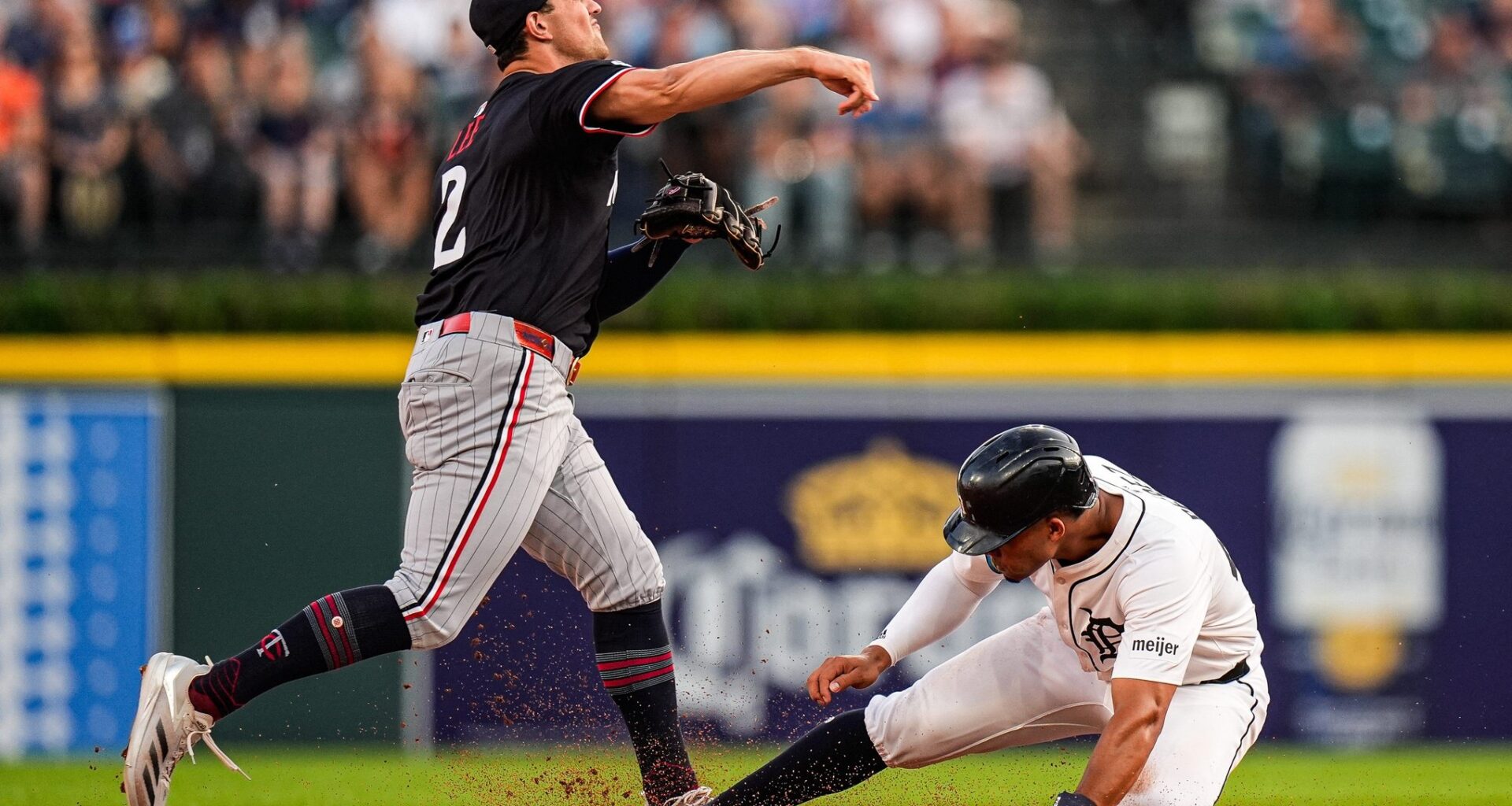
The Minnesota Twins spent years and years trying to find a starting shortstop they could trust. A glance through their Opening Day starters over the past couple of decades reveals an endless folly of trial-and-error at one of the sport’s most critical positions.
The Twins cycled through players who could field but not hit (Pedro Florimón, Nick Punto). Players who could hit but were clearly stretched defensively at short (Jorge Polanco, Eduardo Escobar). Players who were once-elite defenders but plainly just washed up (Andrelton Simmons, Adam Everett). Players who were … Jamey Caroll?! We can add “shortstop prospects” like Brian Dozier and Trevor Plouffe to this list as well.
Throughout all these years, fans persistently commented about the over-abundance of shortstops in the system and the team’s unflinching tendency to keep drafting them with high picks in spite of it. In retrospect, it’s a good lesson on the nature of the shortstop position, and the culling of talent as prospects advance and get pushed to other places by ever-heightening defensive standards.
Since Target Field opened in 2010, the Twins have used eight of their 24 first-round or supplemental first-round draft picks on players who were classified as shortstops: Levi Michael, Nick Gordon, Royce Lewis, Keoni Cavaco, Noah Miller, Brooks Lee, Kaelen Culpepper and now Houston Marek. Some of their biggest international free agency investments over these years have been at the shortstop position: Miguel Sanó, Wander Javier and Danny Andrade to name a few.
And yet, not until the Twins made their biggest free agent signing in franchise history — by far — to bring in an established star did they finally manage to field a legit two-way shortstop. Despite his four-year stay in Minnesota featuring two half-seasons and much of the worst performance in his career, Carlos Correa still produced the most WAR of any Twins shortstop in the past three decades.
After being salary-dumped to Houston in a shameful roster dismantling at the trade deadline, Correa made an interesting comment to reporters: “I’ve been wanting to play third base for the past couple of years, but it wasn’t happening in Minnesota. We were waiting for a shortstop to come in and now that I get to play third base it would be great for me at this stage of my career.”
It’s a silent but damning indictment of Lee, who was once the subject of Correa’s immense praise during his first spring camp. No one can deny how promising the former top-10 draft pick looked then, and no one can deny how greatly his outlook has dampened in the two years since.
With Correa out of the picture, Lee is first to get a crack at the starting shortstop position. Is he up to the task? Right now it looks like the answer is a resounding no. Lee has played about one full season’s worth of major-league games (145) and hasn’t been bad. He’s been awful. Among 280 players with 500-plus PAs the past two years, Lee’s .277 wOBA is tied for 22nd-worst and his negative-0.2 fWAR is 16th-worst.
More disturbing than the poor performance is the lack of any standout skill or trait to build on. Lee can put the bat on the ball with consistency but that is about it, and has no value on its own. He swings at everything. He has no real power, outside of running into a mistake pitch for the occasional home run. He is SHOCKINGLY slow, with a sprint speed on par with Ryan Jeffers.
Even defense, formerly his most reliable floor-setting skill, has failed him this year: Lee’s negative-4 DRS is better than only Edouard Julien and Trevor Larnach among current Twins. Granted, much of that poor glovework came at second and third, but it’s not exactly an endorsement of his capability to handle short, where his arm is pretty borderline.
I still believe Lee has some talent, along with a pretty good pedigree and track record prior to 2024. No such player should be written off at age 24 with a mere .500 big-league at-bats under his belt. But as he continues to falter and show the opposite of improvement, the idea of Lee tapping into some perceived upside from his minor-league days has all but vanished.
My expectation is that Lee will get the rest of this season as regular shortstop to try and give us some reason to believe. It’s the right move, and also, they really have no other options. If Lee doesn’t show significant improvement, especially with some of his underlying issues, in the final two months I don’t see how you could pencil him in as the 2026 starting shortstop, regardless of contention hopes.
Right now he is not a major-league player. Yes he’s young. Yes he was a high draft pick and a good prospect. Yes, the (current) manager seems oddly obsessed with him. These are not reasons to give Lee a free pass to indefinite playing time while he puts forth an offensive profile offering no chance at sustained success. There isn’t a path to production when you can’t control the strike zone, can’t run, and can’t hit for any kind of consistent power. With a deteriorating plate approach and a sub-70 MPH bat speed, there’s no tangible reason to envision these weaknesses going away.
If Lee is not the starting shortstop in 2026, it’s anyone’s guess who it might be. The bright side of this whole situation is that the Twins have a pair of intriguing shortstop prospects now rising through the minors in Culpepper and Houston. But, folks, we just went through a litany of once-promising shortstop prospects who all fell by the wayside. I get that Culpepper is red-hot in Double-A and Houston has the freshness factor, but let’s take a step back and look at the reality of what it takes to develop a true, MLB-caliber starting shortstop.
Back the start of the season, I wrote an article raising alarm about the Twins’ lack of organizational shortstop depth. “The Twins’ entire shortstop situation teeters on the health and availability of Carlos Correa — a superstar whose presence is absolutely pivotal, and whose absence could send shockwaves through a team with no real contingency plan.”
Thankfully, this outlook has improved somewhat with the breakthrough from Culpepper and the drafting of Houston. But there seems to be a widespread overconfidence that one of those two will pan out as an MLB-caliber starting shortstop (of which there are maybe 25 in the world?) and the problem will solve itself. History proves this to be wishful thinking.
I hate to be the bearer of bad news, but after saying goodbye to arguably their most talented shortstop ever, in return for absolutely nothing, the Minnesota Twins are back to wandering the desert at this positon of paramount importance. It’s a storyline that will be as central as any other in their efforts to retool and return to contention while steering clear of another prolonged drought.