
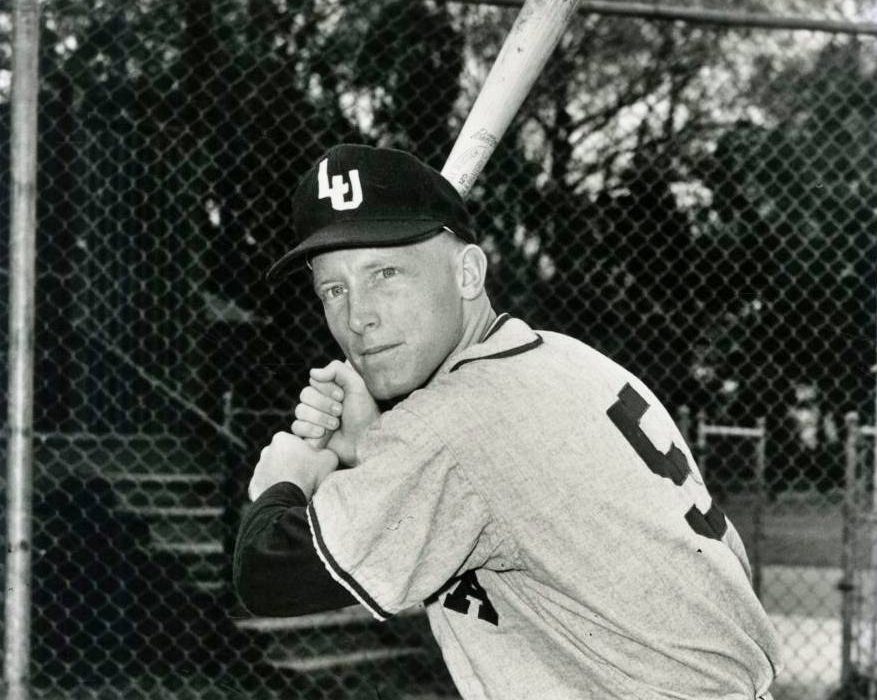

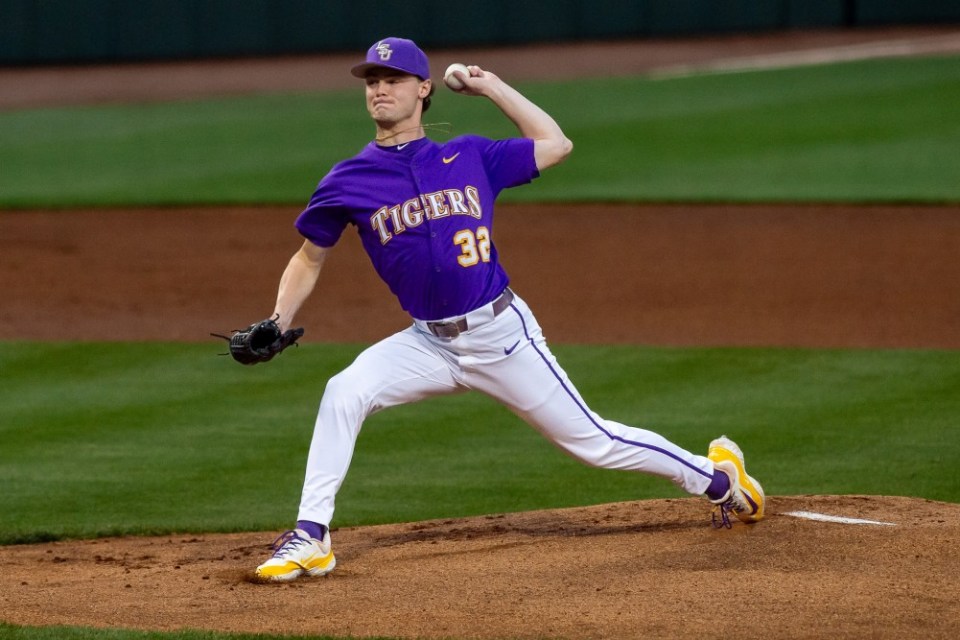
 (Photo: Michael Bacigalupi)
LSU All-American Kade Anderson was the third overall pick of Sunday’s MLB First-Year Draft by the Seattle Mariners. He’ll command a signing bonus worth millions of dollars on his way to what promises to be a productive professional career.
Ever since the Major League Baseball’s amateur draft began in 1965, signing bonuses with major-league teams have been a big part of the process, as the top echelon of picks realized huge paydays.
Before the inaugural draft in 1965, major-league teams competed against each other to sign contracts with amateur prospects. Their bonus offers were often the differentiator for where the prospects would eventually land. Several of New Orleans’ best amateur baseball players received lucrative bonuses for their era.
Here’s a look at a few of those hometown players’ pre-1965 signing bonuses from major-league teams.
Putsy Caballero graduated from Jesuit High School in 1944 as a 16-year-old. The infielder had a scholarship offer to attend LSU to play baseball and basketball. The major-league Philadelphia Phillies were trying to build up its farm system and offered Caballero $8,000 to sign with them. It was a lucrative offer in those days, since other local players had bonus offers in the range of $2,500.
On the advice of major-leaguer Mel Ott, Caballero signed with the Phillies instead of going to college. Philadelphia sent Caballero directly to the majors for the last month of the season, and he became the youngest position player to appear in the majors in the post-World War I era. Caballero played parts of eight seasons with the Phillies during 1944 and 1952.
Pitcher Dick Callahan created significant fanfare among high school and American Legion circles in 1944, by leading Holy Cross to its third straight city championship and the state baseball title. His wins included games in which he pitched 20, 18, and 17 strikeouts.
No less than six teams were interested in signing him. His high school coach, George Digby, oversaw his recruiting process and managed the contract negotiations with the teams. The Boston Red Sox made a generous bonus offer of $15,000, which Callahan accepted, even though he preferred to play for the Brooklyn Dodgers.
The amount of Callahan’s bonus attracted national attention, as independent minor- league teams complained they were unable to compete for high school prospects like Callahan with those kinds of bonuses. He played in the minors during 1944 and 1948 but never reached the major leagues.
Harold “Tookie” Gilbert was another local high-school and American Legion phenom of the mid-1940s. Playing for Jesuit High School in 1945 and 1946, the first-baseman was a two-time Most Valuable Player in the city league and led the Blue Jays to state high school and Legion titles.
His father was Larry Gilbert, a former major-league player and a long-time manager for the New Orleans Pelicans and Nashville Vols. Consequently, his father had numerous contacts within the game, many of whom attempted to sway him into allowing his son to sign with their team. While Tookie was still a junior in high school, the New York Yankees reportedly offered him $40,000 to sign after his senior year.
The elder Gilbert decided to conduct a lottery for his son’s services, with a pre-determined $50,000 signing bonus. Five teams participated in the lottery drawing held at the Monteleone Hotel. Tookie’s mother drew the New York Giants team’s name out of a hat. Giants manager Mel Ott was on hand to sign him to a contract. Although Tookie was a productive hitter in the minors, his ability didn’t translate to the majors. He played two seasons with the Giants, in 1950 and 1953.
Jimmy Harwell, who prepped at De La Salle High School, had a summer American Legion season in 1956 that matches any in New Orleans history. He won 16 games in leading his team to the American Legion World Series. He collected three more victories there, with 34 strikeouts in 26 2/3 innings and a .055 ERA. But his team finished as runner-up to St. Louis for the championship. Harwell earned national American Legion Pitcher of the Year honors.
Although several major-league teams expressed interest in signing him after his senior season, Harwell enrolled at Tulane in the fall of 1957 with the intention of playing baseball. However, when the Los Angeles Dodgers offered him a lucrative $50,000 signing bonus in January 1958, he took their offer. Harwell reached the Triple-A level with the Dodgers in 1961, but an arm injury ended his career during the next season.
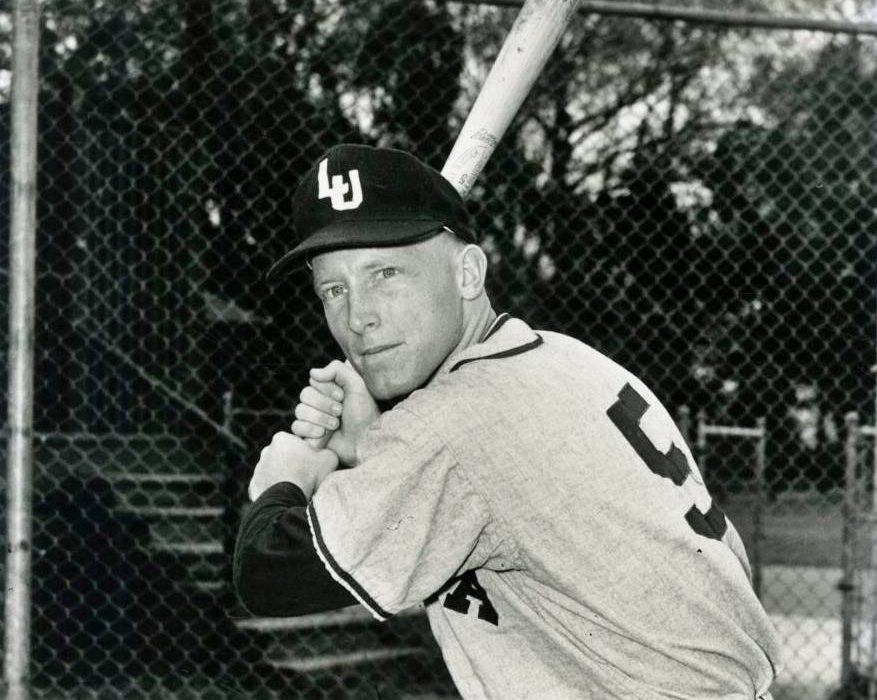
Tom Schwaner was a three-sport letterman at St. Aloysius High School, but it was in baseball that he excelled. After graduation, he enrolled at Loyola University in New Orleans to play baseball for “Rags” Scheuermann, with whom he had developed a relationship while playing on his All-American team in Johnstown, PA.
After posting a stellar sophomore season at Loyola in 1959 that included a .415 batting average, six home runs, six triples, and seven doubles, Schwaner anticipated an offer from the Los Angeles Dodgers, since one of their scouts had closely followed him at Loyola. But when a Dodgers offer didn’t materialize, he signed with the St. Louis Cardinals for a well-paid $50,000 bonus, as reported by the Associated Press. The Cardinals’ farm director Walter Shannon labeled Schwaner “the outstanding shortstop prospect in the United States.”
Schwaner played four seasons in the minors with the Cardinals and Kansas City A’s, ending in 1962. He returned to New Orleans where he became a successful high school and American Legion coach at Rummel and Brother Martin. He followed that with an impressive coaching career at the University of New Orleans that included 14 seasons as the Privateers’ head coach.
Rusty Staub set hitting records at Jesuit High School, but it was his appearance with Jesuit-based Tulane Shirts in the 1960 American Legion World Series that attracted the attention of major-league scouts. The New Orleans entry defeated Billings, Montana for the championship.
Boston Red Sox all-time great Ted Williams made a visit to New Orleans to see Staub play in 1961. Staub impressed him with a 400-foot grand slam. But the Red Sox ended up making Baton Rouge standout Dalton Jones their top offer. The new Houston franchise, then known as the Colt .45s, offered a $100,000 signing bonus to Staub. He agreed to the deal and by 1963 he was a starter at 19 years old. He wound up playing 23 years in the majors.
LSU’s Anderson stands to become a wealthy young man when he signs with the Mariners. According to mlb.com, the third overall pick of the 2025 MLB Draft carries an assigned slot value of $9,504,400. That’s the amount Major League Baseball recommends the team offer the third pick, but actual signing bonuses can vary depending on negotiations.