
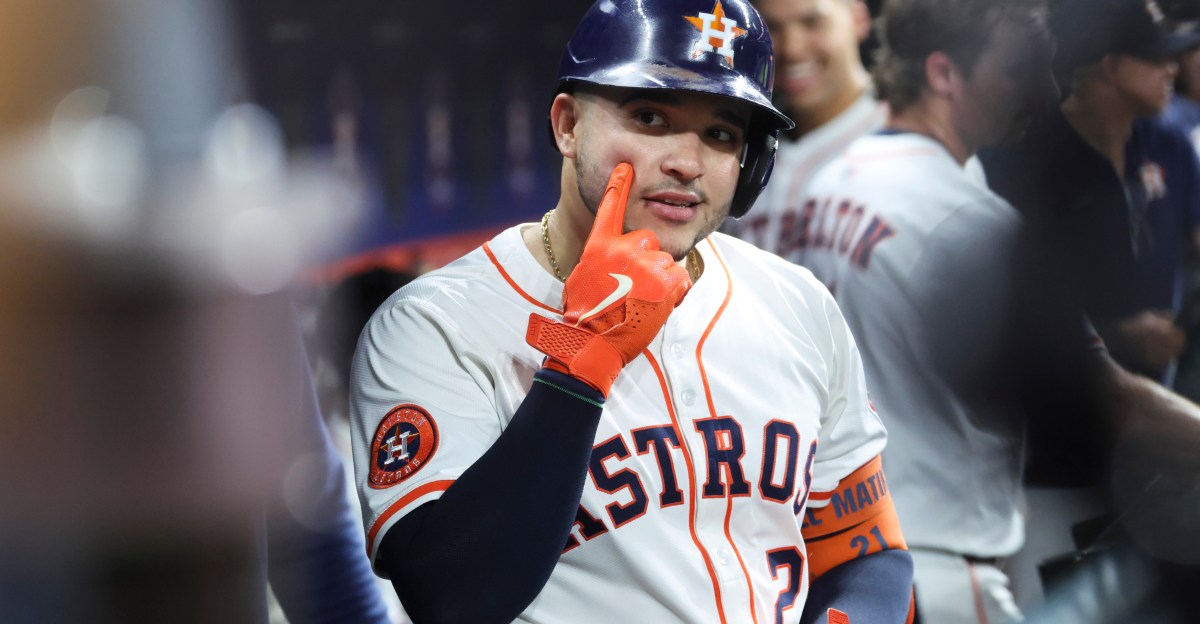
I noticed something in the comments of my last post. Sometimes I like to geek out with these things, so I thought I would take the extra time to do that here. Last time, I compared Yainer Diaz to Salvador Perez. Many people in the comments didn’t think that was an apt comparison. They thought that Willson Contreras was the better comp. So, I decided to compare all three of them. In this instance we will purely look at per season numbers. In hitting we will look at a per 500 plate appearance model. In fielding we will look at a per 1000 innings model. For our WAR scores we will look at a per 120 game model.
Instead of focusing on the high fangled hitting stats like we did last time we are going to go bare knuckles and look at the garden variety numbers we have used for more than a century. I think those numbers on a per 500 plate appearance basis will do a better job of demonstrating whatever gaps there are between these players and why some players have more value than other players. Let’s start with the offensive numbers.
HitsBB/HBP2B3BHRRunsRBIContreras11264251206264Diaz13321241195769Perez12523231225273
People often miss the important stuff when they focus on basic counting numbers. Yes, these three players have similar home run, runs, and RBI numbers. Yes, at first blush it looks like Perez is the better of the three based on those three numbers alone. Even when we expand to the other extra base hits we find very similar numbers when we normalize the data to 500 plate appearances.
The single most important offensive skill is the ability to steal first base. Avoiding outs is the single best predictor of run production. Contreras reached based a combined 176 times per 500 plate appearances. Diaz and Perez only reached 154 times and 148 times respectively. Those additional 22 (or 28) times means something. Those are 22 more opportunities to score runs. It’s also an extra hitter faced for the pitcher. Those add up as well over time.
This is the biggest reason why the comparisons to Contreras made me scratch my head. They just aren’t that comparable offensively. One walks nearly ten percent of the time and has a healthy number of HBP throughout the season. The other two walk less than four percent of the time and aren’t hit nearly as often. When we look at the differences in WAR at the end, the biggest impact will come from those additional times on base.
DRS/1000FRV/1000Contreras0.5-0.5Diaz-2.0-7.1Perez-0.5-5.3
Teams move players out of positions for a variety of reasons. We can take the relative cases of Carlos Correa and Jose Altuve as examples. Is Correa really a bad shortstop? Historically he is above average to solid defensively. He has had some brilliant seasons (2021) along with some pedestrian ones. He is moving to third base. Obviously, that is mostly about Jeremy Pena being better, but it is likely also a function of the fact that they want his bat in the lineup more often and feel that third will be less of a strain on him physically. Jose Altuve has moved off of second because he is just not a good defensive second baseman.
Contreras is more in the Correa category. No one is going to mistake him for Pudge Rodriguez, but most if not all of the defensive metrics show him to be a league average catcher defensively. I’m sure the Cardinals have some internal numbers that may say otherwise or the pitchers may say otherwise, but the fan sourced numbers are neutral. The comparison was made that Diaz may have to move from behind the dish like Contreras. The Astros may end up doing that, but it would be for different reasons.
Again, when looking to compare players, we want to compare players that have performed similarly. Two of these players are more similar than the other. This is like an SAT question. Which one of these does not belong? This is why Diaz and Perez and more apt comparisons than either of those two with Contreras. I think we will see the end result with the WAR scores.
BWAR/120FWAR/120Contreras3.32.7Diaz2.62.0Perez2.61.4
To put this in the simplest of terms. Contreras averages out to be a three win player. Diaz and Perez more or less average out to be two win players. Granted, there is a little bit of separation between those two guys. However, they are more similar than Diaz and Contreras. Obviously, when you move someone out from behind the plate it can alter their overall value some. A first baseman with a .750 OPS is not worth nearly as much as a catcher with a .750 OPS.
Ironically, Perez and Contreras are similar in terms of their contract. Contreras signed a five year, 82 million dollar contract with an option year that can make it six seasons and 100 million dollars. Perez is in the last guaranteed season of a four year, 80 million dollar contract. He has an option year that could effectively make it a five year, 93.5 million dollar contract. That makes both contracts similar in terms of AAV.
That brings us back to the same question. If we see Diaz as similar to Contreras (I don’t) then are we willing to offer a similar contract for a player that will be younger at the start of the contract than Contreras was when he started his contract. If he is a two win player then getting him at 15 million AAV would be about right. The question is whether they can confidently project him to continue to do that for the length of the contract.