
Recently, I had reason to think back to some of my most painful Red Sox memories.
One was sitting in the basement alone, stunned and crying, wearing my baseball glove as I watched the Sox lose it all in 1986.
And later, in 2003, walking through Manhattan with my friend Joanne, leaving “the Riv,” a now-closed sports bar which was a safe haven for Red Sox fans, the only place we knew of in New York City where we could openly root for our team. Did I mention it was moments after Aaron Boone’s home run? I was suddenly in a terrible mood and Joanne asked me why I was taking it so hard. Genuinely surprised at both her quiet acceptance of the shattering turn of events and her confusion at my devastation, I don’t remember what I said, but I was thinking, Why aren’t you?
The Sox are in a good place in early mid-August of 2025, but the reason for recalling these memories just now is because of new research that arrived in the form of my UConn alumni magazine. Dr. Dimitris Xygalatas, a professor of anthropology and psychological sciences at the University of Connecticut, is writing a book about sports fandom and says that his research shows that watching your team lose can actually cause pain.
We fans know this because we live it, but now it’s been scientifically proven. His team observed brain scans of both Red Sox and Yankees fans while they watched their respective team lose. The researchers saw the scans light up in the areas of the brain that are associated with feeling pain. This doesn’t make me feel any better about those earlier, terrible losses (and many more, I assure you), but I guess I feel vindicated now for being so upset about them.
And the opposite is also true: a win sparks the brain’s pleasure centers.

BOSTON, MA – AUGUST 2: Reliever Aroldis Chapman #44 of the Boston Red Sox smiles as he is congratulated by teammates after getting the save in their 7-3 win over the Houston Astros at Fenway Park on August 2, 2025 in Boston, Massachusetts. (Photo By Winslow Townson/Getty Images) Getty Images
Even more interesting, the research team proved that schadenfreude in sports is a real thing: those same pleasure centers light up when the other team does badly.
Sorry, what was that about the Yankees having the worst record in MLB since mid-June? Ah, that felt good!
This shouldn’t come as a surprise because, to me, that joy at others’ misfortune feels all-too human. But it’s one thing to feel human (which can be so damn messy, can’t it), and another to get confirmation that those icky feelings are actually completely normal.
It’s normal to experience the highs and lows of Red Sox Nation. As go the Red Sox, so go I. Quick—someone tell my girlfriend this is acceptable! No, not just that—it’s biological.
I have written before about the collective experience of watching and loving sports. There’s nothing quite like turning to the people around you and demanding, with a huge grin, “Did you see that?!”

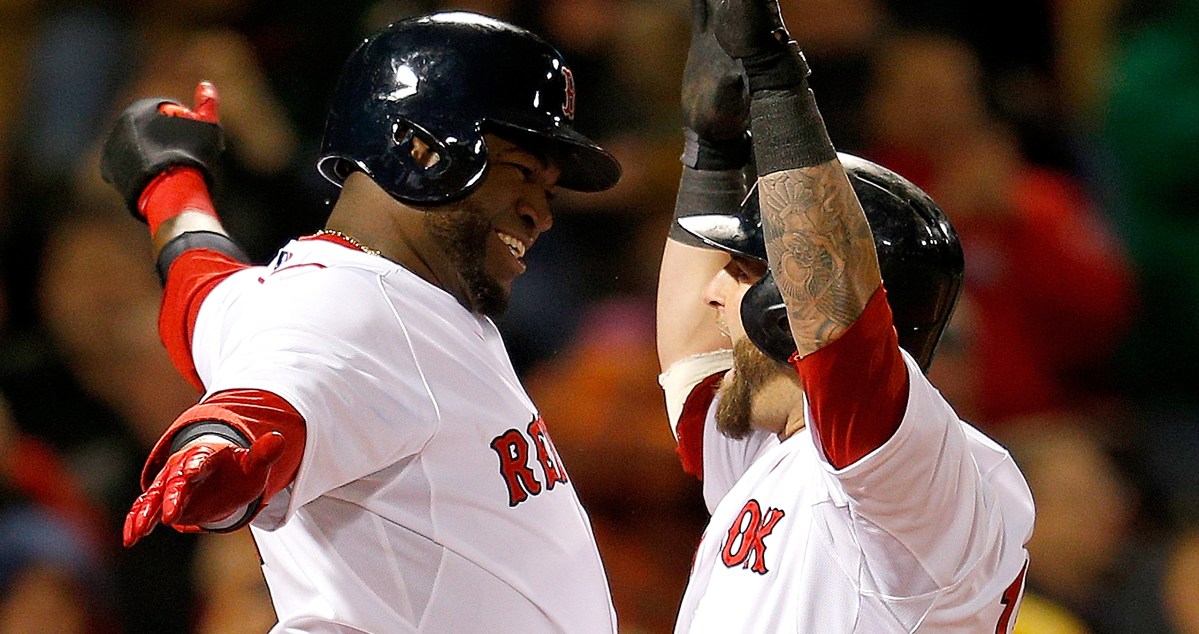
BOSTON, MA – OCTOBER 13: Torii Hunter #48 of the Detroit Tigers tries to catch a grand slam hit by David Ortiz #34 of the Boston Red Sox in the eighth inning of Game Two of the American League Championship Series at Fenway Park on October 13, 2013 in Boston, Massachusetts. (Photo by Al Bello/Getty Images) Getty Images
Adding to the research, Dr. Xygalatas has capitalized on the success of the UConn men’s and women’s basketball teams (between them, they’ve won the NCAA championship for the last three years, thank you very much) to study the real-time effects of fans sitting together, watching their team playing on the home court. A person who doesn’t care about sports might characterize this, ungenerously, as crowd mentality, but what we’re really talking about is collective experience.
Outfitting fans with wearable technology allowed the researchers to compare those in Gampel Pavilion to those who watched in groups on TV, and they found that the bodies of the in-person fans took on the characteristics of their neighbors, even to the point of synchronizing their heartbeats.
They took this experiment on the road to see if the results held up across different cultures. In Brazil, they organized a study around a pregame ritual where fans greeted their soccer team’s bus as they arrived before an important cup match. Not only were the fans’ bodies exhibiting telltale signs of what the study called “emotional synchrony,” but the measurements from the staff members on board the bus matched those of the fans’ as well. When researchers took a look at the game-time body stats, they saw that the level of collective connection during the pregame ritual was as strong as the most exciting in-game moments.
There are things we know as fans: it’s easy to make friends with another person who’s wearing your team’s shirt. Ask me how I know! I can spot a Red Sox hat or shirt a mile away on the mean streets of Seattle (and I make a point to go up and talk to almost every one of these fans). We fans also know that it feels good to win. And it sometimes can feel truly awful to lose. And even though an awesome play is an awesome play, it’s even better when it’s your team that executes it.
And then there are things that Dr. Xygalatas is proving scientifically: these events feel good (or bad) because we have evolved—pack animals that we are—to find them that way. Game experiences can be completely satisfying or horrible, depending on who you’re rooting for. Our bodies are rewarding or punishing us, but either way, our reactions serve to unite us more strongly with our neighbors in our collective triumph or grief. We’re all in it together. As he writes:
“Fanship taps into some of our fundamental evolved tendencies—our need to belong, to cooperate, to compete, to be part of something larger than ourselves, and, ultimately, to find meaning.” — Dr. Dimitris Xygalatas, Professor, University of Connecticut
So our shared pain (when it’s warranted), our shared elation (thank god for it when it comes), even the rhythm of our mutual hearts—they all mean something. They are part of being alive!
Saying something like, for example, All Cubs fans bleed Cubbie blue takes on a more specific, nearly literal, meaning. There’s something to it after all. And being a fan who lives and dies by the Sox is more or less hardcoded (once you account for geography, nurturing, and other relevant influences).
I have an answer the next time my passion as a fan is somehow called into question. I was born this way! And so were you.
The hearts of Red Sox Nation beat as one.