
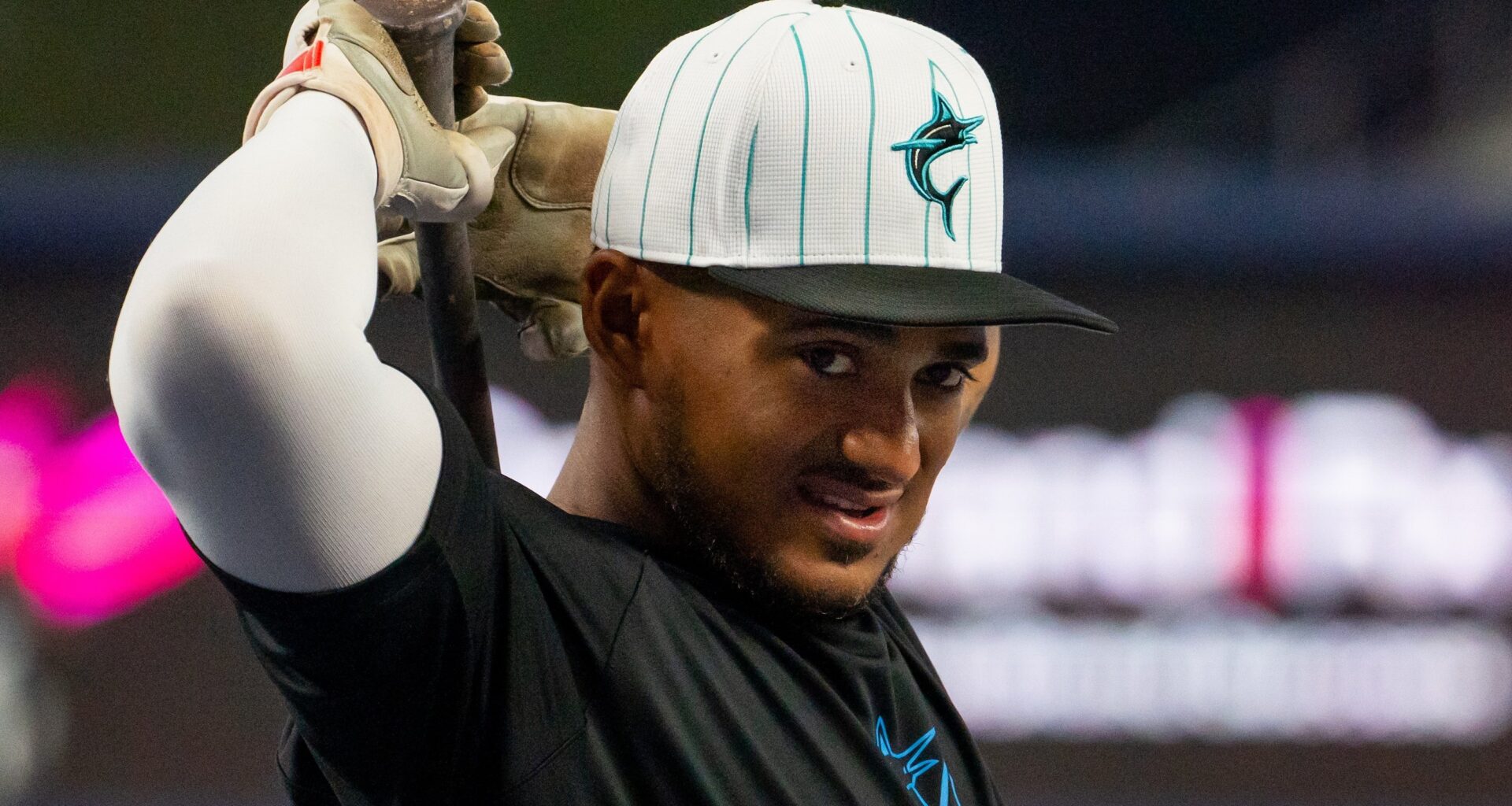
The Major League Baseball season is preposterously long. Nearly halfway through the 2025 campaign, it was not unreasonable to argue that the Dane Myers was the Miami Marlins’ best all-around position player.
The 29-year-old’s hard work was finally paying off. The Marlins were giving Myers an opportunity to establish himself as an everyday big leaguer. June 16 was his 13th consecutive game in the starting lineup, with all but one of those appearances coming in center field.
Most importantly, he was raking. Through June 16, Myers boasted a .333/.381/.481 slash line with a 142 wRC+ (42% better than league average). A right-handed batter who previously had awful production in limited opportunities against right-handed pitching, he was doing all he could to shed the “platoon guy” label.
Since then, Myers has been the worst hitter in the majors (among those with at least 100 plate appearances during that span). His playing time has gradually dried up, and his only reps since the trade deadline have come in the corner outfield spots now that Jakob Marsee has taken over in CF. That slide down the defensive spectrum puts even more pressure on Myers to contribute at the plate.
Less than two months ago, Myers and Kyle Stowers were seemingly in the same tier. Now, it’s far more fitting to group Myers and Derek Hill together. Yikes.
What the hell happened?

All of the stats used below were updated entering Sunday’s game.
I don’t like picking arbitrary endpoints to manufacture player hot streaks and slumps. In Myers’ case, though, June 16 is significant. He took his 139th plate appearance of the season on that date and has taken 139 more since then, so the before/after sample sizes are identical.
Also, there was an incident on June 16: Myers was hit on the left elbow by a Mick Abel fastball. He initially stayed in the game to run the bases, but was removed the next inning and sat out the following day before returning to the lineup on June 18.
When a player’s fortunes swing this dramatically, strikeouts are usually a factor. For Myers, not really! He had a 23.0 K% during his successful stretch, which has been followed by a 24.5 K%. The MLB average this season is a 21.9 K%.
Myers was the beneficiary of some conveniently placed batted balls while he was on an All-Star-caliber pace. “Great Dane” had a .419 batting average on balls in play. Nobody has maintained that over the course of a full-length MLB season in generations. Fielders are too skilled and defensive positioning is too advanced. He could have kept playing to the best of his abilities and some regression still would’ve been inevitable.
It works both ways. “Diminished Dane” has a .183 BABIP, which is unsustainably unlucky. If there was a real possibility of him continuing to hit this poorly, the Marlins would’ve already optioned him to the minor leagues.
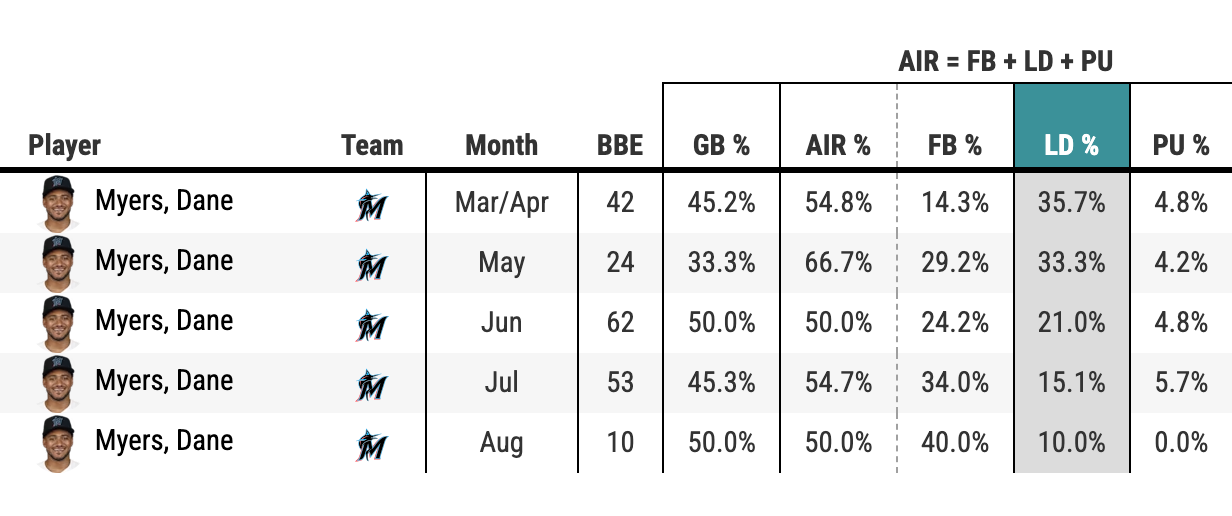
That being said, players make some of their own luck by impacting balls at ideal angles. Line drives, as they’re defined by Statcast, are gold, resulting in a .631 batting average. With each passing month, Myers’ line drive rate has declined.
Even when Myers gets the launch angle he wants, he isn’t making the same quality of contact as he previously did. His average exit velocity has plummeted from 92.6 mph to 88.3 mph. To use a pair of veteran hitters as points of reference, that’s approximately the difference between Vladimir Guerrero Jr. and Jonathan India.
The location of those batted balls has changed, too. Close your eyes and visualize a typical Dane Myers hit—it’s a line drive to right-center field. There have been a lot fewer of those recently. Per Sports Info Solutions, he’s gone from a 33.0% pull rate—very low by MLB standards—to 42.6%.
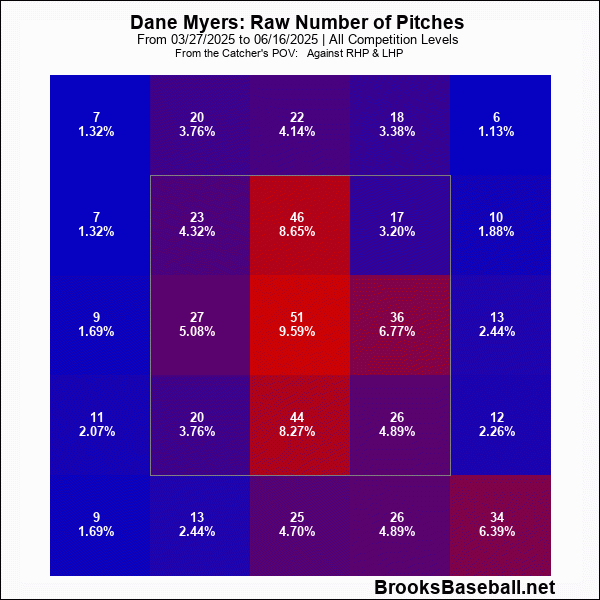
These before/after pitch distribution breakdowns from Brooks Baseball are fascinating. It is almost like opponents were conspiring to get Myers off to a good start to the season, leaving 26.5% of all pitches in the middle third of the strike zone. That rate has dropped to 20.9%. A lot of the “mistakes” made early on are now winding up just below the zone.

This 6-4-3 double play from Saturday’s game is a microcosm of what’s ailing him:
QXc1clpfVjBZQUhRPT1fVTFkUVhGQUNVVkFBRHdjRFVnQUhDRkpTQUFOVUJnTUFWZ0FFQ1FBRkJ3SlVWVmRR.mp4
There isn’t a smoking gun with Myers’ mechanics. For the first couple weeks of 2025, he utilized a toe tap and stood at a relatively straight angle facing the pitcher. Ever since, throughout both the highs and lows, he’s had a modest leg kick and more open stance.
Perhaps modifying his approach will be the key to snapping out of this funk. Myers stays composed in two-strike situations, but he has been less productive than most of his Marlins teammates when operating ahead in the count or swinging at the first pitch. His overall swing rate on in-zone pitches has also dipped. Understanding what kind of pitches he can barrel up and specifically hunting them could lead to more hard contact.