
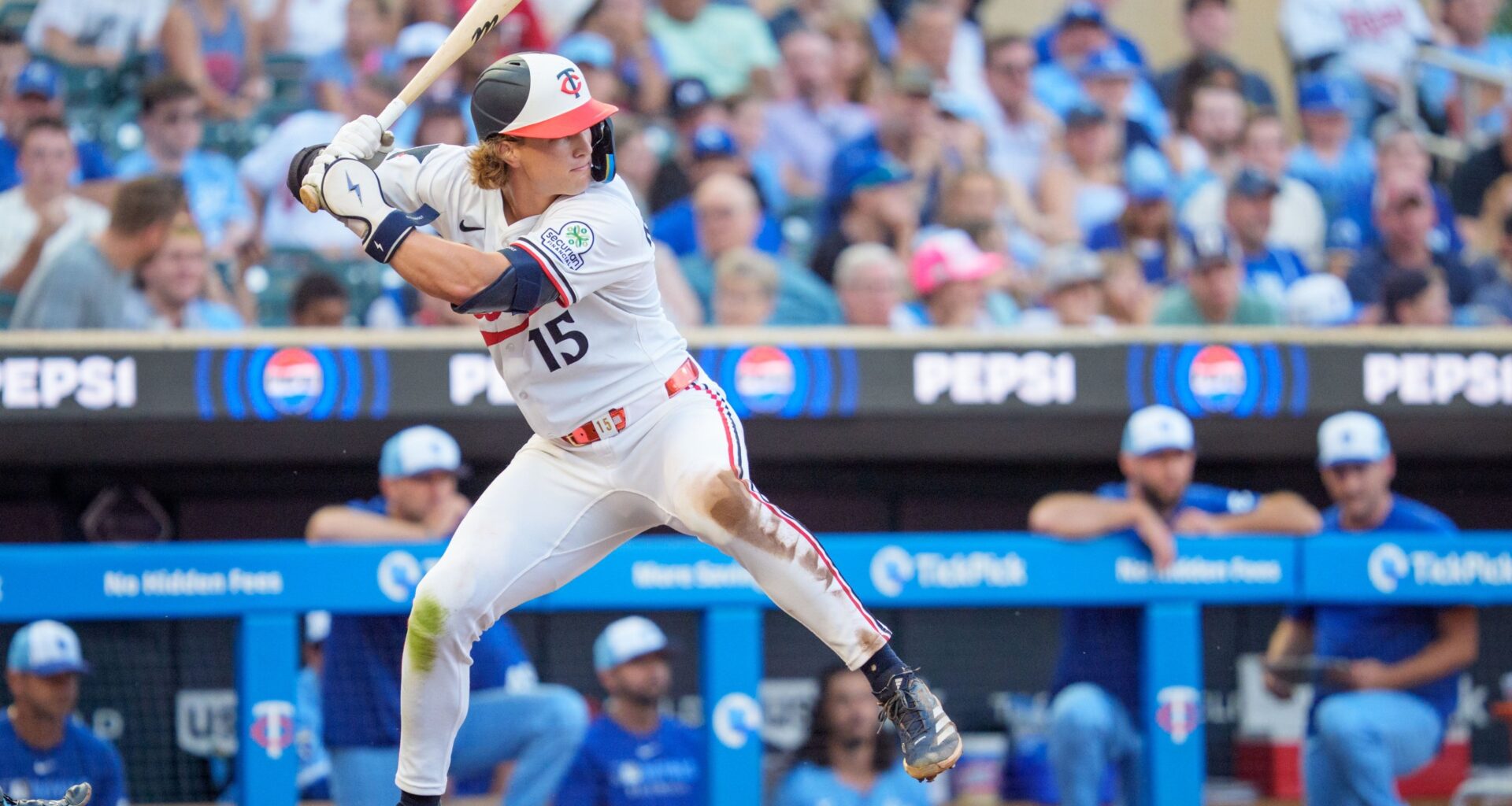
Luke Keaschall recently sent Twins fans braving post-fire sale August baseball home happy with a walk-off home run. He’s hitting north of .400, in just under 50 plate appearances. He’s playing like his blood is equal parts plasma and energy drink, a jolt this team sorely needed after the midsummer collapse and subsequent roster detonation.
It’s also hard not to root for a guy who missed time with a forearm fracture, only to return and pick up exactly where he left off.
Now, yes, we’re talking about a small data set here. But let’s look under the hood. Keaschall’s bat speed clocks in at 66.9 mph, which would put him in the bottom 10 among MLB hitters. That’s not necessarily a death sentence for production. Luis Arraez and Jacob Wilson live in that neighborhood, too, and they’re both capable of hitting their way out of a paper bag (with Arraez building a summer home inside it). The key for Keaschall is that his bat path is exceptionally short, at just 6.3 feet, tied for the third-shortest in baseball with Atlanta’s Nick Allen. For comparison, Byron Buxton’s swing path measures 7.9 feet (13th-shortest) while moving the barrel at a brisk 75.1 mph.
Short swings can be a gift. They allow hitters to make later decisions and still get the barrel to the ball. MLB’s bat-tracking data now includes metrics like “squared-up” (how close a hitter comes to their projected max exit velocity given pitch speed and bat speed) and “blasts” (elite contact factoring in both bat speed and that max EV potential). Blasts, in particular, are worth paying attention to, because those swings have produced a .563 average, 1.182 slugging, and .727 wOBA league-wide.
Here’s the rub: hitters with low bat speed tend to produce fewer blasts. Arraez has the lowest blast rate in baseball (2.0%) and, unsurprisingly, is not known for denting scoreboards. But he compensates by leading MLB in squared-up rate (45.4%), maximizing the contact he does make.
Keaschall is currently at a 14% blast rate, which is middle of the pack, and a 51% squared-up rate, which would be best in baseball over a full season. That’s a sign of a hitter who consistently delivers the barrel to the sweet spot.
And it’s not just the bat-to-ball skills. His swing decisions have been elite. He’s offered at only 13% of pitches outside the strike zone, which would be the lowest chase rate in the league. In fact, the only truly non-competitive pitches he’s swung at came in his first two big-league games against Atlanta, and even those were borderline check-swings.
Given the modern scouting landscape, Keaschall will not sneak up on opponents for long. With just one season’s worth of games in the minors (162 across three years and four levels), it’s likely pitchers are still figuring out how to attack him. So far, he’s shown he can turn around elevated fastballs (both of his home runs came on pitches up in the zone) and handle breaking stuff down.
The league will adjust. They always do. But Keaschall’s combination of short swing, quality decisions, and sweet-spot contact means he should remain a tough out. For now, he’s exactly what this Twins lineup needed: a hitterish, caffeinated spark in a season that’s had precious few.