
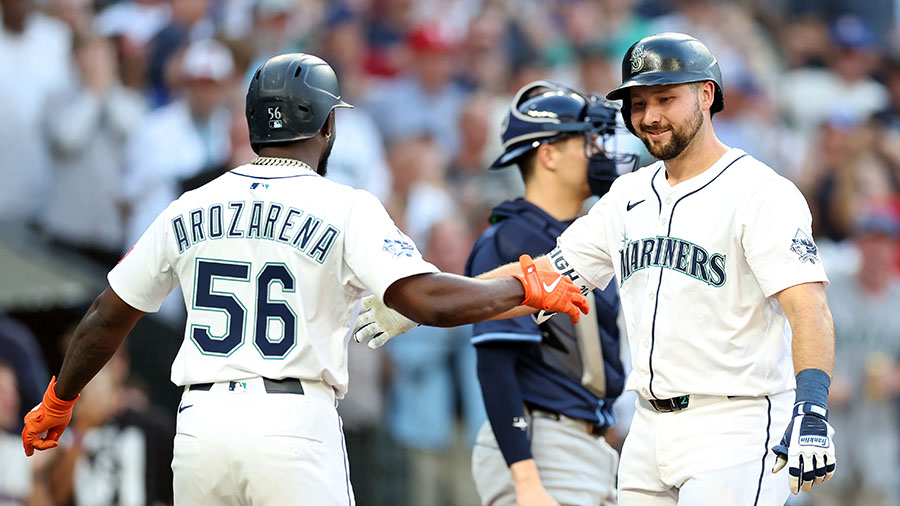
When the Seattle Mariners left Sacramento with Eugenio Suárez in tow, it was clear they had improved their team. Getting Josh Naylor was a coup, but acquiring Geno had the combined effect of adding someone who was familiar and beloved, plus the consensus best bat on the market.
The stats behind Seattle Mariners’ post-trade deadline surge
Regardless of how each player performed moving forward, the front office had shown an intense commitment to this group of players.
But when they rolled out their new toys at home for the first tie against the Rangers, we got a chance to see this lineup in action. Seeing the nine batters laid out on a card, you could just tell it looked impressive. In fact, in the 10 games that followed, they scored 55 runs (5.5 per game) with their lowest output being three runs (in a win).
OK, that’s not quite the 1999 Cleveland Indians (who averaged 6.29 runs), but it’s a whole lot better than the 2024 Mariners who mustered just 4.17.
Even more than the run production, the new look lineup looked a whole lot more fearsome. In fact, it looked to me like the best lineup I had seen in my 16 years in Seattle.
E L E C T R I C 🔱 pic.twitter.com/owscYt21No
— Seattle Mariners (@Mariners) August 10, 2025
Turns out, it very much is. In fact, it is pretty darn close to being the best lineup in franchise history. Well, kind of. Let me explain.
The three Mariners teams we tend to recognize as the best offenses are the 1996, 1997 and 2001 versions. You are probably pretty familiar with a lot of the names from those teams – Hall of Famers like Griffey, Martinez and Ichiro, with A-Rod, Buhner and others as well. That era of baseball was known for its offense, regardless of how it was produced. And for two of those years, the Mariners played in the Kingdome.
If you look at the raw numbers, all three were superior to the lineup the M’s have run out in almost each of the last 10 games. But, thankfully, baseball statisticians have devised ways to adjust for both the era and the ballpark.
OPS (on-base plus slugging) has always been my favorite catch-all metric for grading offensive players, but it is limited to the raw figures. OPS+, on the other hand, measures a player’s offensive production while adjusting for both ballpark factors and league context. It’s a normalized version of OPS, with 100 representing league average. A player with an OPS+ of 150, for example, is 50% better than the league average.
So when you consider the current pitching dominant era and the run suppression of T-Mobile Park, these new-look Mariners get a lot more competitive.
Taking the combined 2025 OPS+ of the nine Mariners regulars in the lineup gets us to 126.2. That is to say that they are, as a unit, about 26% better than the league average. None of the nine players are below-average. None. It ranges from Cal Raleigh (168) to Cole Young (102), with five players above 125. That’s remarkable.
NUMBER 45 FOR BIG DUMPER! #TridentsUp pic.twitter.com/pxi1QqePvT
— Seattle Mariners (@Mariners) August 10, 2025
It’s clearly better than 1995. As beloved as that team was, the nine players who got the most time at each position averaged an OPS+ of just 116.6.
The 2001 team was similar, with the most regular nine players coming in at 117.8. They may be the two most famous teams in franchise history, but their offenses weren’t as impressive compared to the league they played in as this one is. How crazy is that?
As it turns out, the 1997 Mariners have the edge. Taking their most regular lineup, they had an OPS+ of 126.7. Yes, it was half a percentage point higher than the team Dan Wilson is now rolling out nightly. That’s close enough in my book!
There all kind of benefits to a lineup like this one.
The depth puts constant pressure on the opposing pitcher and allows the team to withstand the slumps that each player inevitably goes through during a season. Their speed and aggressiveness (not accounted for in the OPS+ metric) have added another element. The mix of on-base threats with contact skill players and big boppers puts them in position to win games with various styles.
They have done all of that without sacrificing much defensively. The additional run support allows starting pitchers to live in the strike zone without fear of making one mistake and lets the manager keep his bullpen fresh by using non-leverage arms when he has a big enough lead.
But one hidden benefit is the pressure it removes from the youngest players. Julio may be the most talented player we’ve seen here in a generation, but he has had to carry a significant weight for the last two seasons. Dominic Canzone and Cole Young have flourished in ways we haven’t often seen from young players in Seattle. And it must help to be at the bottom of the lineup, playing without great expectations.
The Mariners may not score 5.5 runs per game over the final quarter of this season. The players may have some ups and downs, as is common in this sport. But they are better set up now to withstand those eventualities than any time in nearly 30 years.
Your eyes aren’t lying. This offense is legit.
More on the Seattle Mariners
• Mariners’ Josh Naylor was snubbed for AL Player of the Week
• With ‘special’ home crowds, Mariners are doing ‘special things’
• M’s pounce on Rays pitcher who wore OKC Thunder jersey in park
• How M’s switch-pitching prospect Cijntje fared in Double-A debut
• Seattle Mariners’ Bryan Woo continues to wow with record streak
