
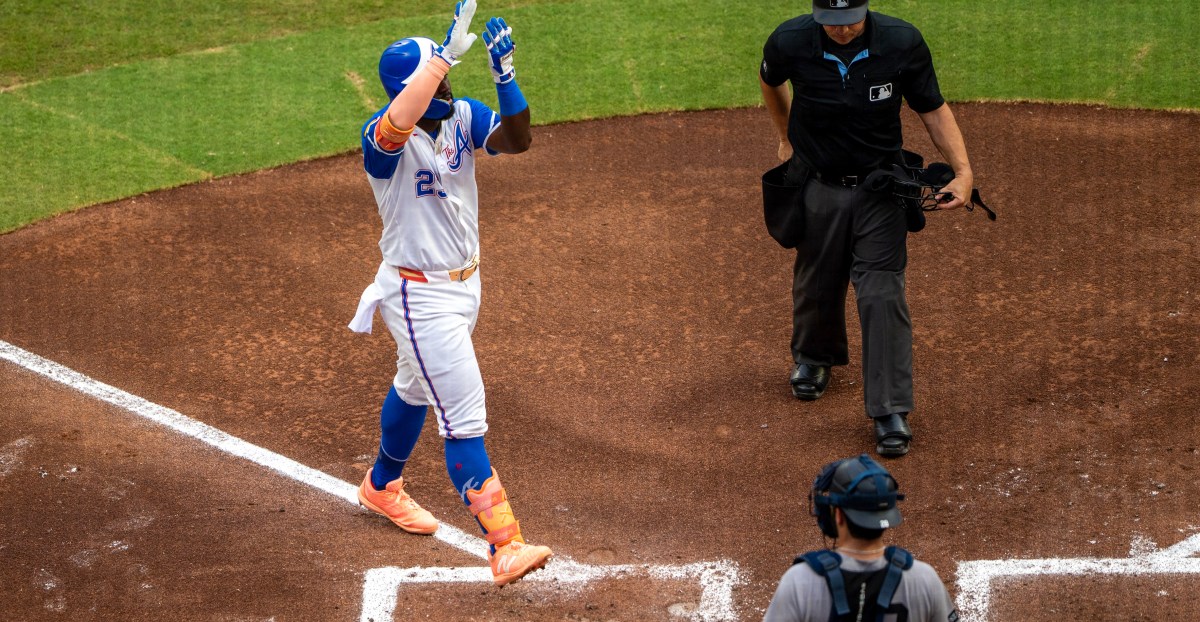
For nearly the entirety of the first half of this season, Michael Harris II was one of the worst hitters in all of baseball. That’s not hyperbole, that’s an actual fact — up until July 10, business was absolutely barren for Money Mike, as he was hitting .205/.229/.310 with a wOBA of .232 and a wRC+ of 44 for the entire season (to that point) across 356 plate appearances. As a matter of fact, the only thing that was keeping Harris from being rated as the worst everyday player in all of baseball up to that point was his defense. However, even his great defense couldn’t save him from being nearly a full win of fWAR underwater — up until July 10, Harris had produced -0.9 fWAR and the only regular player across Major League Baseball who was worse was Michael Toglia at 67 wRC+ and -1.4 fWAR total.
Simply put, the first half of the season was basically The Great Depression for Money Mike. It was truly depressing to watch him struggle at the plate — especially considering the flashes of brilliance that he had shown over the course of his young big league career. The talent was clearly there but he was just scuffling on a major scale. It was especially depressing since this also coincided with the rest of the team going into the doldrums. It’s been a disappointing season and it sure seemed like Harris was on his way to having a season that was full of disappointment.
Fortunately, the thing about The Great Depression (or depression in general) is that it doesn’t last forever. We’ve all seen in it recent times and it’s been a true sight for sore eyes. Michael Harris II has his mojo back and business is booming once again for Money Mike. I asked Brian Snitker about Harris’ performances lately and he provided a clear line of demarcation for the turnaround:
“It started when we were in St. Louis right before the break. He’s made some adjustments and it’s working for him.”
This was a pretty quick answer since it was following the second game of a day/night doubleheader but it was still interesting to note that that pre-All-Star Break series against the Cardinals was in fact the very moment where Harris started cooking. Ever since July 11, Harris has been absolutely scorching at the plate as he’s hit .359/.377/.670 with a .442 wOBA and 189 wRC+.
It’s interesting that he’s hit the same amount of home runs in each stretch (six) but he’s also doing far better in terms of hitting for power (.104 Isolated Power up until July 10, .311 since) and avoiding strikeouts as well (20.8 strikeout percentage up until July 10, 15.9 strikeout percentage since). Some of this might be a tiny bit inflated since his xBA for this season is at .278 but at the same time, that’s not a huge deviation from where it’s been over the course of his career, so there’s that. The point is that Money Mike actually looks like Money Mike again at the plate and he’s done it without sacrificing his defense as well.
So what’s been the impetus for the turnaround? One of the factors has been a noticeable tweak to his swing. David O’Brien of The Athletic mentioned in one of his latest articles (subscription required and recommended) that he’s raised his hands in his batting stance and gone back to a look that he had used before reaching the big leagues. O’Brien also mentioned that Harris feels a lot more comfortable with the hand positioning and that this change is here to stay but considering how meticulous and studious batters are about their hitting stances and approaches in the present day, I’m sure that there will be more tweaks here and there in order to calibrate his swing. For the time being, the hand positioning does appear to be something that he should stick with since, well, the results are obvious.

Michael Harris II preparing to swing on May 29 Getty Images

Michael Harris II preparing to swing in August Getty Images
There’s also been some significant changes to his plate discipline over the course of this season. When you look at his O-Swing percentage tendencies, there’s been a clear change of strategy. After reaching a peak of swinging at a whopping 60 percent of pitches outside of the zone in early July, that coincided with his wOBA being at a season-low 15-game rolling average of .105 for 2025. By the time the end of the month had rolled around, Harris was only swinging at around 38 percent of pitches outside of the zone and his 15-game rolling average wOBA had increased to a near season-high of .476 (his actual peak came on August 9 when it reached a rolling average of .481). It’s taken a bit of a dip recently as Harris has started to swing a bit more at pitches outside the zone but I’d imagine that’s just him doing the baseball equivalent of “heat checks” at this point with the run that he’s on.
His increase in wOBA has also coincided with an increase of swinging at pitches in the zone. While his Z-Swing percentage actually peaked in mid-June, that was also when his swing mechanics were messed up. Once he started making adjustments to both his plate approach and swinging tendencies (which again, you can point to that series in St. Louis as the clear line of demarcation) and started swinging more at pitches in the zone, the hits started coming like he was Prince in the 1980s. Altogether, it’s very clear to see that Michael Harris II is a better hitter when he’s more patient and discerning about the pitches that he chooses to offer at.

FanGraphs.com
The thing that’s still a bit concerning is that he’s still not as patient as he should be, as evidenced by the fact that his walk percentage hasn’t changed a bit despite all of the changes. He’s walking nearly a full two points less (2.8 percent) than his career average, which was already at a paltry 4.3 percent. As such, he’s been unable to put a decent amount of distance between his batting average and On-Base Percentage which means that if he’s not hitting, he’s not getting on base. That appears to be one of the final pieces of the puzzle here, as he could potentially be an extremely dangerous hitter if he continues to show some more patience and plate discipline at bat. He’s still in his age-24 season so there’s still plenty of time for him to figure it out and get better at this point.
For now, it does seem like the changes that Harris made to his plate approach and swing appear to be real. You don’t just go on a month-long tear like that without there being some sort of concrete staying power behind it. In fact, if Harris continues at this rate then he could very well end the season with at least 1.0 in fWAR, which would be an astonishing turnaround considering where he was for the first half of the season.
Sure, this might be a lost season for the Braves but it doesn’t have to be a completely wasteful one. Michael Harris II (and credit to hitting coach Tim Hyers and the rest of the coaching staff) have proven that you can at least build something positive in the midst of squalor. Hopefully these changes stick and we’ll continue to see Money Mike develop into the player that we all know he can be going forward. We’ve all noticed it and hopefully it stays.