
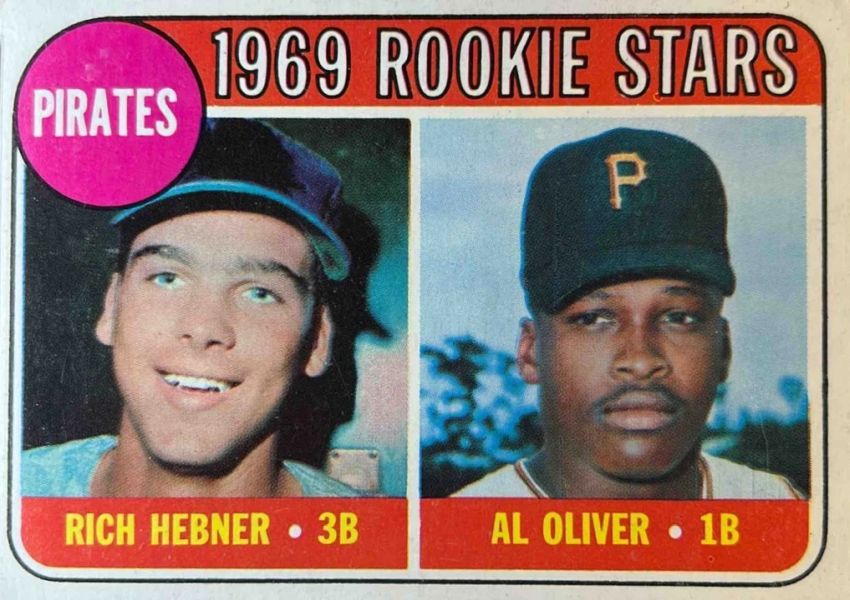
ROSEMONT, Illinois – As consumers of media and entertainment, we love lists. Top 10 greatest players, best teams ever, draft busts – you name it, good or bad, if they list it accurately, we will read it. Another list that is often made among the big three sports in the U.S. is the most overlooked players. For his career, Al Oliver deserves to be on every Major League Baseball list of most overlooked players.
A unique all-around athlete, playing for Portsmouth High School (Portsmouth, Ohio), Oliver earned a basketball scholarship to Kent State but opted to sign with the Pittsburgh Pirates after showcasing his skills at a tryout camp in 1964 at the age of 17. By September 1968, Oliver got his first taste of MLB.
Oliver’s rookie season in 1969 was special finishing second in Rookie of the Year voting. The Pirates rising star hit .285 with 17 home runs while knocking in 70. The NL ROY in 1969, Cincinnati Reds catcher Johnny Bench.
The Pirates worked Oliver up through the minors as a first baseman, but a spot would open in the outfield that would change his professional career.
Asked about his early playing days in Pittsburgh, the seven-time All-Star had a lot to share.
“I think from the earlier part of my career, the fact that when I was called up in 1968, it wasn’t too much longer after that we became a winning team, and we won our first divisional championship in 1970,” Oliver said.” And it was probably the best-power team that they’ve ever had. That’s the thing that stands out.
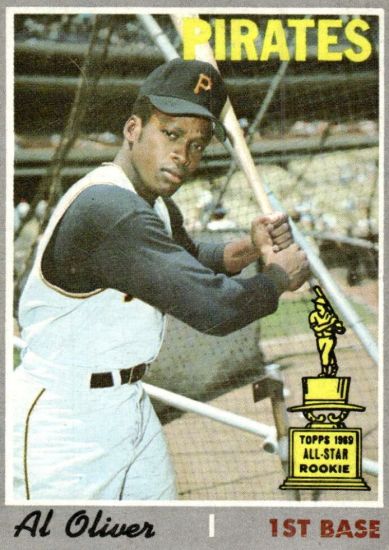 1970 Topps #166 Al Oliver
“I had a chance to eventually play in centerfield between (Roberto) Clemente and (Willie) Stargell. They had to make a move. Bob Robertson and I were first basemen, but Bob Robertson couldn’t play centerfield. But being that I could run, they had to make that transition to put me in centerfield. So, I enjoyed playing between those two guys.”
Leading up to the 1971 season, the Pirates had won seven NL pennants and three World Series titles (1909, 1925, 1960). Another banner was about to be added to Three Rivers Stadium against the Baltimore Orioles.
“In 1971, we were fortunate enough to go on and win the World Series, and that was the key, winning the World Series,” Oliver reminisced. “To see Steve Blass pitch an outstanding game (Game 3; three-hit, 1-run, complete game), to see Roberto Clemente (WS MVP) do his thing and show the world how great he was.
“I was just glad to be a part of that team. I did make a little contribution, but Roberto just told us just to give a little help, and he would do the rest. I’m just very fortunate to play on some great teams early in my career and throughout my career.
“I always played on contending teams. I never played on a losing team throughout my career. And so that’s the thing that I feel good about.”
On his way to becoming an 18-year big league veteran, Oliver detailed his transition from a young role player to a counted-on veteran.
“Well, the only thing that I needed early in my career was to play every day,” Oliver shared. “They started out platooning me, which I had never heard of a platoon since I was in Fort Knox, Kentucky, in 1966. I was not a platoon ball player.
“You know, I was an everyday ball player. I was cut out physically and mentally to play every day. That came to play in 1972, when I played every day, and from then on is when I started hitting .300 every year. That was really the key. Yeah, that was really the key.”
From Bud Selig (1992-2015) to Rob Manfred (2015-present), the changes in MLB have turned away the players, like Oliver, that helped build the game.
Asked if he enjoys watching baseball games, Oliver replied, “No. No, I don’t. There are too many rule changes. You know, baseball is not that difficult. The pitcher throws the ball and then the guy hits the ball. They take too many pitches, and they strike out too much.”
The Overlooked Career of Al Oliver
Taking a deeper look at Oliver’s career, one cannot help but bring up what could have been. Per the stats, 11 times in his career Oliver hit .300 or better, retiring in 1985 as a Toronto Blue Jay with a .303 career batting average. Oliver compiled 2,743 hits, was a three-time Silver Slugger winner (1980-82), and NL Batting Champion and RBI Leader (1982).
The “what could have been” for Oliver, he was forced to retire in 1985 citing collusion among franchise owners. This claim was backed by a court ruling in 1995 that awarded Oliver $680,031.05.
Oliver was just 257 hits away from a benchmark that could have gotten him into the Hall of Fame. The Wins Above Replacement (WAR) metric for Oliver, 43.7, places him above players like Julio Franco, Adrian Gonzalez, Jon Lester, Gerit Cole, Cliff Lee, Mel Stottlemyre, Jorge Posada, Don Mattingly, and Xander Bogaerts, to name a few.
The Pirates inducted Oliver into their Hall of Fame in 2025 along with RF Kiki Cuyler and P Vern Law.
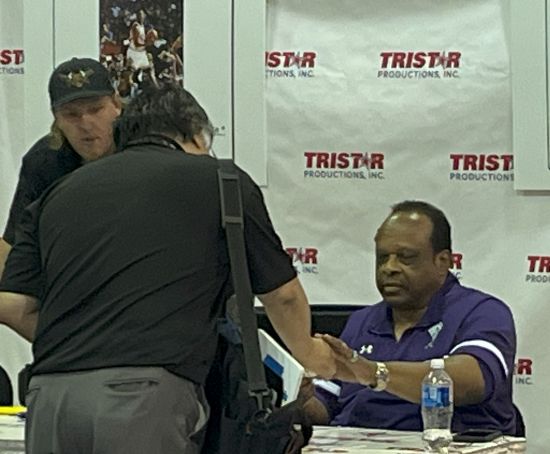 Al Oliver signing for fans at the 2025 NSCC