
Half a century (minus a few days) has passed since I met The Monster.
Yes, it was scary.
It happened on October 10, 1975. The monster I met that day was a green hunk of tin that stood 37 feet, two inches high and separated Boston’s Fenway Park from Lansdown Street. I could have reached out and touched it, but I didn’t. Today there are seats on top of it, but in 1975 it just stood there — naked and imposing.
But the monster wasn’t the scary part.
The scary part was that Johnny Bench happened to be in the batting cage at that time. He was sending screaming line drives all over Fenway Park. Even though I was on the left field warning track I didn’t feel safe.
My purpose for walking out there in the first place was to talk to Cincinnati Reds left fielder George Foster, who was idly shagging an occasional fly ball. I, and two other sports writers, had decided that this would be a good time to ask him what he thought of The Monster. After all, this was his first encounter with the creature.
There was no interleague play in 1975. Most of the Cincinnati players hadn’t been in Fenway Park before this day, but in 24 hours they would be playing Game One of the World Series there. Even then Fenway was regarded as an ancient ballpark, full of quirks. The signature feature was (and still is) the Green Monster.
The left field foul line is only 302 feet from home plate, which always makes it an inviting target for right-handed sluggers. The Reds feature three such hitters — Foster, Johnny Bench and Tony Perez. But it is a tricky obstacle. Any ball that clears it has to be hit with loft.
Many home run balls in Boston would be lazy flies to the left fielder in other parks. But screaming line shots that lack elevation — balls that would easily sail out of most parks — simply clang up against that Monster. A clever left fielder can snatch the ball on the carom sometimes limit the batter to a single.
Foster was the one player who would be dealing with The Monster when he played the field and when he batted. That’s why I considered it essential to find out what he was thinking now that he’d seen it first-hand. I didn’t find out. His answers were polite but non-committal. He seemed to be a bit overwhelmed by everything that was happening all around him, and that was understandable.
After all, when the season began Foster had been his team’s fourth outfielder. He became a regular in May, only after left fielder Pete Rose had agreed to shift to third base. That’s when Cincinnati’s “Big Red Machine” began to feature eight pistons.
That “Big Red Machine” moniker had originated in 1970, but this was the most awesome version yet. It had won 108 games in the regular season and swept the Pittsburgh Pirates in the League Championship Series. Now the Red Sox were the only remaining obstacle as they sought to bring Cincinnati its first World Championship since 1919.
The Boston team had exceeded all expectations, mostly because of the contributions of rookie outfielders Fred Lynn and Jim Rice. Lynn was about to become the first player in history to be named Rookie of the Year and Most Valuable Player in the same season. Rice would finish second in the Rookie of the Year balloting.
Like the Reds, the Red Sox had won the LCS with a sweep —a very impressive sweep. They polished off the Oakland Athletics, who had won the three previous World Championships.
I, for one, could hardly wait for this World Series to begin. I thought all the ingredients were in place for a terrific struggle. As it turned out, I was underestimating it. What unfolded was the greatest World Series I ever saw and ever expect to see.
The opener was scoreless through the first six innings before the Red Sox erupted for six runs, which was five more than they would need. Veteran Luis Tiant throttled Cincinnati with a 100-pitch masterpiece.
The Sox took a 2-1 lead into the ninth inning of Game Two, but the Reds tied it on Dave Concepción’s two-out RBI single. Concepción then stole second and scored the go-ahead run on Ken Griffey’s double. Cincinnati held on for a 3-2 victory that squared the Series, 1-1.
Things were already breath-taking. Interestingly, in two games neither team conquered the Green Monster. In fact, nobody on either team hit a homer to any part of the oddly shaped park.
Cincinnati’s Riverfront Stadium seemed to be a stark contrast to Fenway. It was a perfectly circular structure that was only seven years old. It had been designed to accommodate football and baseball — in that order — and the surface was artificial.
Both teams found their power strokes for Game Three, as they combined for six homers in the first nine innings. But, with the score tied, 5-5, the game’s key play was a bunt by an obscure player named Ed Armbrister.
Cincinnati’s Cesar Geronimo opened the bottom of the tenth with a single. Armbrister, a pinch hitter, put down a bunt that wasn’t a particularly good one. Catcher Carlton Fisk pounced on it and threw to second, expecting to force Geronimo. The throw was high and the Reds wound up with runners at second and third with none out.
Fisk complained that Armbrister had struck his arm while he was making the throw. Umpire Larry Barnett refused to call interference because he did not believe the contact had been intentional. The Red Sox grumbled mightily but Major League Baseball said that Barnett had made the proper call.
The Reds capitalized on the error when Joe Morgan smacked a game-winning single.
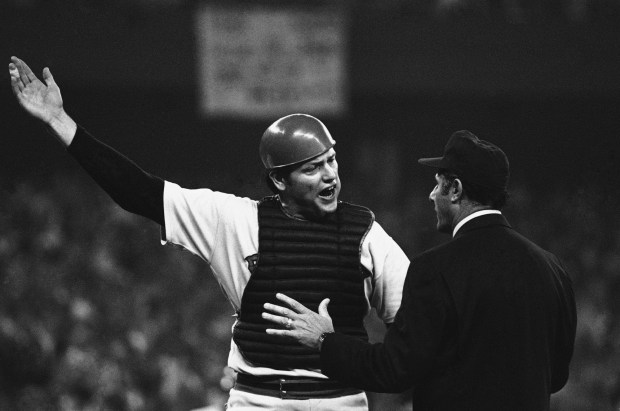 Boston catcher Carlton Fisk, left, argues with first base umpire Dick Stello that he was interfered with when Cincinnati batter Dick Stello that he was interfered with when Cincinnati batter Ed Armbrister brushed him at home plate as he threw to second trying to force out runner Cesar Geronimo, who eventually scored the winning run in the tenth inning of the third game of the World Series, Tuesday, Oct. 14, 1975, Cincinnati, Oh. Cincinnati won the game 6-5. (AP Photo/Bob Daugherty)
Tiant struck again in Game Four, posting his second complete-game victory. Perez homered as the Reds won Game Five, giving Cincinnati a 3-2 lead as the Series returned to Boston.
Day games were scheduled for Saturday and, if necessary, Sunday, but Mother Nature intervened. An autumn nor’easter blew through New England, washing out the entire weekend.
Even that was fun.
On Sunday, Reds manager Sparky Anderson decided he wanted to keep his hitters sharp and discovered that two local colleges — Harvard and Tufts — had indoor batting facilities. Both schools said the Reds would be welcome if they wanted to take batting practice, but Anderson chose Tufts. He thought ” Harvard” had too much of a Boston connotation.
Thus, the Reds in full uniform, boarded a bus bound for Tufts. There was only one problem. No one, including the bus driver, knew were they were going. In frustration, Anderson directed the driver to pull into a service station and he hopped out in the heavy rain, to ask directions.
I can’t quite picture that situation, but I know one Cincinnati sportswriter who was on the bus and witnessed it himself. “That guy,” he said, “must have been looking for the candid camera.”
By Monday the rain was gone, but Commissioner Bowie Kuhn declared the field unplayable and Game Six was put off until Tuesday — five days after Game Five had been played.
It should be noted that at some point during the interlude, NBC’s director had decided the camera he had placed inside Fenway Park’s left field scoreboard ought to be moved, but the TV crew had been too busy to shift it. As gametime approached the director determined that the camera should be left in place, but one need operate it. It would merely be turned on and pointed towards home plate.
The game was remarkable throughout — full of defensive gems and plot twists. Tiant started for Boston, but he departed in the eighth inning with his team trailing, 6-3. A three-run homer by pinch hitter Bernie Carbo — a former Red — tied the score in the eighth. As Carbo rounded the bases he caught the eye of his pal Rose, who gave him a big smile and asked, “Don’t you just love playing in this game?”
In the bottom of the ninth the Red Sox loaded the bases with nobody out, only to have the Reds turn a foul ball into a double play. Foster caught Lynn’s weak popup in foul territory and was astonished to see Denny Doyle tag at third and attempt to score the winning run. Doyle was easily thrown out. Third base coach Don Zimmer had yelled “no, no, no,” after the catch, but Doyle thought he heard, “go, go go.”
The Sox failed to score in the ninth and, for the second time in the Series a game went into extra innings.
In the top of the 12th the Reds had a chance to score — two on and one out — but failed. The contest was still knotted when Fisk led off the bottom of the inning. He got hold of an 0-1 pitch and drove high into the October sky. It went in the direction of the left field foul pole. He turned to watch it, frantically gesturing with his arms as though he could direct the ball to stay on the “fair” side of the pole. Once he was satisfied that it would, he leaped one more time before beginning his home run trot.
Amazingly, it was the first time in the Series that anyone had been able to scale the Green Monster. Amazingly, NBC had Emmy winning pictures that had come from an unmanned camera.
Everything seemed amazing.
Game Seven was no letdown. In fact, the score was tied, 3-3 after eight innings.
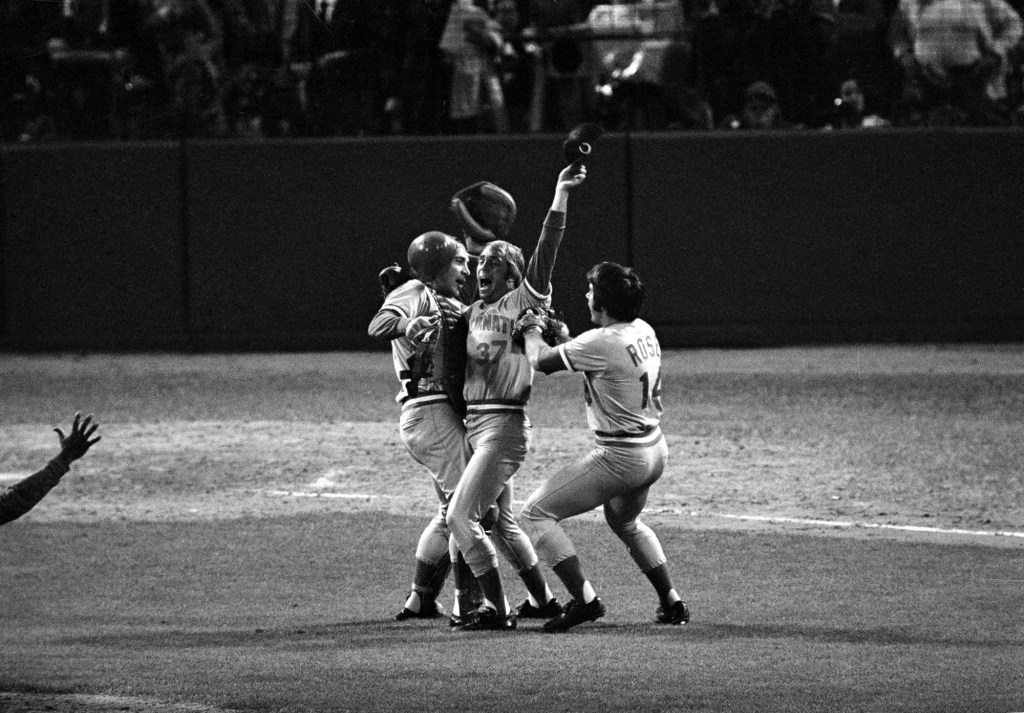
Somebody had to win, and it was the Reds. Morgan, who had driven in the winning run for Game Three, did it again.
Somebody had to lose and, technically, that’s what the Red Sox did. But it doesn’t seem appropriate to call anybody associated with this World Series a loser.
Fifty years ago the big winner was the game of baseball.
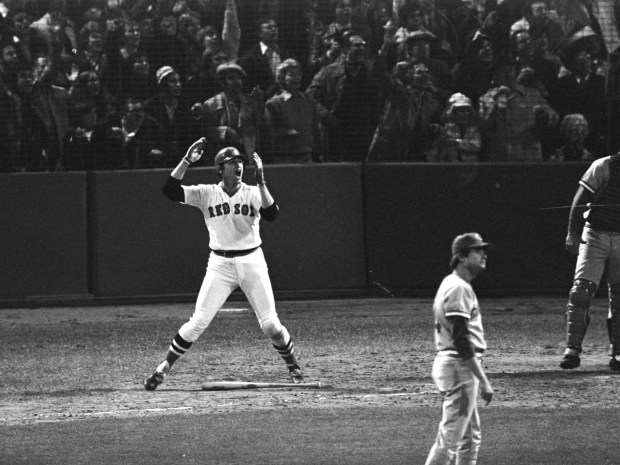 FOR USE AS DESIRED FOR THE 100TH ANNIVERSARY OF FENWAY PARK – FILE – In this Oct. 22, 1975, file photo, Boston Red Sox’s Carlton Fisk, left, watches his 12th-inning home run against the Cincinnati Reds to win the sixth game of the World Series at Fenway Park in Boston. The Red Sox will celebrate the 100th anniversary of Fenway’s opening on April 20, 1912, when they host the New York Yankees. (AP Photo/Harry Cabluck, File)
A FEW STATISTICS (Wednesday’s games not included): Tean highs and lows — Batting Average: Blue Jays .270, Guardians .228; Batting Average with runners in scoring position: Brewers .288, White Sox .224; Batting Average from the seventh inning on: Blue Jays .278. Rangers .210; On Base Percentage: Blue Jays .340, Rockies .296; Slugging Percentage: Yankees .447, Pirates .244; OPS: Yankees .776, Pirates .647; Singles: Blue Jays 743, Guardians .568; Doubles: Red Sox 249, Mariners 156; Triples: Rockies 29, Cardinals 4; Home Runs: Yankees 190, Pirates 84: Grand Slams: Diamondbacks 9, Royals, Twins, Cardinals, Rangers, Nationals 0; Stolen Bases: Rays 151, Tigers 51; Thefts of Third Base: Mariners 19, Braves, Angels 0; Stolen Base Percentage: Mets .903, Rockies .674; Sacrifice Bunts: Padres 35, Orioles, Twins 3; Sacrifice Flies: Diamondbacks 48, Rockies 20; Hit Batsmen: Twins 71, Marlins 79; DPs Grounded Into: Cubs 49, Athletics 98; Batting Average for Pinch Hitters: Nationals .318, Royals .134. Runners Picked off Base: Mets, Yankees, Angels, Tigers 5; Royals 16.
Former Hall of Fame voter Jay Dunn has written baseball for The Trentonian for 57 years. Contact him at jaydunn8@aol.com
Originally Published: August 13, 2025 at 12:56 PM EDT