
Just over a year ago the Rays treated the 2024 MLB trade deadline as an opportunity to blow up most of the team, dealing All-Stars and veterans — Isaac Paredes, Randy Arozarena, Zach Eflin, Aaron Civale, Jason Adam, and more — just months after dealing the face of the franchise Tyler Glasnow.
At the time the Rays were well out of playoff contention, and made the moves with an eye on the future, expecting acquired talents — both veterans (INF/OF Christopher Morel, OF Dylan Carlson, RHP Hunter Bigge) and prospects (RHP Dylan Lesko, RHP Brody Hopkins, OF Aidan Smith) — to set the stage for the team’s immediate future.
Advertisement
And yes, immediate.
The afternoon after trading Randy Arozarena to the Mariners president of baseball operations Erik Neander said, “I have a responsibility to try to get this team to a World Series,” emphasizing the front office’s strategy was built around returning to playoff contention as quickly as possible:
“We don’t want 2024 to be 2014, don’t want 2029 to be 2019,” Neander said. “Don’t want to go five years without a playoff appearance, so these decisions were made to make sure that we don’t fall off and it doesn’t take us five years to find our way back.”
[mlb.com]
That is why many who follow the Rays closely were quick to say 2024 wasn’t a firesale. The team held on to Yandy Diaz and Brandon Lowe, two of the most productive players in team history, and had plenty of young talent locked and loaded in 3B Junior Caminero, OF Josh Lowe and 1B Jonathan Aranda, the return for Glasnow in RHP Ryan Pepiot and OF Jonny DeLuca, and injured players ready to bounce back in LHP Shane McClanahan and RHP Drew Rasmussen.
The goal was simple: ride the wave of talent through 2025, and catch an even bigger wave in 2026 with a farm system now replenished with an absurd amount of depth.
Advertisement
On the major league side, that obviously did not materialize. Among the players named above Diaz and B. Lowe have done their part, and newly minted All-Stars Caminero and Aranda surpassed expectations. But that only got the team so far.
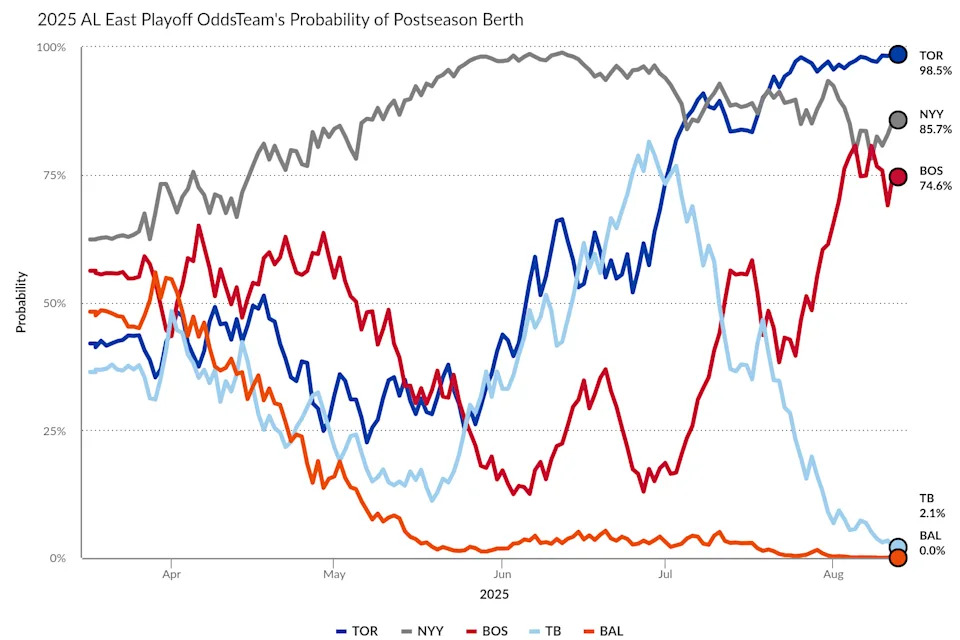
At the 2025 trade deadline the team moved the deck chairs around, swapping two catchers and two starting pitchers out via deals, but without upgrading the abysmal outfield that has suffered poor performance across all three positions. A few more injuries later (B. Lowe had 35 plate appearances in July, Aranda fractured his wrist on August 1) and the team’s playoff odds have dropped from 81.4% at the end of June to just 2.1% as of today, August 13.
But fear not, right?
Advertisement
All the pain the fans needed to face in trading away the stars was sure to be assuaged by the incoming talent should the major league side fail to deliver.
Unfortunately, no.
Baseball America just re-assessed the farm systems across baseball and dropped the Rays down to 20th overall, despite the massive influx of additional talent over the last two seasons via trade, with only one player considered a top-100 prospect (SS Carson Williams, 75 overall), writing:
System Summary: This has been a year to forget, as injuries and ineffectiveness have struck numerous hitting prospects.
System Strengths: Competition. The difference between the No. 5 and No. 25 prospect in the Rays system right now is relatively miniscule. Despite the lack of Top 100 Prospects, few teams have as many potential big leaguers as Tampa Bay. They just need some of them to emerge as elite prospects rather than possible big leaguers.
System Weaknesses: Upper-level production. This was supposed to be the year that Xavier Isaac, Tre’ Morgan, Carson Williams and Brayden Taylor all pushed for big league promotions. Instead, all four seem to need more seasoning that may stretch into 2026.
There’s a lot to be said about diversifying risk through quantity, but for the wider prospect blogosphere to suddenly back peddle on the quality of the Rays system is astonishing.
Advertisement
Entering the season the Rays farm system was No. 2 overall at MLB Pipeline, and No. 1 mid-year in 2024. At Baseball America the system ranked 6th pre-season, and 7th the year before.
For years, the Rays have sold fans on the idea that losing stars today would mean winning bigger tomorrow. But if the on-field product is crumbling and the farm is losing luster, the future starts to look a lot less like a light at the end of the tunnel and more like an oncoming train. Quantity can only take you so far without quality to anchor it.
If the crown jewel of the organization—the pipeline—can no longer be counted on to deliver elite talent, then the entire Rays model is in question. There isn’t a great team on the field today, there isn’t a better one waiting in the wings. The team doesn’t even have a major league stadium to play in.
Is it a problem that money (and a new owner) can fix?