

Ceaseless curiosity pulls me forward. Whether I’m wondering how Stonehenge was built or why good people suffer, there is but one question that stands out most right now: Why is Eric Wagaman still one of the Marlins’ most-used players despite consistently failing at the plate?
Maybe that doesn’t seem existential, but for us Fish fans, it’s uncomfortably baffling. Baseball is full of mysteries- why hitters slump right after looking locked in, why certain bullpen arms always seem to melt down in the 8th inning- but this one feels personal. Just recently, during the now infamous massacre at Truist Park, a mild uproar on Marlins X occurred when McCullough pinch-hit Jakob Marsee- who has been lighting up since arriving to the show- for Wagaman. Meanwhile, data tells us Wagaman is roughly 40% more likely to ground into a double play than hit a home run, making the move feel painfully tone-deaf. For fans who live and die with each lineup card, it was insult layered on top of the countless injuries sustained at the hands of the Braves.
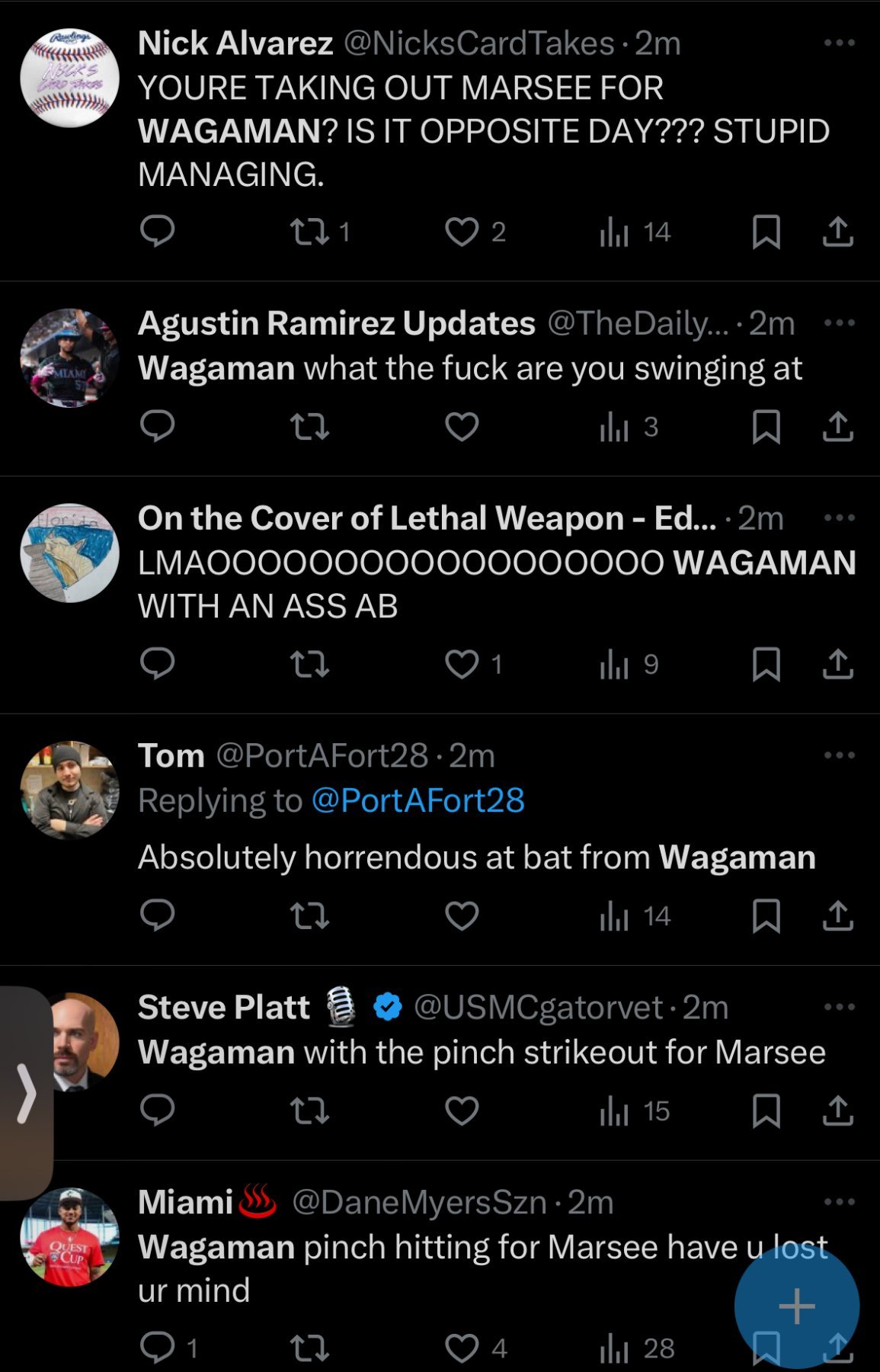
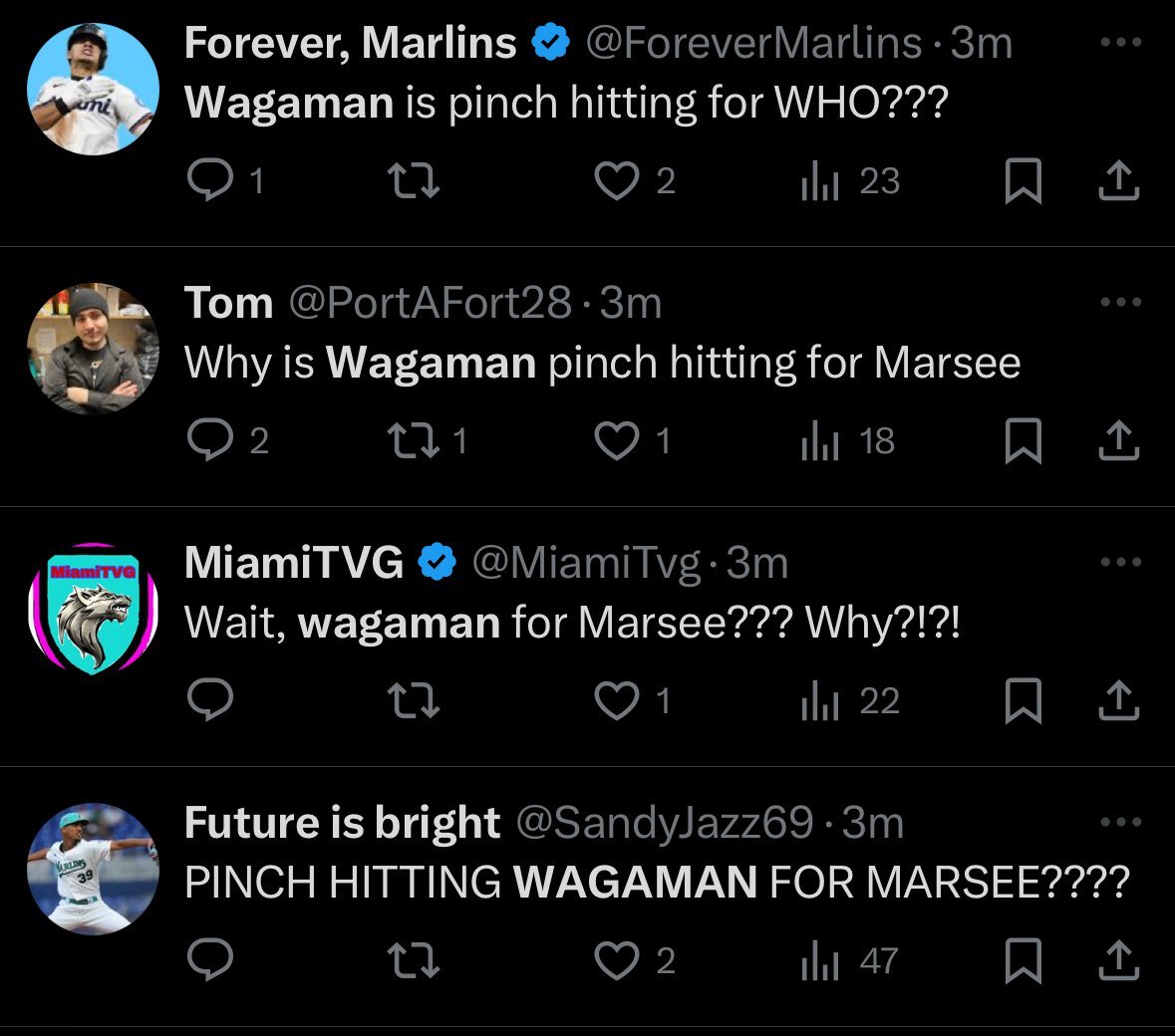
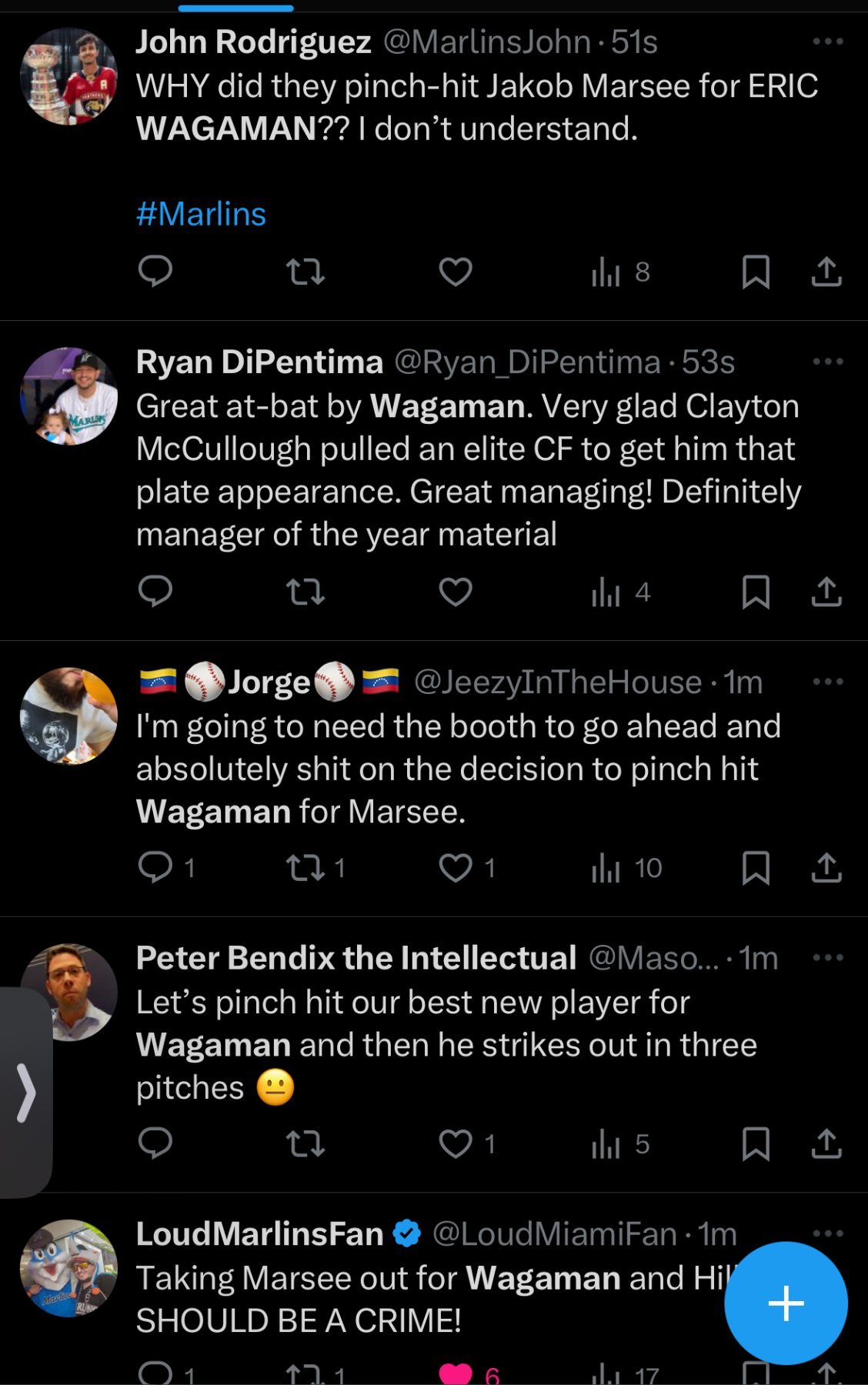
Watching Wagaman’s name in the lineup again and again makes his walk-up song, Kid Cudi’s “Alive (Nightmare)” feel incredibly appropriate and not just in title: you’re waiting for it to end, but it just drones on, hypnotic and surreal. There’s this strange tension where you half expect it to fade out… but it never does and, in this purgatory, I know that I’m not alone is constantly asking the question:
Does Wagaman have blackmail on the front office?
What do Bendix and McCullough see that we don’t?
We constantly see it thrown around that there are some vague statistical reasons why, despite his numerous shortcomings, Bendix views Wagaman as serviceable, but for those of us who haven’t wanted to spend any more time than we’re forced to paying attention to Eric Wagaman, digging deeper feels like a large undertaking. So I decided to take one for the team and spend 48 hours psychotically combing through his Baseball Reference, Savant, and FanGraphs pages to get to the bottom of it so that you don’t have to! If you’d rather skip all the math and get straight to the moral of the story, just scroll down to where it says TL;DR.
It’s not hard to understand what Wagaman offers: a low-cost, theoretically versatile corner bat. Hypothetically, this is the kind of player you keep around because he’s replaceable without being urgent to replace, but the results? Not so much. Over his last 30 games, he slashed .157/.255/.241- a steep fall from his overall .230/.281/.345 line this season. At some point, the theoretical value has to meet reality, and right now they’re on different planets.
The hard numbers:
He’s seen 1,544 pitches, 996 of which were strikes (~64.5%). Yet he swings at just 45.3% of pitches — a rate near MLB average.
His BB/K ratio stands at .30, meaning he strikes out over three times as often as he walks.
His called strike rate (cStr%) is 19.2%, higher than the MLB average (~16–17%), suggesting pitchers routinely freeze him in the zone.
Taken together, Wagaman isn’t passive in a strategic way- he’s just not taking advantage of hittable pitches. This often puts him behind in counts, which is one of the fastest ways to tank your offensive value. It’s the kind of “swing decision” problem player development departments talk about constantly, because you can’t fully unlock a hitter’s raw power if they’re giving away at-bats before they ever take a real hack.
But here’s why Bendix still keeps him around- and why it might make sense.
Statcast shows Wagaman’s average exit velocity is 90.6 mph, Hard-Hit% at 45%, and Barrel% around 6%- all indicators of quality contact. Plus, his xwOBA (.316) exceeds his actual wOBA (.272), implying poor results may be more about bad luck or sequencing than bad skill. To a front office built on analytics, that’s catnip. Those numbers whisper “hidden value” in the same way a promising stock chart does to an investor who thinks they’ve spotted an overlooked gem.
There’s also the platoon split: his wRC+ vs LHP is 94, but only 63 vs RHP. That screams “platoon option.” Add in his ability to cover 1B, 3B, and the corner outfield in an emergency, and he fits a certain archetype the Marlins have leaned on for years: inexpensive utility with upside. A bench bat who can give the regulars a breather, handle lefty starters, and maybe, just maybe, run into a ball for an extra-base hit. The big question is whether coaching tweaks can bridge the gap between his quality-of-contact metrics and his actual production. Better swing decisions could turn that 6% Barrel rate and 45% Hard-Hit into more consistent offensive value. If it happens, Bendix looks smart. If it doesn’t, Wagaman is easy to replace. There are many, many other statistics that can paint a fuller picture, but for brevity’s sake, these feel the most pertinent to me.
TL;DR
Bendix probably views Wagaman as a cheap, multi-position bat with undeniable hard-contact ability. His underlying numbers (average exit velocity, barrel rate, xwOBA) suggest upside, even if results lag. Strategically, he’s a platoon/bench piece whose true value depends on whether he can refine plate discipline and convert quality contact into real production.
How about that? Did that make you feel better?
Me neither. After all, Wagaman’s sample size is large enough that continued struggles hint at a limited ceiling- or reflect coaching shortcomings of which either option could sufficiently indicate that this situation is beyond saving.
The way I see it is that Eric Wagaman is 27 and on a one-year deal. He’s a low-risk depth play that buys time as younger prospects develop. As frustrating as it is, keeping him around until a Jacob Berry-type replacement is ripened might be the rational move for a rebuilding club, but adopting that mentality requires accepting that this team is not playoffs ready and, after all the excitement we’ve seen this year, that may be a tough pill for all of us to swallow.
Still, in the heart of baseball’s unpredictability? Well, he walked 3 times yesterday and that just might be what we need out of him. Stranger redemptions have happened.