
SURPRISE, Ariz. — Given their history at the position, this story starts with the obvious punch line: Over the last two years, the Texas Rangers have drafted a bunch of pitchers who can’t pitch.
But wait. It gets better.
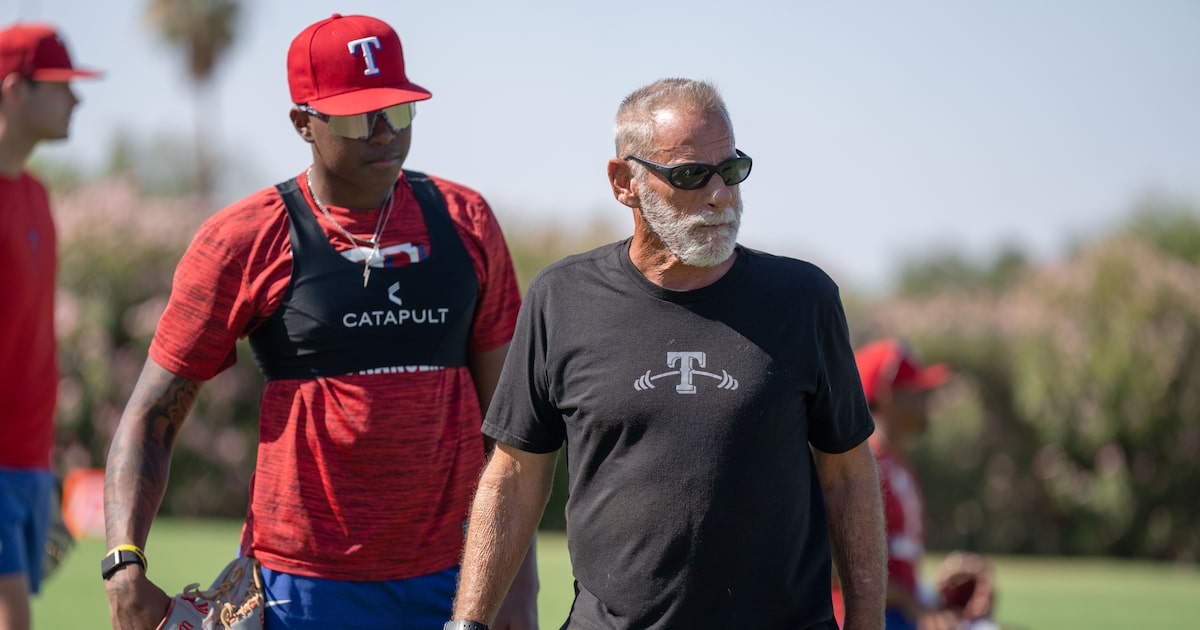
They did this partly so they could turn them all over to a gruff, wise-cracking, gimpy-walking, Red Bull-swilling soon-to-be 70-year-old whose legacy as a player is tied closely to his decision to pose for a baseball card that appeared to show him being hit by a ball in the testicles.
And you know what? It may just be a stroke of subtle brilliance that helps give them an edge in the lifeblood of an organization: Turning draft picks into outsized value.
Rangers
In other words, the Rangers are identifying hurt pitchers who may be undervalued by other organizations and drafting them. They are confident in a three-part program that helps them better evaluate and rehab the pitchers so that they come out of a year-long process as better prospects than before they got hurt.
So is the strategy to just draft a bunch of guys just off elbow surgery?
Well, not exactly. But they are opportunistic.
“It’s definitely part of our calculation on how we can create the best return on investment,” Rangers general manager Ross Fenstermaker said. “Between relationships and personnel we have, we feel we have a slight edge.
“We feel very confident that we can take a pitcher who has what was once seen as a career-derailer kind of injury and get that player back in an even better position to move forward.”
A three-pronged approach
The approach is three-pronged. It involves experience and stability. It begins with their 22-year association with world-renowned orthopedist and team physician, Arlington-based Dr. Keith Meister, who often gets to know the draftees at their most vulnerable moments, in the week after they saw their high school or college season end abruptly.
It is coordinated by vice president of performance Napoleon Pichardo, who helped create the club’s rehab department 20 years ago. And its face, voice and spikes on the ground of the Arizona desert is former journeyman big league pitcher Keith Comstock, affectionately known in the organization as “Commy,” who has been in his role 20 years with the Rangers and is in his 50th season in professional baseball.
It led them to take a pair of pitchers in the 2024 draft who’d recently had Tommy John surgery, didn’t pitch much of the season ahead of being drafted and were potentially undervalued by other organizations. It worked so well, the Rangers drafted three more rehabbers, Mason McConnaughey of Nebraska (fourth round), Ben Abeldt of McKinney and TCU (fifth) and Julius Sanchez of Illinois (19th), a month ago. All three are Meister patients.
It’s already netted real value. Two weeks after the most recent draft, the Rangers turned 2024 picks David Hagaman (fourth) and Garrett Horn (sixth), who had a total of 46 professional innings between them, into key pieces in trades that brought them veteran arms Merrill Kelly and Danny Coulombe for the playoff drive.
“The way we run things, we’re OK not having that player until the following year,” Pichardo said. “ I’m a little biased, but we can make the argument the development that player is going to get through the rehab process may be better than the development he would get as a healthy player.”
“It’s about creating a team”
Some of the planks of the rehab program are self-explanatory. A world-class surgeon to repair the ligament is essential. Physical therapists/medical personnel to oversee range of motion exercises and strengthening programs are necessary.
The “secret” to the Rangers’ program, though, is Comstock, a baseball lifer straight out of a “Bull Durham” casting call. He oversees the baseball aspect of rehab, which may seem a little unnecessary since most of these guys can’t throw for six months but is essential to keep them moving forward with a tedious process in which early progress is measured in the smallest of increments. Comstock has a saying for his rehabbers: The days are short, but the year is long.
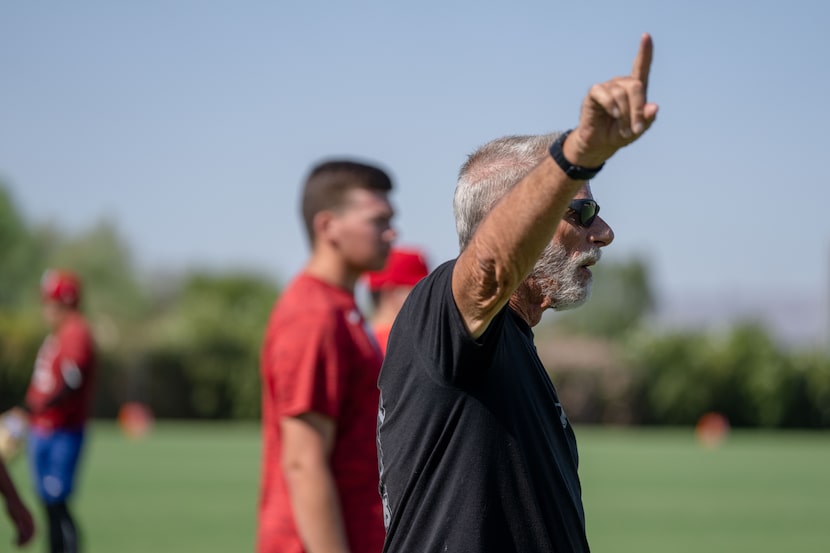
Rehab pitching coordinator Keith Comstock works with players at the Texas Rangers practice facility in Surprise, Arizona Friday August 8, 2025. The Rangers have bet big on rehabbing pitchers in the draft the last couple of years and there is reason to think they have identified a market inefficiency or the possibility of creating a competitive advantage with Keith Comstock, in his 50th year in baseball running the rehab program for the last 19 years.
Laura Segall / The Dallas Morning News
“I’ve seen so many guys go into a program like this down and out and in their own bubbles,” said Rangers mental performance coach James Jones, who spent two years in the majors and two tours of the rehab program when he tried to transition to pitching. “Guys come in just wanting to count down the days until they are back in uniform. What Commy does is bring the idea of a team structure to the whole program and makes everybody feel like a team. He pays attention to the smallest details. He transforms you from the inside out.”
He’s seen a lot since he was drafted in 1976 by the California Angels. He pitched for seven organizations in the states and spent two other seasons in Japan. He didn’t make his major league debut until eight years in when, at age 28, he found himself teammates in Minnesota with a utility infielder named Ron Washington. Four years later, trying to hang on, he ended up with Las Vegas of the San Diego organization, occasionally pitching to another journeyman, 33-year-old catcher/unofficial coach Bruce Bochy in his final playing season.
Comstock was once sold by Oakland to Detroit for $100, a typical minor league transaction price in those days. Separately, the Tigers asked to see some yellow baseballs that Oakland had been experimenting with. Comstock delivered a dozen of them when he arrived. In his telling: He was traded for $100 and a bag of balls. MLB.com ranked it one of the eight strangest trades of all-time.
In that 1988 season alone, he was so bored with minor league baseball card photo poses, he convinced a photographer to take his shot with a baseball super-glued to his pants as if he just took a line drive to the groin. The pose even included his best pained grimace. If you can find an original version of the card now, it goes for about $500.
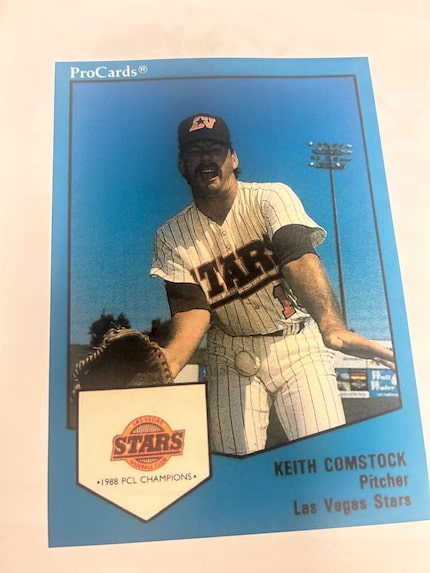
Keith Comstock’s 1988 minor league baseball card featured a posed photo, where it appears a baseball hits the pitcher in the groin.
Courtesy/Keith Comstock / Courtesy/Keith Comstock
Later that same season, on the day he was released, he convinced team management to let him play the Vegas’ mascot, Star Man, for the game. Then he found a go-cart tricked out to look like an F1 racer.
Things went about as you would expect.
Comstock convinced his former teammates to tape his hands to the wheels because the bulky mascot’s suit made it too difficult for him to hold the wheel on his own. He sped onto the field between innings. The car spun out and started to tip before it became kind of wedged on a ramp near the bullpen. His teammates cut off the tape and out jumped Star Man to the wildest pop a player-turned-mascot has ever received.
Great memories, sure. But where he found his real calling came a decade after he got into coaching when he noticed players off on the horizon at minor league camp, doing everything in solitude. When told it was the rehab group, an idea sprung to mind. They needed to have baseball in their heads, even when they couldn’t throw a ball. He mentioned it to a friend, Scott Servais, one day. Servais was just starting as the Rangers’ director of player development under a young GM named Jon Daniels. It didn’t take long for everybody to be sold on the idea. He joined the Rangers in 2006 and has run the rehab program out in the desert ever since.
“I just made the connection that rehab is player development,” Comstock said. “It had never really hit me before.”
The first step was to turn them into a team. It was his idea that all the rehabbers wear red T-shirts, something to separate them. It was part to create an identity and part to make sure coaches didn’t push a kid into drills in which he wasn’t cleared to participate. After that, it was just baseball and relationships. Or maybe the other way around. Either way, depending on the injury, it gave him up to 15 months to work with kids, many of whom were still teenagers, living on their own for the first time. As much as they needed treatment, they needed structure even more. He brought an old-school mentality to a new-school process.
“For 14 months [of rehab], they’ve been part of a team,” Comstock said. “Now, they just go to another team and fit right in. It’s about creating a team instead of just being a bunch of individuals.”
They may not be able to throw, but they can work on fundamentals and stoke competitiveness. Mornings on the field begin with a pretty spirited round of hackysack. Most workouts end with a round of fielding practice; pitchers may not be able to throw, but they can field grounders. Players have to watch a certain number of Arizona Complex League games together to keep them engaged in baseball. When pitchers are able to progress to throwing, Comstock acts as a pitching coach, too. It’s not merely a medical process.
Players who have to stay through the loneliest period of October and December when there is nobody else on the spring training campus become part of his “Winter Warriors,” an even more elite team of what he calls his Navy SEALS. They’ll all hike up Camelback Mountain before they go home for a holiday break.
Maybe most importantly, he listens when players need to talk.
“What he does is unique and special,” Jones said. “He takes on a father role, too.”
Initiation Day
Barely three weeks ago, Comstock welcomed the three new draftees to the rehab team – currently 23 players strong with seven elbow surgery rehabbers among them – with what he calls “Initiation Day.”
In front of the new players stood the rest of the group, which included Marc Church, who spent the first month of the season in the majors before an oblique injury; Emiliano Teodo and Winston Santos, who both participated in the All-Star Futures game in 2024 before back injuries set them back this season; and Izack Tiger, who underwent the elbow procedure last September and was within a month of returning to the mound.
A military buff, Comstock rolled out his best profanity-spewing-drill sergeant routine as he marched back and forth favoring his balky right knee for a couple of minutes before welcoming them warmly into the group.
“It gets you into panic mode real quick, but then they all engulf you and embrace you with this warm welcome,” said Abeldt, who is scheduled to start playing catch next week for the first time in six months since his February surgery. “It’s been a very welcoming process, but, like Commy says, he wants to help you build elephant skin.”
Said McConnaughey, a month behind Abeldt in his program: “You become vulnerable up there for two or three minutes. People can see how you react. But at the same time, everybody’s gone through it. By the end of the day, everybody is just closer.”
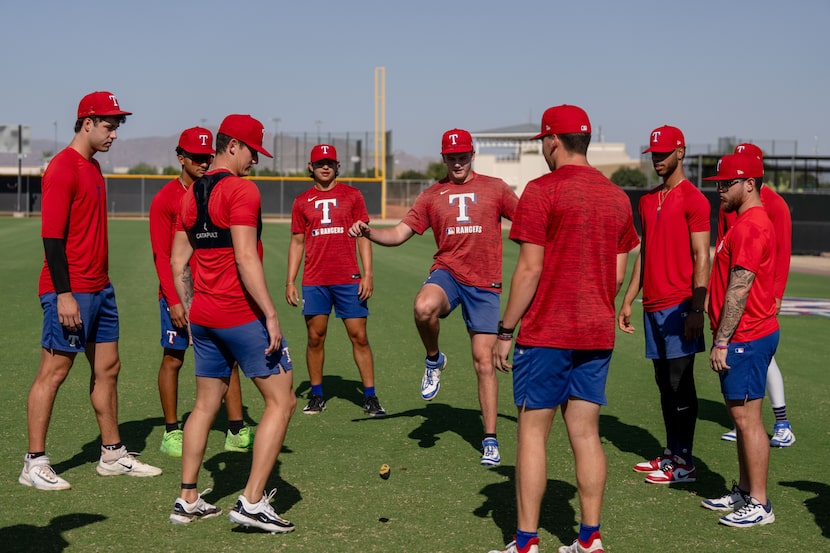
Texas Rangers play hacky sack at the practice facility in Surprise, Arizona Friday August 8, 2025. The Rangers have bet big on rehabbing pitchers in the draft the last couple of years and there is reason to think they have identified a market inefficiency or the possibility of creating a competitive advantage with Keith Comstock, in his 50th year in baseball running the rehab program for the last 19 years.
Laura Segall / The Dallas Morning News
Comstock came up with the bit, he said, in his garage one day early on in his tenure, drinking a beer and watching baseball. He wanted something else to help galvanize the group as special.
“I wanted to let them know that they were coming into an elite squad,” Comstock said. “There is an initiation process for those when they enter. There’s one when they graduate and go to blue [healthy campers wear blue tops]. I wanted them to understand this was special.
“I don’t want one sunken head coming into rehab. No one is allowed to do that. You come here, it’s all about the next year. It’s all about getting ready. We have to hit the road running in rehab. You’ve been passed up. People have leap-frogged you. But we will outwork them in the winter. We will be ready for spring training. And we will make an impression in spring training when the higher-ups come out. I always tell the front office, we’re like the kitchen in a hotel. Nobody wants to see what goes on in there; they just want to see what comes out.”
Nobody is immune to the rituals of rehab. Each morning before the workouts begin, Comstock gathers his on-field staff for Red Bull shots to start the day. A reporter comes through. He’s handed one, too. You come to rehab, you are part of rehab. Then he asks the rehabbers to welcome the visitor with the camp hymn. On cue, the rehabbers shout: “Him. Him.” Then an expletive “him.”
Even a cynical journalist can’t help but chuckle.
“He commands a large level of respect and seriousness, but he will keep it as light as it comes,” Pichardo said. “It’s not just with words, but actions. You know if the guy is giving me crap, he’s giving me crap because he cares. He’s watching and working and it’s such a welcoming environment. He puts checks and balances on things for us and it just allows for growth and success right away, even if they aren’t able to pitch at the moment.”
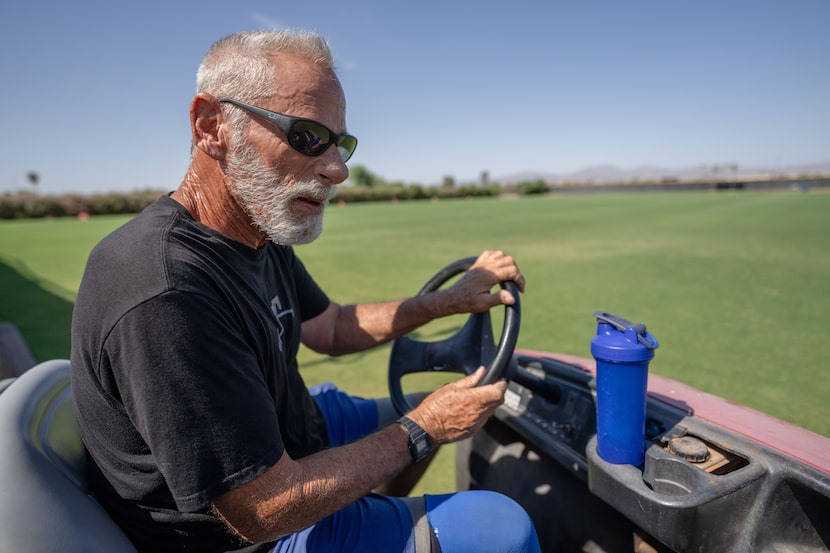
Rehab pitching coordinator Keith Comstock drives a golf cart at the Texas Rangers practice facility in Surprise, Arizona Friday August 8, 2025. The Rangers have bet big on rehabbing pitchers in the draft the last couple of years and there is reason to think they have identified a market inefficiency or the possibility of creating a competitive advantage with Keith Comstock, in his 50th year in baseball running the rehab program for the last 19 years.
Laura Segall / The Dallas Morning News
Good soldiers just fade away
Now the question becomes: How long can the Rangers enjoy this little edge on the margins of building an organization?
Comstock turns 70 in December. Just in the last five years, he’d endured kidney cancer, a hip replacement, dealt with a double hernia and helped nurse his then 32-year-old daughter back from a stroke. His knee is perpetually gimpy, giving him the gait of an old gunslinger as he trudges around camp. It was so pronounced this spring that his old teammate, Bochy, kidded him about it.
Comstock’s retort: “You want to race? I’ve seen you walk to the mound. Takes you four minutes.”
And in retelling the story to a visitor, he adds: “We had a brawl in Edmonton. The bullpen got to the mound before he did. And he was behind the plate.”
He can banter with the best.
Comstock had said this past spring that this would be his 50th and final year in baseball. Rangers officials have heard the same story for the last five years. And usually it ends the same way, with Comstock walking back the idea after he’s been around another season of rehabbers.
“I’m a big military guy and General MacArthur said: ‘Good soldiers just fade away,’” Comstock said. “Part of me just wants to be a good soldier and just fade away. But I also believe that there’s an importance for a gray-haired guy in this clubhouse. Part of what’s important is wisdom that needs to get passed on. You can’t keep it to yourself and say: ‘I’m out. I’m just gonna walk away.’
“I just don’t think I want to walk away quite yet.”
The Rangers couldn’t be happier to hear those words.
Texas Rangers running out of runway for a playoff push after latest gut punch lossRangers fall back to .500 after Phil Maton’s ninth-inning meltdown costs them vs. Arizona
Find more Rangers coverage from The Dallas Morning News here.
Click or tap here to sign up for our Rangers newsletter.