
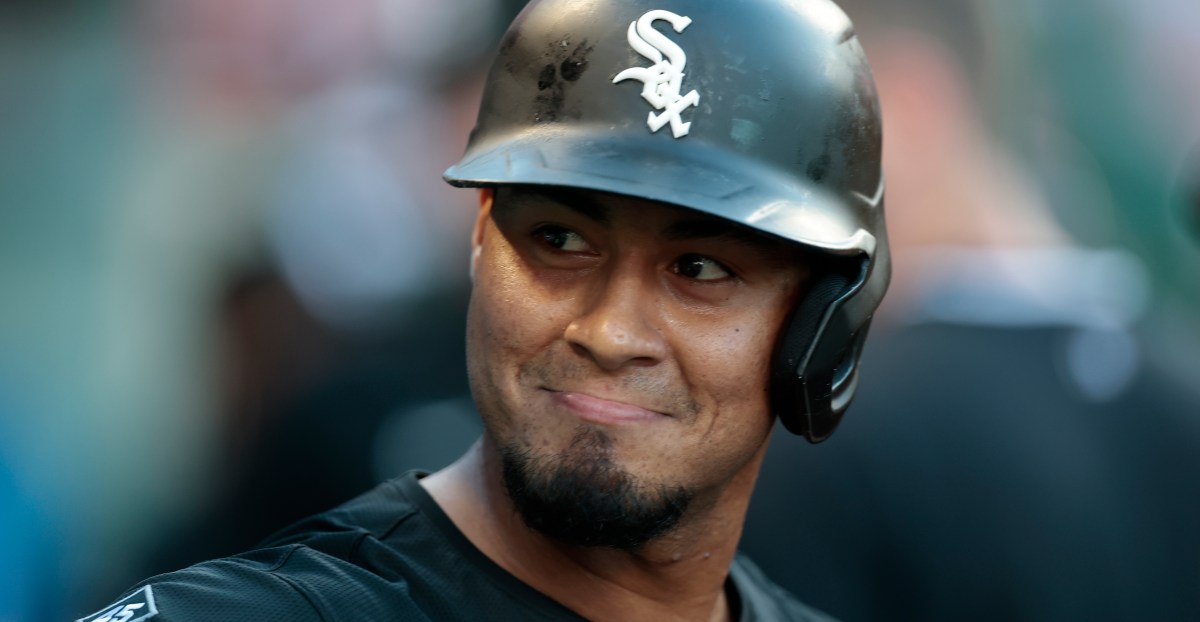
Call it “The Curse of Gordon Beckham,” because Beckham is still the last person to hold the starting second base job for consecutive seasons.
Here are the 10 seasons since Beckham and his good baseball face transitioned to a utility role in 2015:
2015: Yolmer Sánchez
2016: Brett Lawrie
2017: Yolmer Sánchez
2018: Yoán Moncada
2019: Yolmer Sánchez
2020: Nick Madrigal
2021: César Hernández
2022: Josh Harrison
2023: Elvis Andrus
2024: Nicky Lopez
There are two obvious takeaways from this list: 1) Yolmer Sánchez is more resilient than a cockroach stuffed inside a Twinkie and 2) The keystone position at 35th and Shields has been a revolving door of guys who either fell short of expectations or were just trying to hang on for their 10 years of service time.
I come before the SSS readership today to announce that our long local nightmare — or, at least this particular one — is finally over. Sweet-swingin’ Lenyn Sosa is a certified Dude. I anoint him the long-term answer at second base. Long may he reign.
What about Meidroth?
Before I start talking Sosa, lets address the Chase Meidroth of it all. Meidroth was tabbed as a second baseman when he came to the Pale Hose in the Garrett Crochet deal in the offseason. According to FanGraphs, Meidroth projected as a fringe second baseman out of college with real concerns about his ability to stay anywhere in the infield. He worked hard at it once he was drafted, however, and became a solid fielder.
By April of this year, the FanGraphs guys believed he could be a spot starter at shortstop in the majors. Meidroth has clearly made another leap this season; Baseball Savant currently has Meidroth fielding 3 OAA (Outs Above Average) at shortstop, a much more important position than second base. Now that we’ve seen Colson Montgomery look comfortable at the hot corner, Meidroth should be considered the starting shortstop for 2026. He’s too good NOT to be.
That’s not to say that Sosa is a charity case at second base. Sosa’s glove has not done damage to the White Sox this season. His OAA is a, nice round zero. Among guys with at least 500 innings at second base this season, Sosa is tied for 8th out of 19 — perfectly pedestrian.
All you can ask from the guy playing your least impactful infield position is that he outhit his glove. That has not been an issue for Lenyn the Launcher. FYI — I will keep trying nicknames until one of them sticks. Yes, that is a threat.
Nobody launches it like Shotgun Sosa
(Because the ball sounds like a shotgun off his bat)
(No bad ideas in a brainstorm)
Sosa has my favorite Savant page of anyone on the White Sox. Nobody in the entire league approaches hitting with his particular skill set. He has a mixture of pitch recognition, timing and bat-to-ball skills that allows him to be aggressive and occasionally bordering on reckless.
Here is Sosa’s 2025 Savant page:

At a glance, you can tell that this is a weird page. Sosa’s walk and chase rates look disastrous. And they would be, except for his whiff percentage, which is in the top half of the league. Swinging and missing at a 23% rate at an “elite” volume of swings is real superfreak shit.
Here are the bottom 14 in chase percentage:

And here is that same group ranked by contact made on pitches swung at outside the zone:

If you’ve watched a lot of White Sox broadcasts, you probably know that Lenyn Sosa is leading the league in hits when the count is 0-2. These metrics show us why. The metrics also slander Pete Crow-Armstrong, which is incidental to this exercise but also really fun to learn.
First-pitch approach
OK, so Sosa is good enough to get away with swings at pitches out of the zone. Don’t these numbers show that Sosa is a man without a plan at the plate, just hoping to run into a ball by chance?
Goddamn, you have a lot of questions. Well listen here, Mr. or Mrs. Smarty Pants! Lenyn Sosa may a free-swinger, but he does have a plan.
It starts with the first pitch:

Sosa’s leading the bottom-five percentile chase group in first-pitch takes and it’s not even close. He’s in the 74th percentile league-wide. Going off his year-by-year progression, Sosa has made a point every season to lay off the first pitch of an at-bat more than he did the year before:

Pitchers know this tendency, so they’re throwing meatball in the zone to go up 0-1. I think Sosa WANTS this. It gives him something more valuable than a favorable count; he gets to time up the pitcher in the strike zone.
Let’s go pitch-by-pitch on two home runs Sosa hit at the turn of the month (note, I am so fired up about Sosa that this article was first written before the Seattle series began):

In his first at-bat against Tyler Anderson on August 1, Sosa took a first-pitch fastball down and away for a strike. It was a meaty pitch, too; Sosa handles down-and-out very well when it’s not located on the black, as it was in this case. Look at his batting average on pitches in that area (yellow square):

Sosa took the next two pitches for balls: a fastball wide and a changeup inside. Anderson followed with a high fastball/low changeup/high fastball sequence meant to disrupt Sosa’s timing. Swiss Watch Sosa, reliable like a Rolex, met each pitch where it was and fouled it off.
Now seven pitches into the at-bat, Anderson tries to blow a high fastball past him. Sosa had seen enough.
This process was much more efficient on July 29 against the Phillies:

Daniel Robert comes in to start the inning, Sosa takes one sweeper, gets the timing down, and bashes the second one.
Both home runs give us an insight in Sosa’s philosophy. Let him see it once, and he’ll hit it next time its within reach.
Why Take a Walk When You Can Just Hit It Hard?
Sosa has more going for him once he puts bat onto ball. For one, Sosa has elite launch angle metrics. You can see that he’s in the 90th percentile this year for Launch Angle sweet spot %, which Savant defines as between 8 and 32 degrees. Even crazier, Sosa has regressed from 2024, when he was in the top 1%.
Sosa’s ability to keep his bat on plane for optimal launch angle is the main reason he is in the top one-fourth of all players in both xBA and xSLG despite average bat speed, hard-hit and barrel percentages. Sosa doesn’t need to swing hard to launch a ball. This swing profile should age more gracefully than a bat speed savant like, say, Colson Montgomery. Age can take your hand speed, but it can’t ruin your mechanics.
In the two graphs below, you can see every season Sosa has played from 2022-25, along with his career totals (dark grey) and this year’s MLB average (lighter grey). The launch angle numbers correlate to his line-drive percentage, which is currently 6.3% better than average (!).
Some of these other numbers are incredible: Sosa is getting the ground balls out of his game (30.3 GB% compared to 44.3% league-wide) while getting the ball in the air way, way more than league average (69.7% compared to 55.7%), albeit with a slightly elevated pop-up percentage of 9.1% (league average 7.1%).

Most importantly, Sosa is getting ahead of fastballs enough that his pull AIR % is now well better than league average at 19.9% of all balls put in play, despite mediocre swing speeds.

Baseball Savant has a cool little feature that I do not totally understand, but I trust it without reservation nonetheless, as it will give you player comparisons based on a player’s hitting profile.
Here are the five guys most comparable to Sosa when I initially wrote this article on August 3:
Jordan Westburg (.262/.307/.464)
Andy Pages (.280/.323/.462)
Brandon Lowe (.276/.325/.499)
Paul Goldschmidt (.276/.331/.422)
Comparisons to Paul Goldschmidt in 2025 aren’t as exciting as they would have been in, say, 2017. Still, Sosa can count himself in good company with above-average big-leaguers. Sosa provides solid first baseman production at a middle infield position. With one more year of control before arbitration, Sosa is a good asset for now and will be the best long-term answer at second base.
Rest easy, Gordon. Your ghost no longer must haunt the South Side infield.