
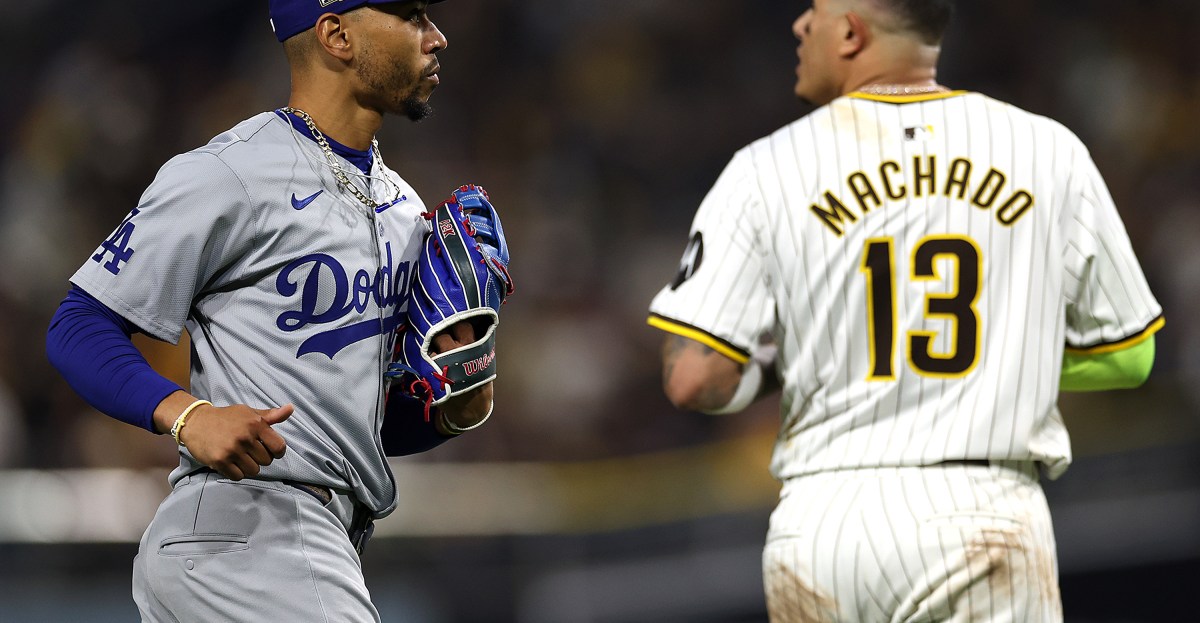
The last time the Dodgers and Padres played each other, both managers wanted to fight each other. Now, the Los Angeles is looking up at San Diego in the standings heading into this weekend’s three-game series at Dodger Stadium.
It’s a battle between the two best teams in the National League West, though the Dodgers haven’t been playing anywhere near that level for a month and a half. Four straight losses coupled with four straight Padres wins have San Diego up by a game in the division, the first time the Dodgers have trailed since April 27.
An actual Dodgers-Padres rivalry is a relatively recent phenomenon, because they’ve rarely both been good at the same time.
San Diego had catching up to do as an expansion team in 1969, and they were mostly awful for their first two decades of existence. The Padres did not finish higher than fourth place in a six-team division for their first 15 seasons, before winning the National League pennant in 1984. The Dodgers that year were also-rans at 79-83.
The Dodgers and Padres have finished 1-2 in some order in the NL West only five times, and three of those came in the last five seasons.
It took all the way until 1996 until Dodgers vs. Padres had any real stakes, and even then was marred by the unintended consequences of adding new playoff teams. The Dodgers had a two-game lead over the Padres before getting swept at home at Dodger Stadium to give the Padres the division. Former Dodger Chris Gwynn delivered the big blow in the division-clinching Sunday win.
But this was the second year of a wild card team in each league, which loomed over the weekend. In reality, the Dodgers clinched their playoff spot on Friday night, when the Expos lost, and the Padres earned a postseason berth on Saturday.
Instead of a win-or-go-home game for the division, Sunday was mostly for seeding.
“You just knew when they invented the wild card that something weird would come up,” Dodgers pitcher Tom Candiotti told the Los Angeles Times. “And here it is. This is as weird as you can get.”
Instead of Ramón Martínez making a normal start on Sunday with the division on the line, the Dodgers had Martínez go only one inning as a tuneup for his NLDS Game 1 start three days later. Pedro Astacio followed with 6?
? innings and the game was scoreless until Gwynn doubled home two runs in the 11th against his former team.
Both teams were swept in the NLDS, the Dodgers by the Braves and the Padres by the Cardinals.
4+1 , and another wild ride
Ten years later, the Dodgers and Padres were back at it, with a division race that is most remembered for the Dodgers hitting four consecutive home runs in the ninth inning against the Padres, then winning in the 10th inning on a Nomar Garciaparra walk-off home run.
That win put the Dodgers in first place by a half-game, but there were still 13 days remaining in the season. And even with the loss, the Padres were 13-5 against the Dodgers that season, which earned them the tiebreaker.
San Diego reclaimed first place the very next day, and never looked back. But it wasn’t for lack of trying by the Dodgers, who were 9-3 after the 4+1 game, including winning their last seven games. Their win on Saturday, September 30 in San Francisco — the penultimate day of the season — clinched a wild card berth for Los Angeles.
Both the Padres and Dodgers finished 88-74, with San Diego winning the division due to head-to-head record.
Like a decade earlier, both teams were ousted in the NLDS. The Dodgers were swept by the Mets, while the Padres took a game off the Cardinals.
Aside from 1996 and 2006, the Dodgers and Padres never really matched up their competitive seasons in their first 52 years as divisional mates. There were a few situations when one of them finished first and the other was in third place — 1985 and 1987 were Dodgers years, and 1998 for the Padres — but the other team was double-digit games behind, mere specs in the rearview mirror.
But for the bulk of now six years running, the Dodgers and Padres have been largely operating in the same arena. There are even more wild card teams now but there have been actual stakes in these recent Dodgers-Padres tilts, buoyed by the fact they’ve also done battle in the postseason in three of the last five seasons.

MLB Photos via Getty Images
In 2020 the Dodgers ran roughshod through the league, finishing 43-17 in the truncated season. The Padres at 37-23 had the third-best record and second-best run differential in the majors. The Dodgers swept the Padres in the NLDS in three games, in their first-ever playoff meeting. Game 1 was close until the sixth, then the Dodgers had to hold on to win Game 2, highlighted by Cody Bellinger’s catch to rob a home run from Fernando Tatis Jr.
Game 3 was a 12-3 rout, and the Dodgers later won the World Series.
Two years later, the Dodgers reached their regular-season peak with 111 wins, the most by a National League team since the 1906 Cubs. That earned Los Angeles another NLDS matchup with the second-place, 89-win Padres.
The Dodgers scored the first five runs of Game 1, which was enough to win the opener. But they scored only seven runs over the final 32 innings and went 5-for-34 (.147) with runners in scoring position for the series. The Padres won the next three games by two, one, and two runs, and advanced to their third NLCS in franchise history.
Last year the two teams were in a legitimate divisional race, and both teams finished with 90-plus wins for only the second time (1996 was the first instance, with the 91-win Padres taking the division over the 90-win Dodgers).
They met for three games in the final week of the regular season to decide the division. The Dodgers had the upper hand, but a loss in the series opener cut the distance between the two teams to just two games. Los Angeles prevailed in the final two games and the Dodgers were able to celebrate at home, but that was only the beginning of their 2024 story.
The Padres scored three runs in the first inning of Game 1 of the NLDS, which was somewhat triggering at Dodger Stadium after the Dodgers’ 2022 NLDS loss to the Padres followed by their 2023 NLDS sweep at the hands of the D-backs. This time, however, the Dodgers fought back to win Game 1, but still managed to drop the next two games, with time for an overblown manufactured “controversy” of a Manny Machado throw near the Dodgers dugout in between.
Staring down an elimination game on the road and the possibility of a third consecutive early exit, the Dodgers simply stopped permitting runs to the Padres, to keep their season alive. A bullpen game put up zeroes in San Diego in Game 4, then Yoshinobu Yamamoto and pals shut out the Padres in Game 5 back in Los Angeles. The Padres did not score over the final 24 innings of the series.
This was the ultimate in the Dodgers-Padres rivalry, in that both teams were very good — the Dodgers at multiple times over the next few months would say San Diego was their toughest opponent en route to a championship — and their late-season and postseason battles featured compelling games. This is what makes a rivalry.
The two best teams in the NL West this year are playing each other for two weekends in a row, which should make for some interesting theater. Or at the very least set the tone for their inevitable rematch this October.