
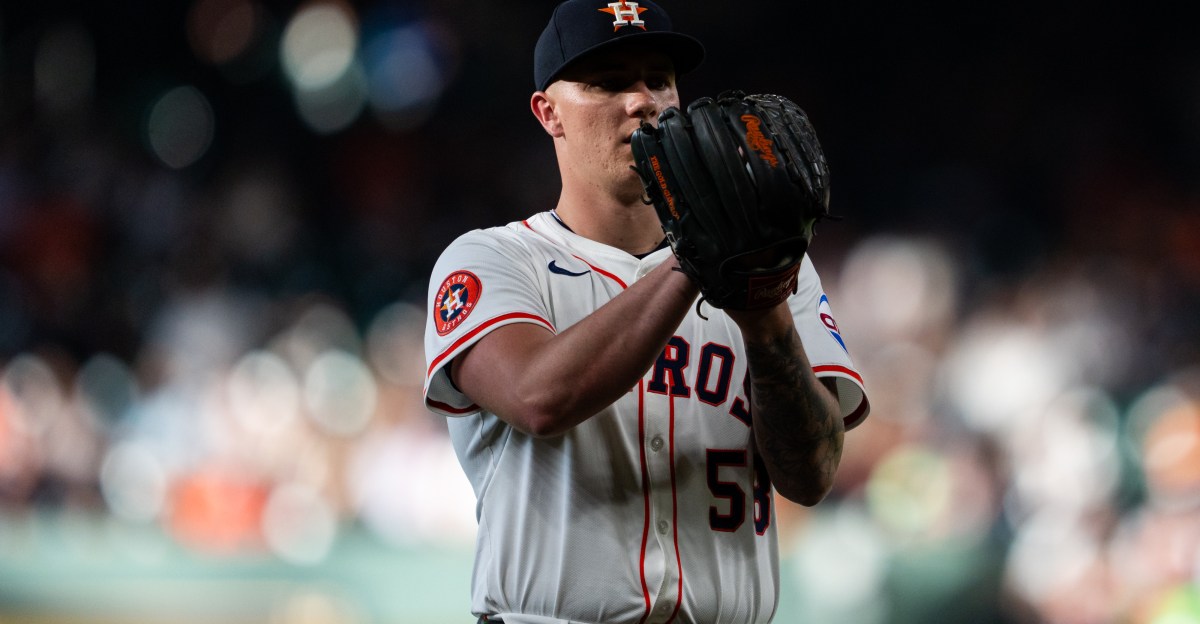

Aug 13, 2025; Houston, Texas, USA; Houston Astros starting pitcher Hunter Brown (58) walks from the bullpen to the dugout before pitching against the Boston Red Sox at Daikin Park. Mandatory Credit: Thomas Shea-Imagn Images Thomas Shea-Imagn Images
Hunter Brown gave the Astros a gritty start against the Red Sox this week. Perhaps he didn’t have his best command of all his pitches. But he adjusted during the game. His fastball usually is viewed as his best pitch, but the Red Sox were hunting fastballs…and his command of the fastball wasn’t at its best. He adjusted by throwing more breaking pitches in fastball counts. Afterwards, several articles mentioned that Brown is reinforcing his candidacy for a Cy Young Award.
But how likely is Brown to win a Cy Young Award? It’s too early to give a definitive answer. I think Brown will be in the Cy Young conversation; his performance has been that dominant. However, he will need a renewed and improved performance in the final month and a half of the season to surpass some of the competitors for the award. To evaluate where he stands, we can look at the Fangraphs Cy Young Award tracker. This model has been pretty good at predicting top CYA vote getters. Of course, voters may look at different stats to inform their decision, and the model allows y0u to look at various individual statistical approaches. In recent years, the FIP based method probably should receive more weight than it has in earlier years. The current status of AL pitchers for the AL CYA based on performance to day is shown below.

Hunter is third ranked behind Tarik Skubal and Garrett Crochet —no matter whether you rely upon actual stats or the projected stats for the year. Although only the actual stats to date are shown above, I have ordered the projected winners based on actual plus projected rest of year stats. For the top three candidates, the use of projected data doesn’t change the order, nor does a preference for FIP or RA9 change the result. Basically Brown, Skubal, and Crochet are the clear top three candidates.
Interestingly Framber Valdez is also a top candidate whose ranking depends on whether FIP or RA9 is given emphasis. Valdez is projected as 4th ranked for CYA if projected FIP is utilized. However, if actual FIP or projected RA9 is used, Valdez and Eovaldi change positions, with Valdez at 5th. Overall it appears that that the Astros have a chance at putting two pitchers in the Top 5 for AL CYA. That is a pretty unusual feat, and I’m not sure whether it alters the probability for either candidate. It’s possible that voters are less likely to rank both pitchers that high, meaning that Valdez could take votes away from Brown or vice versa. Eovaldi and deGrom are the only other two pitchers from the same team (Rangers) who appear on this top 10.
Despite the rankings above, Brown will need to shake off his somewhat sub-par performance over the previous month and a half. Since July 1 Brown’s ERA is 4.00 and his FIP is 3.35. His performance against the Red Sox perhaps is an indication that he is breaking out of that mini-slump.
I tried to think of a 20th century Astros pitcher whose pitching style is most similar to Hunter Brown. I used the Bill James / Rob Neyer Guide to Pitchers as a reference. The book is an amazing compilation of pitching repertoires of 20th century pitchers. Just for fun, here is a passage from the book for the selected Astros pitcher. Try to guess who it is. The answer is at the end of the article.
Repertoire: 1. Fastball—2 seam and 4 seam 2. Slider 3. Change up. 4. Curveball
Initially he threw a fork ball as his change up. But after he injured his finger playing basketball, he shifted to a more standard change up to use against LHB and RHB. He says that he would use the early stage of the game to determine whether the 4 seam or 2 seam FB was more effective, and then lean heavily on that fastball. If it turns out that both versions of the fastball were really good, he would pitch with just a 4 seamer and 2 seamer, with few sliders or change ups needed, for the remainder of the game.
Fangraphs shows the PitchBot and Stuff+ pitching models, which measure the quality of pitches based on physical parameters like velocity, location, and movement. The pitching models are also capable of providing useful information in small samples. I will look at the stuff-based results since July 1. This provides us information on recent pitch quality, as well as results for starting pitchers who have only pitched 1 game so far.
So, let’s look at the Stuff+ since July 1 for Astros pitchers. Stuff+ is based on a rating above and below 100, with 100 as average. Pitching+ is a combination of Stuff+ and Location+. Since Location+ is roughly a measure of “command,” Pitching+ indicates whether the command improved or detracted from the raw stuff.
Blubaugh’s recent outing against the Marlins was terrific. It’s one game, but Stuff+ views both his stuff and location as spectacular. That small sample gave him the top stuff ranking among Astros’ pitchers—right up there in Josh Hader range. Sure, his Pitching+ probably will decline after more appearances, but this substantiates my view that Blubaugh could provide high leverage support for the bullpen, given Hader’s recent injury.
Over the last month and a half, Framber Valdez’s stuff and location has been better than Brown. Brown’s Stuff+ is still fine over this period, but his Stuff+ rating has declined compared to earlier in the season.
Looking at the bullpen, both Okert and Abreu have pitched with excellent stuff in this recent period. However, both have exhibited below average Location+ (in the 90’s). Sousa’s Stuff+ has been nearly as good as Okert and Abreu, but his 95 Location+ indicates that command isn’t always great. Okert, Abreu, and Sousa have exhibited the stuff you want in high leverage situations, but lapses in command can be an issue. King’s Stuff+ is not very good (91) but he has exhibited very good command (111 Location+). Ort has exhibited decent stuff, but his location is very problematic.
We can also see the early small sample results from the returning injured starters. Arrighetti’s Stuff+ was pretty good, which is encouraging. But his command was a problem (93 Location+). If he can improve his command in his next start, Arrighetti will likely see better results. Javier’s first returning start was pretty good. His stuff has a ways to go (91 Stuff+) but his command was good, making his start average to above average. Dubin’s numbers are in a very tiny sample, so take it with a grain of salt. But his Stuff+ was not encouraging, and the location was even worse.
Of course, we are hoping for improved command and stuff for all of the Astros pitchers’ prospective appearances.
Larry Dierker, an excellent starting pitcher in the 60s and 70s followed by stints as an Astros’ broadcaster and Astros’ manager. At 6-4, 215, Dierker had a similar build to Hunter Brown. He pitched over 2,300 innings in the major leagues. When I was growing up, I liked reading a lot of the baseball and sports magazines, and they sometimes included articles about Dierker. As I recall those articles, opposing hitters said that Dierker’s “rising” fastball was tough to deal with, and practically unhittable at the top of the strike zone. That’s my main reason for comparing Dierker to Brown. Also they have a similar mix of pitches which they can adjust from game to game.