
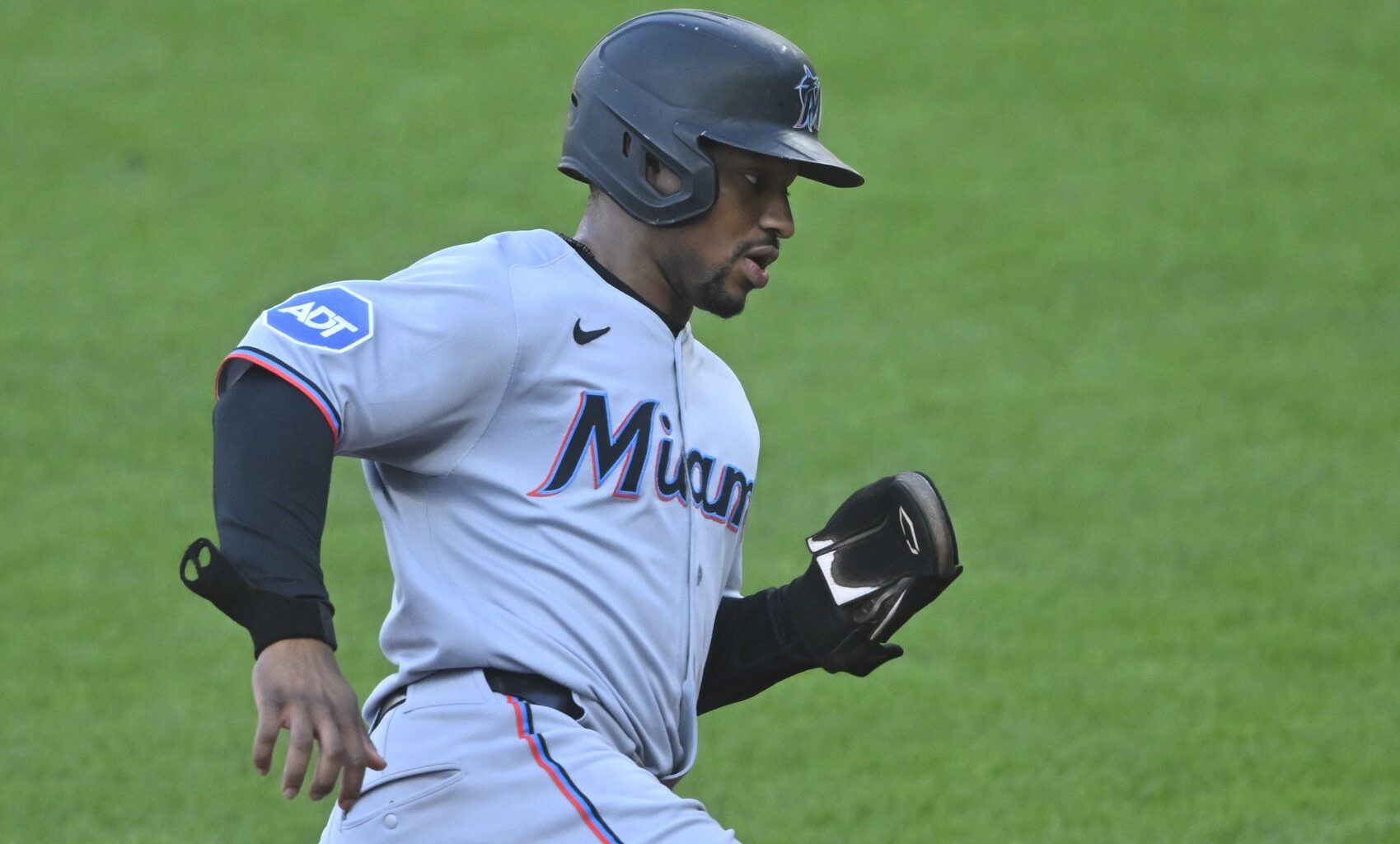
A core philosophical tenet of mine is that we’re all capable of change. It does a disservice to the willpower and intellectual capacity of human beings to assume their present flaws will continue to define them.
That applies to baseball as well and specifically my views on Xavier Edwards, the ballplayer. As recently as late May, I was under the impression that Edwards was an overall liability to Miami’s competitive aspirations.
Over his first 42 games played this season before a mid-back injury sent him to the injured list, Edwards’ 79 wRC+ and .292 SLG ranked 23rd and 24th, respectively, among the 24 hitters with at least 190 plate appearances to that point in the season. The latter figure was not particularly surprisingly considering his minor league track record—the short switch-hitter had homered in only .68% of his MiLB plate appearances.
One could look past Edwards’ lack of power when he was running better-than-average strikeout and walk rates with 70-grade speed.
Where I really took umbrage with Edwards’ game was on defense. While primarily a second baseman in the minors, Edwards began auditioning at shortstop during Miami’s 100-loss 2024. With the presumption that the 2025 season would also prioritize development over competitiveness, he was basically awarded the job entering the new year.
Even in a time when the noun “Marlins” and adjective “competitive” are used in the same sentence, which would generally be accompanied by a “not” somewhere in there, the sheer idea of Edwards, someone noted for a below-average throwing arm, as a shortstop would be all the nightmare fuel for fans of defensive metrics, traditional and advanced.
And, well, the numbers pretty much reeled that out.
In a 69-game sample to end the 2024 season, Edwards graded out at minus-14 total zone runs and minus-8 defensive runs saved. His negative-10 outs above average (OAA) that season placed him 33rd among the 34 players with at least 200 chances at shortstop.
All of this, however concerning it may be, felt like an afterthought considering Edwards hit .328 with an .820 OPS and 31 stolen bases. Warts with the leather aside, Edwards was, to me after 2024, a building block for the Marlins fortunes.
Yet, the concerns that remained surrounding Edwards’ shortstop defense were anything but quelled in the first quarter of 2025, as evidenced by a negative-7 OAA. Now, when you have a sizeable sample of bad defense accompanied by not producing offensively, Edwards had gone from asset to liability seemingly overnight.
All that remained now was the question of when the Marlins would move Edwards back to his natural second base. The problem was that the Marlins already had a plus-defender at second base in Otto Lopez, who put up 14 defensive runs saved there between 2024 and 2025. Lopez did, however, give Miami 52 innings of commendable play at shortstop the previous year, with little in the way of doubt among his peers and the peanut gallery that he could hang at the position.
Upon returning from the injured list on May 31, Edwards would pinch-hit and finish the game at second, while Lopez would ultimately take over primary shortstop duties in his absence.
From there on out, Edwards took off.
Since assuming the primary second baseman’s job on that final May day, Edwards has hit .336/.386/.444/.830. Of the 16 second basemen with at least 250 plate appearances in that span, only Ketel Marte (154) has a higher wRC+ than Edwards 133. The Coconut Creek product’s 2.3 fWAR has him as a top-15 player in that span.
But while the sight of Edwards hitting is a familiar one, foreign was the overnight shift in his defense. A noted liability at shortstop, Edwards not only became a good second baseman, but one who could one day threaten for a Gold Glove.
In his time there in 2025, Edwards has been plus-4 total zone runs, plus-6 OAA, and amassed seven defensive runs saved. Among 23 players with at least 200 chances at second, Edwards’ OAA ranks third best.
In an almost contagious manner, the aforementioned Lopez’s play improved as well, as his elite defensive metrics transitioned seamlessly to shortstop (+5 DRS), along with a modest uptick in his production at the plate.
As for the Marlins, since May 31, they’re 35-30, an 87-win pace over a full season. Improved play in multiple aspects only forces us to ponder the question of where Miami would be if it had gone with such a defensive alignment all along.
Regardless of where their future fortunes may lie, if he keeps up this type of play, Xavier Edwards is who I want manning second base for the Miami Marlins moving forward.