
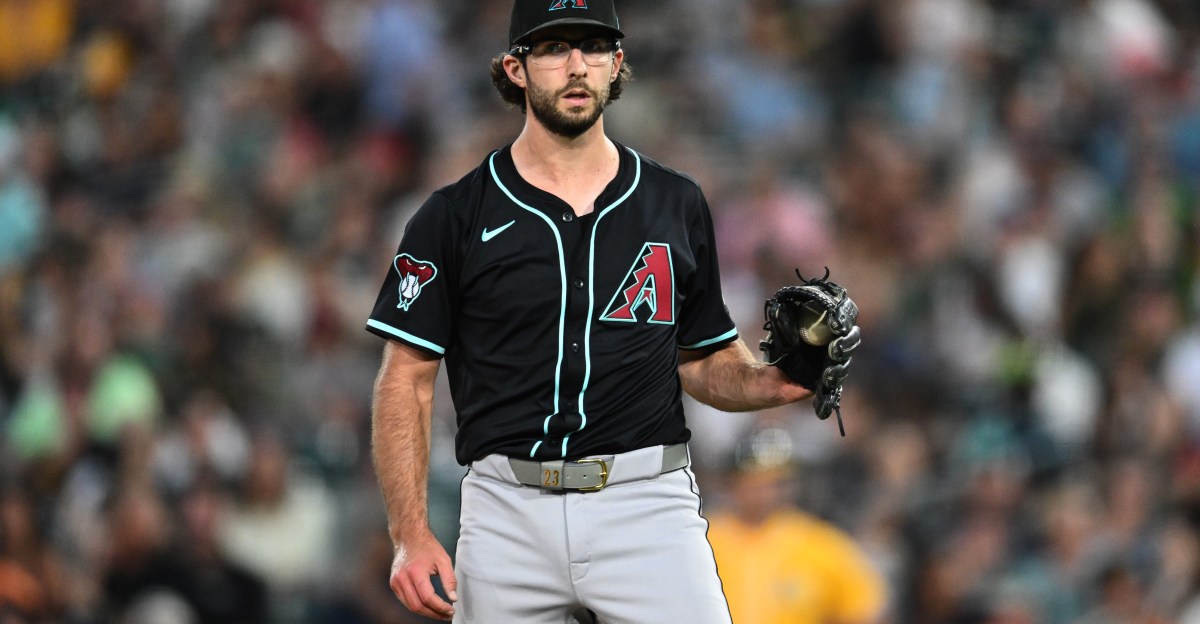
Of all the Diamondbacks’ players who were considered potential trade chips at the deadline this year, the biggest name who did NOT move was obviously starting pitcher Zac Gallen. He’s now approaching the end of his current contract in Arizona, and will become a free agent at the end of the season. What happens then is going to pose an interesting challenge for GM Mike Hazen. That they didn’t trade him at the deadline strongly suggest there wasn’t a lot of interest elsewhere. But whether Gallen returns to the desert for 2026, or goes elsewhere, remains an open question. That’s because the team could offer him a Qualifying Offer, retaining his services for one more season. How does this work, and what are the pros and cons?
This is a scheme laid out in the current Collective Bargaining Agreement (CBA), and is intended to give teams some compensation for losing major free-agents. They can offer the impending free agent a Qualifying Offer (QO), which is fixed at the average salary of the 125 highest-paid players in the majors that year. If he accepts it – and players can only get a QO once in their career – they will play for the team the next season, receiving that amount in pay. If they decline, they will become a free agent, and can sign for any team. However, their old team will get an extra draft pick. The position depends on factors such as whether they pay Competitive Balance Tax, are revenue sharing recipients, and the total amount of the contract. The signing team will also lose a draft pick.
In most cases, players who are made a QO will decline it, because they think they can do better in the free-agent market. Last year, for example, thirteen players were made one, at a value of $21.05 million. However, only one, the Reds starting pitcher Nick Martinez accepted it. Among the dozen to decline were the D-backs’ first-baseman Christian Walker, who then went on to sign a three-year, $60 million deal with the Astros. While the average value of that deal was lower, the length of the contract certainly has its benefits. And he was right, since Walker’s performance this year has been well below par (sub-replacement by bWAR). Had he taken the QO and performed so badly, he would be in a precarious position as a free-agent this winter.
A couple of years ago, this would have seemed like a no-brainer. The year the D-backs went to the World Series, Gallen was an All-Star, and finished third in the Cy Young voting, going 17-9 with a 3.47 ERA. At age 28, he was right in his prime, and seemed set to build on that towards a massive free-agent contract this winter. But it hasn’t unfolded like that at all. In particular, after Gallen missed almost all of June 2024 with a hamstring strain, he has been a different pitcher entirely. He fired six scoreless innings against the Athletics in his first start back off the IL, but that proved to be a false dawn. Over 41 starts since the start of July 2024, Gallen has a 4.93 ERA. Of the eighty pitchers with 30+ starts in that time, Gallen ranks #70 by ERA.
Last season, you could make the case he has been unlucky, with a FIP of 3.38. But that number has jumped up by more than a run this year, to 4.62. Zac’s strikeouts have dropped to a career-low of 8.2 per nine innings, and he has been giving up home-runs at his worst rate ever. In four fewer innings than last year, Gallen has already allowed close to double the number of homers (24 vs. 13). His ERA of 5.31 is second-worst of the 58 qualified pitchers in 2025. Before Opening Day, Zac was generally seen as a top five free-agent for the upcoming winter. But now he’s outside the top ten, in merely the “honorable mention” category.
It’s therefore much more of a risk for the team to make Gallen a QO, because it’s by no means certain that he would decline it and test free-agency. Keeping him around wouldn’t necessarily be a bad thing for the Diamondbacks, because they will otherwise have a spot to fill in the rotation – and quite probably more, if Merrill Kelly does not return to Arizona after finishing up his contract with the Rangers (worth noting, having been traded, Kelly is not eligible for a QO this winter). Gallen’s career ERA+ is 119, which is very solid. While the cost of the QO has yet to be determined, but it should be around the same as last year’s $21.05 million, or slightly higher.
With money coming off the books this winter, the team could afford to make Gallen the QO. If he declines, then we accept whatever bonus draft pick may result. If he accepts, then that fills a gap in the rotation while we await the eventual return of Corbin Burnes from his elbow surgery. However, $21 million is an awful lot to pay for a pitcher who has barely been better than replacement level this year (0.3 bWAR, 0.4 fWAR). Gallen appears baffled by the cause of his struggles, leading to his famous quote from June: “I feel like I’ve tried just about everything, really. Or at least turned over every rock. I’m still trying to find rocks to turn over. But it’s getting pretty frustrating in that sense.” His ERA since that outing has been 4.82.
Admittedly, it does feel that 2026 might be something of a retooling year for the D-backs, as they seek, for example, to find long-term solutions at the corner infield, and (as part of your regular off-season programming!) rebuild the bullpen. A good Gallen could help lead to unexpected contention next year, and if he sucks… Well, it probably isn’t going to make much difference – unlike in 2025, where just one more Zac win… Yeah. But deciding whether to offer the QO, or let Gallen walk without any return, promises to be one of the more challenging choices faced by Hazen at the end of the season.
What do you think? Poll below, explain yourself in the comments.