
The Minnesota Twins’ 2025 season was already shaping up to be one of the most disappointing in the Derek Falvey–Rocco Baldelli era. Popular players were shipped out at the trade deadline, the roster is underperforming on the field, and now the Pohlads’ announcement that they will remain as owners has put a bit of a damper on hopes for significant organizational change.
With ownership unchanged, the front office still has to answer a significant question: What direction does this roster take from here? As things stand today, there are two drastically different paths forward.
Path 1: The Full Teardown
If the Twins are ready to admit they’re entering a true rebuild, there’s little reason to hold onto pitchers like Joe Ryan, Pablo López, and Bailey Ober. The organization was transparent with Carlos Correa before dealing him to Houston, acknowledging that this wasn’t what he signed up for. If the front office is serious about building a roster to compete a few years from now, those starters won’t be around for the next window of contention.
Ryan was already the subject of trade conversations in July, and those talks can easily be revisited this winter. López, owed $21 million in 2026, is now the highest-paid player on the team. In a cost-conscious approach, the Twins might prefer replacing him with younger, cheaper options from their system or via smaller acquisitions. Ober, while not yet expensive, is becoming more so through the arbitration process. Like Ryan and Lopez, he could also bring back useful prospect capital, if he has a strong finish to the seaspn.
This route is about maximizing return on assets before their value dips, and it signals a clear commitment to a multi-year rebuild. This is something the Twins have been reluctant to admit publicly. However, there is a way for the team to get their overall payroll below $100 million if they choose this path.
Path 2: Reinvest for 2026 and Beyond
The alternative is to take the salary relief gained from the deadline deals and use it to stabilize the roster. That could mean offering an extension to Ryan and/or Ober, ensuring the pitching staff retains a reliable core. Ryan Jeffers is another extension candidate, especially with no strong catching prospect near the big-league level.
The math makes sense: even after arbitration raises, Minnesota’s projected 2026 payroll sits under $100 million. For context, they were at $158 million in 2023 before the infamous “right-sizing” of the payroll leading into the 2024 season. Minnesota ranked in the middle of the pack for payroll for multiple seasons coming out of the pandemic. However, that is no longer the case. According to Spotrac.com, their 2025 figure of about $125 million ranks 20th in MLB following the team’s moves at the trade deadline.
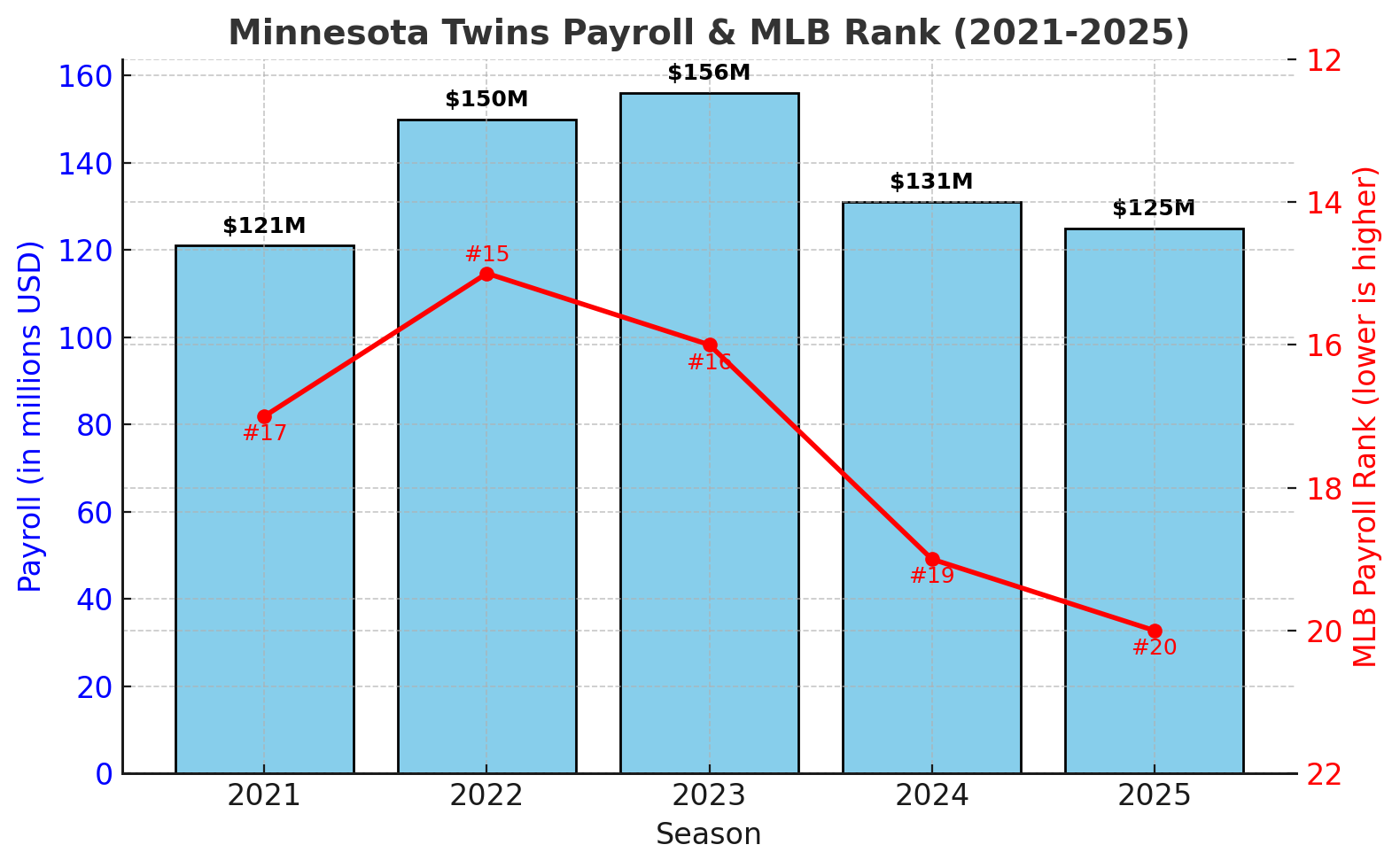
The space is there to add a bat, shore up the bullpen, and retain key arms, but history tells us that’s not how the Pohlads have been leaning. The messaging from ownership points toward a Tampa Bay Rays/Milwaukee Brewers style model, where payroll remains modest and efficiency becomes the defining trait. That doesn’t mean they can’t win, but it does mean relying on high turnover and sustained player development, rather than locking in veteran talent.
The Twins’ trade deadline sell-off may have hurt the 2025 big-league roster, but it’s already paying dividends in prospect capital. MLB Pipeline’s post-deadline farm system rankings have Minnesota sitting second overall, an impressive leap from their preseason ranking of 10th. The front office added 10 prospects in those trades. That group is headlined by Eduardo Tait, one of baseball’s top catching prospects; he was acquired in the Jhoan Duran deal. Combined with the five 2025 draft picks, the Twins now feature a rare blend of elite talent and organizational depth that should help define their next competitive window.
The Twins stand at a familiar crossroads. The Pohlads’ decision to stay on as owners means the philosophy at the top likely won’t shift dramatically. A complete teardown might be the clearest baseball move, but it would mean another long wait for meaningful games in September. Reinvestment could keep the team competitive sooner, but it requires a willingness to spend in a way the franchise hasn’t embraced in recent years.
In either case, the 2025-26 offseason could be one of the most crucial in recent Twins history, not just for the roster, but for the tone it sets with the fanbase.
Which path will the Twins follow? Leave a comment and start the discussion.