
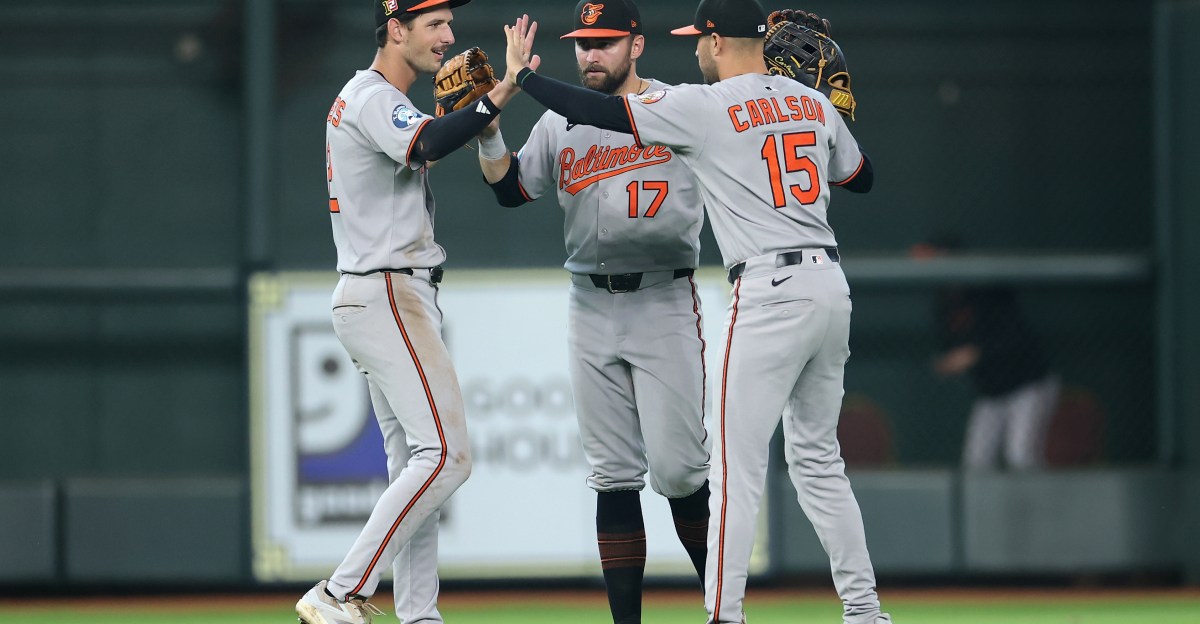
The vibes around the Orioles took a dramatic shift this past week. They emerged from their post-deadline swoon to win back-to-back series against playoff contenders, and they promoted two of their top prospects in Samuel Basallo and Dylan Beavers. Better yet, the Orioles are getting just a touch of good injury luck. Ryan Mountcastle and Colton Cowser recently returned to the lineup, and they should be followed by pitchers Kyle Bradish and Tyler Wells before the month is out. This sort of joy is what this season was supposed to bring all summer long.
By now, the Orioles early-season struggles are well-documented. They got off to a horrific start with a 15-28 record through May 16. That cost Brandon Hyde his job as manager and sent the season, as whole, down the toilet. But that was not the absolute pit of the campaign. Right after Hyde’s firing, the O’s lost six of their next seven to fall to 16-34 on the year before turning things around.
It was a failure on all fronts. GM Mike Elias needed to be more aggressive at improving the rotation. Instead, he took what felt like a cautious approach that ended up blowing up in his face. The homegrown hitters needed to, in general, take steps forward. Instead, almost all of them regressed to a point that the lineup was impotent. And the baseball gods needed to be a bit kinder on the injury front. Instead, nearly every major contributor spent extended time on the shelf throughout the season.
What’s at least somewhat reassuring about all of this is that everyone involved seems to be taking ownership of these failures. Elias admitted that he needed do a better job on the pitching front. And a report from The Baltimore Banner at the time made it clear that the players were frustrated with themselves as much as anyone else.
Whatever the case, things began to turnaround during a double-header in Boston. The Orioles won the second game that day, and it was from that point on that interim manager Tony Mansolino and his downtrodden Birds began to right the ship.
Since the second game of that double-header against the Red Sox on May 24, the Orioles have gone 41-33. That’s a .554 winning percentage, which translates to about 90 wins over a full 162-game season. None of the three teams that currently possess the AL Wild Card spots (Red Sox, Mariners, Yankees) are on pace to win 90 games this season. The Orioles should have been right in the mix with them.
Now, this is not to say that the Orioles “deserve” to be in the playoff conversation. They are victims of their own performance, which was dreadful in April and most of May. The ineptitude of the starting pitchers is well known—they had a 5.72 ERA through May 24—but the hitters stunk too. A team that was supposed to be carried by its lineup ranked in the bottom third of MLB in runs scored, batting average, on-base percentage, strikeout rate, walk rate, wRC+, and wOBA, among other metrics, through May 24.
As you would imagine, their improved record since that point has come with improved output on all fronts.
Their lineup is eighth in MLB in runs scored since May 24. Some of their peripheral numbers aren’t quite as good—16th in wRC+, 11th in slugging, 26th in on-base, etc.—but given all of the bad luck they had early, it’s reasonable to get a few better bounces later on.
And the rotation has been a lot more fun to watch since late May. They are in the top half of the league in ERA (12th, 4.06), FIP (8th, 3.93), and xFIP (12th, 4.04). Plus, they are showing durability, compiling the eighth-most innings (388.1 IP over 73 games) in MLB in that time. Trevor Rogers (2.2 fWAR, 1.57 ERA) and Dean Kremer (2.2 fWAR, 2.87 ERA) standout for both their dominance and dependability.
While the Orioles have ascended, the rest of the AL has lagged. There are only three teams (Blue Jays, Astros, Red Sox) on the junior circuit with better records than the Orioles since May 24. And that trio of clubs ahead of them all added at the deadline, while the Orioles sold off their entire bullpen, depth in their rotation, and arguably their top two hitters this season. The fact that this club has bounced back, especially here in August is commendable.
It also makes you wonder what could have been if the Orioles had just held things together back in April and May. They didn’t need to be a juggernaut. They just had to be competent. It’s clear that this team has/had the pieces to compete in a mediocre American League. Had they been close enough to .500 in late July, Elias might have been able to add a starter and/or a bat. The prospects still could have come up to provide a boost. Bradish could have come back as a postseason rotation option. The 2025 season might have been their chance at a deep playoff run.
Of course, this team always had its flaws. They were discussed pre-season. They were evident early on in the season. And they remain frustrating on a regular basis now. Winning the World Series would have been exceedingly difficult with the crew that Elias assembled. But it should have at least been on the table rather then the current goal of “spoiling” the season for someone else.
It’s unfortunate that the Orioles have essentially “wasted” a season for key players like Gunnar Henderson, Adley Rutschman, and Jordan Westburg. But this year could still be “worth it” if the O’s are able to take this momentum and turn it into wins in 2026 and beyond. That could manifest itself in several ways.
The most crucial development would be seeing some of the team’s core players continue to get better. Henderson (132 wRC+) and Westburg (144 wRC+) have been really good since late May. Basallo and Beavers are likely to get extended runs in the team through season’s end to see where they can stick. The same is true for Coby Mayo, who is finally getting an extended turn at everyday at-bats. There has to be a hope that Adley Rutschman and Jackson Holliday can gain some traction before the year is out as well.
Health is another key component. Injuries happen in baseball, but the Orioles have suffered to a ridiculous level in 2025. There is only so much they can do to avoid a similar outcome in 2026, but hopefully they can at least send most of their players into the offseason with a clean bill of health. That is especially important for the organizational tent poles and the starting pitchers.
Something that will need to wait until the offseason is how Elias plans to leverage his revamped minor league system into big league talent. The Orioles added oodles of young players to their organization in July. They had the biggest draft signing bonus pool in history, and they followed that up with a ton of deadline deals that further padded their “Top 30” prospect list. By now, it should be evident to Elias that not all of your supposed “top prospects” are going to make a positive impact on your big league squad. Sometimes it is smart business to trade 20-year-old lottery tickets for proven 30-year-olds. That’s something he has not done enough of as the Orioles boss.
It’s a big offseason ahead for Elias. He has to sort out the manager’s role and set his team up for success in 2026. If they fail again, he might be looking for work shortly thereafter. He won’t be able to lean on “shoulda, coulda, woulda” for a second year in a row.