
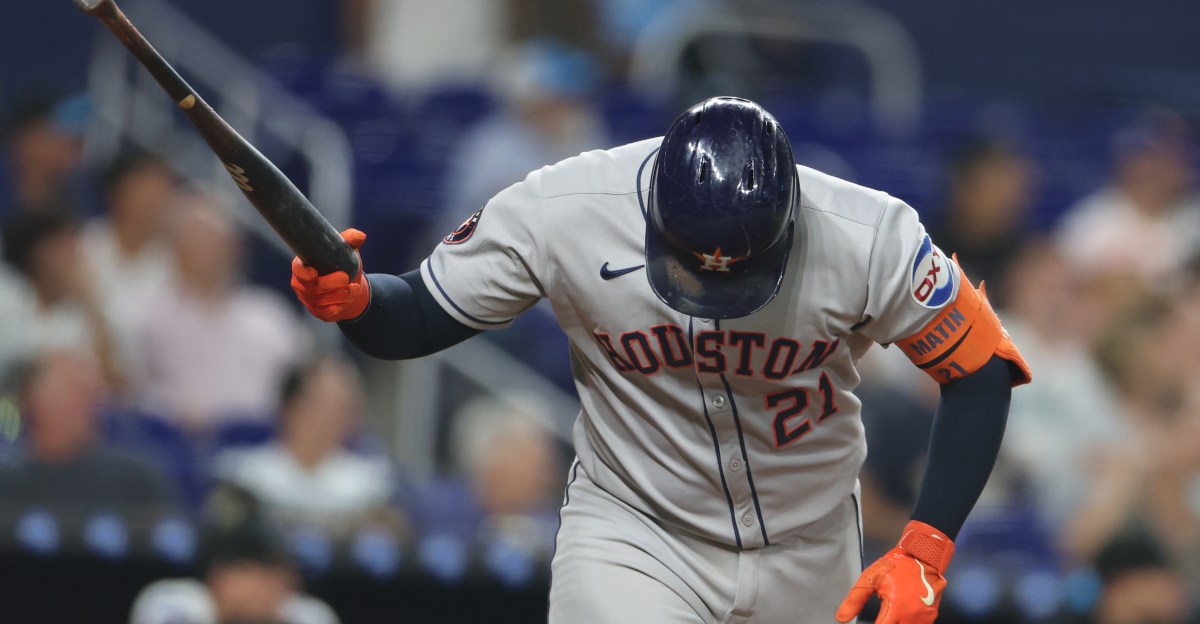
Entering this season, I was fairly encouraged with where Yainer Díaz was in his progression as a Major League catcher. While his overall offensive numbers were down compared to his rookie season in 2023, he assumed a larger share of the catching responsibilities in 2024 with Martín Maldonado gone. Naturally, with catcher being arguably the most challenging position in baseball, a downturn in his offensive numbers was somewhat expected, but he still posted a 116 wRC+ and 16 home runs. Those are quality numbers as a hitter for plenty of catchers.
The hope for 2025 was that Díaz could build upon his first season as the primary catcher, both offensively and defensively. It isn’t a secret that the Astros struggle with keeping the opposing run game in check, with only the Marlins allowing more stolen bases (291) than Houston (261) in 2024 and 2025 (so far) combined. With that said, that issue isn’t all on the catchers, as Houston pitchers are notorious for their inability to keep the run game suppressed as well. Díaz, for crying out loud, was in the 78th percentile in Caught Stealing Above Average last season. Yes, framing isn’t a strong suit for Díaz either, but the hope is that he’ll be passable until the ABS system is implemented in the near future. However, he graded out fine enough as a receiver and blocker behind the plate. With an above-average bat, you could tolerate some poorer defensive numbers, especially if he could block, receive, and throw out runners well enough to keep them a bit more modest on the basepaths.
But rarely does hope ever fully translate into what you expected or even wanted. Díaz’s frigid start to the 2025 season — .130/.175/.222 and a 7 wRC+ in his first 57 plate appearances — stands out, but his performance since then has been roughly average at best (101 wRC+ with 16 home runs in the subsequent 389 plate appearances). But even with one more home run than he had all of last season, Díaz’s best attribute as a hitter (power) has still declined a bit further. Throw in the fact that he still maintains a walk rate below 4%, he requires hits to get on-base. That has been a bit more of an issue this year, with a decline in on-base percentage compared to his first two seasons.
When analyzing the information for this post, I kept circling back to ground ball double plays with Díaz. He seems to hit a lot of those, right? Entering Monday, dating back to 2023, here are the hitting leaders for double plays.
1. Manny Machado – 59
2. Alec Bohm – 53
3. William Contreras – 51
4t. Ty France – 51
4t. Vlad Guerrero Jr. – 51
6. Pete Alonso – 50
7. Carlos Correa – 49
8. Lourdes Gurriel Jr. – 47
9. George Springer – 46
10t. Josh Bell – 45
10t. Yainer Díaz – 45
Frankly, it wasn’t a surprise to see Díaz on this list in any shape or fashion. Eleven of those ground ball double plays have occurred in 2025, with one more yesterday, making 12 total. He tends to halt any rallies before they gain momentum. However, what caught my eye is how many ground balls, not just double plays, he tends to hit against right-handed pitchers compared to left-handed pitchers, dating to his first full season in 2023.
Ground Ball Rate, by Pitcher Handedness (2023-25)
– RHP: 49.1%
– LHP: 42.6%
That split is even more extreme this season, with a 48.3% ground ball rate against right-handers compared to 35.9% against left-handers. Nothing really new against right-handed pitchers; however, his rate against left-handed hitters has noticeably declined. To be fair, though, the Astros have taken the fewest plate appearances against left-handed pitchers this season (922), and Díaz only has 84 of those. In 2024, he had 170 plate appearances against lefties, so it is difficult to put too much reliance on that side of the ground ball split, at least for now.
However, the Astros’ heavy reliance on right-handed hitters for much of the season has influenced how opposing teams pitch to them, as evidenced again by the fewest plate appearances against lefty pitchers this season. While Díaz has historically hit right-handers better (112 wRC+) compared to left-handers (102 wRC+), it is worth pointing out that his ground ball double play numbers are much higher when facing the former. Not a surprise considering the sheer number of times he faces right-handers compared to left-handers, but still worth mentioning.
Ground Ball Double Plays, by Pitcher Handedness and Total Number of Pitches (2023-25)
– RHP: 39 (3,611 pitches total)
– LHP: 7 (1,247 pitches total)
Would Díaz still struggle with a more balanced lineup around him? It is certainly possible. With that said, groundballs are less of an issue against left-handers for whatever reason (future post about that incoming), and some of those double plays could convert into something positive for him and the team. In any case, Díaz does have a groundball issue when facing right-handers compared to left-handers. A higher rate of ground balls means more opportunities for double plays, unfortunately.
Defensively, I mean, where to start? Catcher metrics, like any defensive metrics, should be taken with a grain or two of salt. But whenever you begin grading out in the bottom across multiple categories, which more or less matches what your eyes are seeing, then it isn’t great.

The overall issues and large swath of injuries have only exacerbated any regression from Díaz. Not having a better left-handed presence, or any at all at times, has allowed opposing teams to load up on right-handed pitchers against this lineup. That has a trickle-down effect on the entire lineup, including Díaz. Defense is an ongoing issue. With Victor Caratini on an expiring contract and former first-round pick Walker Janek in the minors, Dana Brown has some decisions to make at the catcher position, in both the short- and long-term. I don’t think the organization will move on from Díaz before 2026. Still, even with ABS incoming within the next couple of years, I wonder how much of an appetite there is internally for him as a catcher defensively. And if his offensive numbers continue to lag, then the primary advantage to keeping Díaz as a catcher becomes increasingly difficult to justify.