
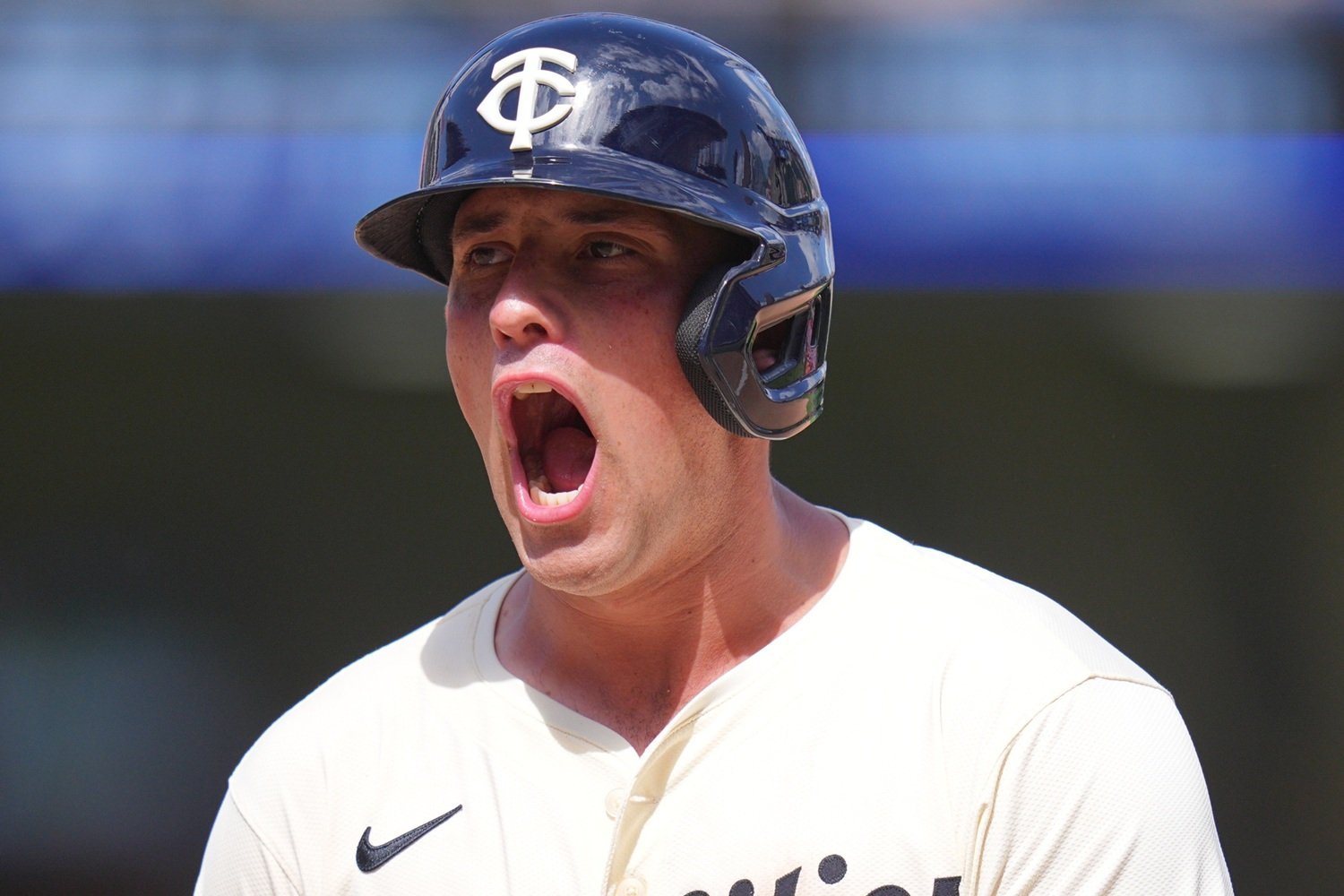
The Minnesota Twins believe in Brooks Lee, even if his on-field results haven’t matched the organization’s expectations. They believe in him because his approach, bat-to-ball skills, and polished college pedigree suggest he could be a foundational piece of the next great Twins lineup. But if Lee isn’t careful, he may be walking down a familiar road—the same one Jose Miranda traveled back to Triple-A St. Paul, perhaps for good.
The Contact Paradox
Lee’s ability to put the bat on nearly any pitch is both his greatest strength and his most pressing concern. While making contact is a highly coveted skill in today’s game, putting “pitchers’ pitches” in play doesn’t often result in much damage. Weak choppers, lazy fly balls, and soft groundouts aren’t much better than strikeouts, and in many cases, they’re worse, because they rob hitters of the chance to unlock power.
This was Miranda’s downfall. Despite his contact-heavy approach, he often put bad pitches in play, rolling over into outs rather than punishing mistakes. His strikeout numbers were never the problem (15.4% strikeout rate in 2024); it was the lack of consistent impact that held him back. His Hard-Hit% ranked in the 42nd percentile, and his Barrel% ranked in the 28th percentile. Lee is starting to show the early signs of falling into the same trap.
The Discipline Gap
In the minors, Lee’s bat played because pitchers weren’t as refined. His walk rates looked solid (10.0 BB%), but big-league pitchers are more willing to challenge hitters—and they have more ways to manipulate and bait them.
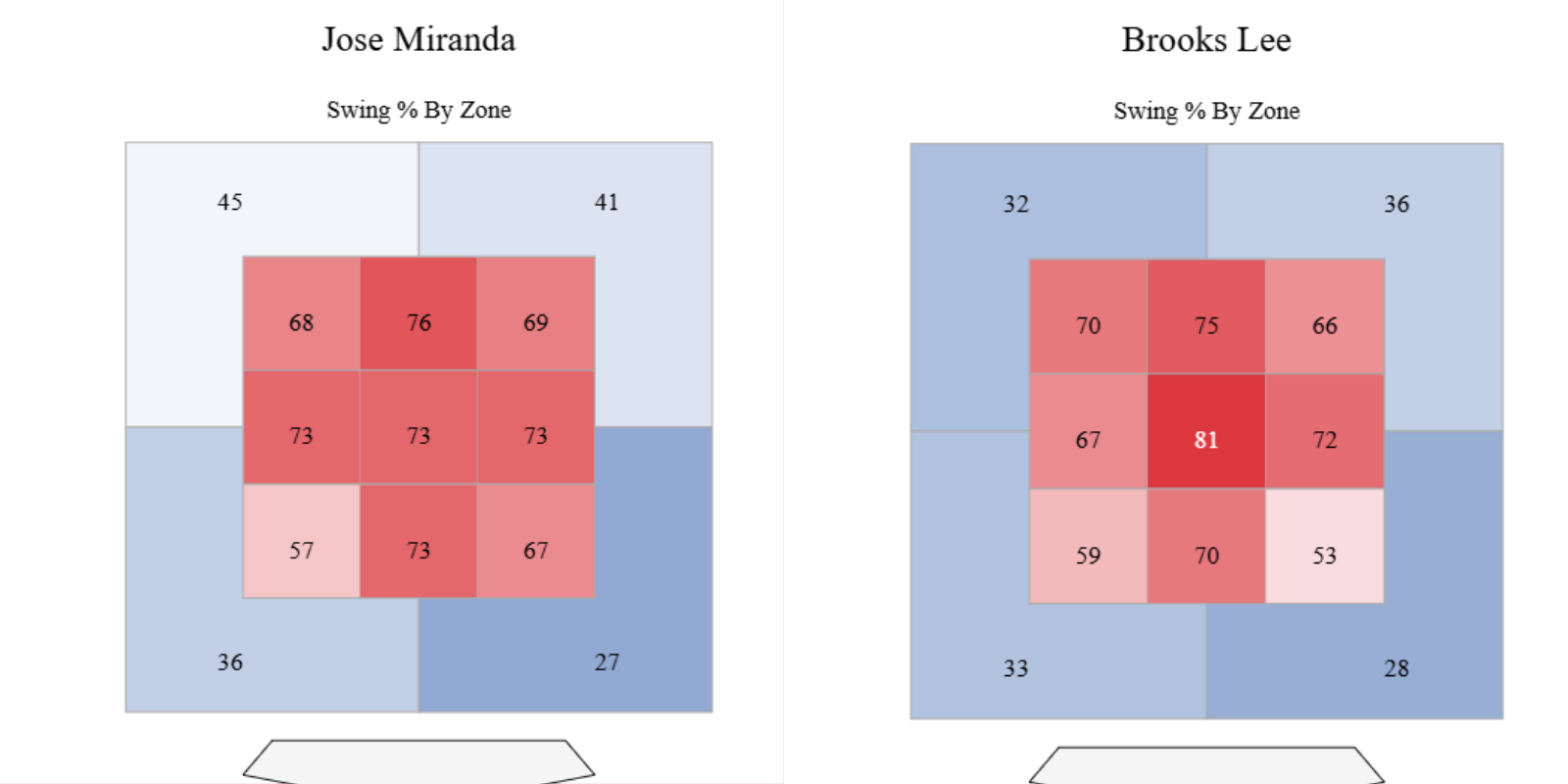
The numbers back it up. Lee currently owns a 31.3% chase rate, ranking in the 25th percentile in the American League. In other words, he’s swinging at pitches on which he simply can’t do damage. Against high-level pitching, that approach will bury a hitter quickly.
Lee vs. Miranda Swing Decisions
Player
Chase%
BB%
K%
Hard-Hit%
Brooks Lee (2025)
31.3
5.1
18.3
40.0
Jose Miranda (Career)
34.3
5.0
17.6
40.3
The similarity is clear: both players avoid strikeouts but expand the zone often, such that even though they’re capable of making solid contact, it’s rarely the most valuable kind. The difference is that Lee’s chase rate suggests more potential for adjustment, whereas Miranda has struggled to show that patience. As a switch-hitter, Lee also has a wired-in advantage when it comes to plate discipline.
The Path Forward
The encouraging part for Lee and the Twins is that his swing decisions are not set in stone. Unlike Miranda, whose free-swinging nature has never truly adjusted at the big-league level, Lee still has the developmental runway to refine his approach. The tools are there, and the Twins believe in his ceiling.
“I think I just have to be smart [about] picking and choosing my times to take that A-plus swing,” Lee said after his recent grand slam. “Other than that, I’m the type of player to put the ball in play. Supposed to be gap-to-gap and outrunning the balls. But it’s more important for me to get the next guy up.”
For Lee, the next step is learning to control the zone. It’s not enough to avoid strikeouts; he needs to identify and punish pitches he can drive. That means laying off borderline offerings and staying patient enough to hunt “his” pitch. If he can shift his profile from a hitter who can put anything in play to one who makes selective, damaging contact, the Twins will have a cornerstone infielder.
The Twins have seen this story before. Miranda’s bat-to-ball ability looked like a weapon until it became a liability, and he fell out of the team’s long-term plans. Lee now stands at that same crossroads. The difference between a productive, middle-of-the-order hitter and a frustrating contact-first infielder will come down to Lee’s ability to say “no” at the plate.
If he can, he’ll be more than just another contact hitter. He’ll be the impact bat the Twins envisioned when they called his name on draft night.
How can Lee avoid following Miranda’s path? Leave a comment and start the discussion.