
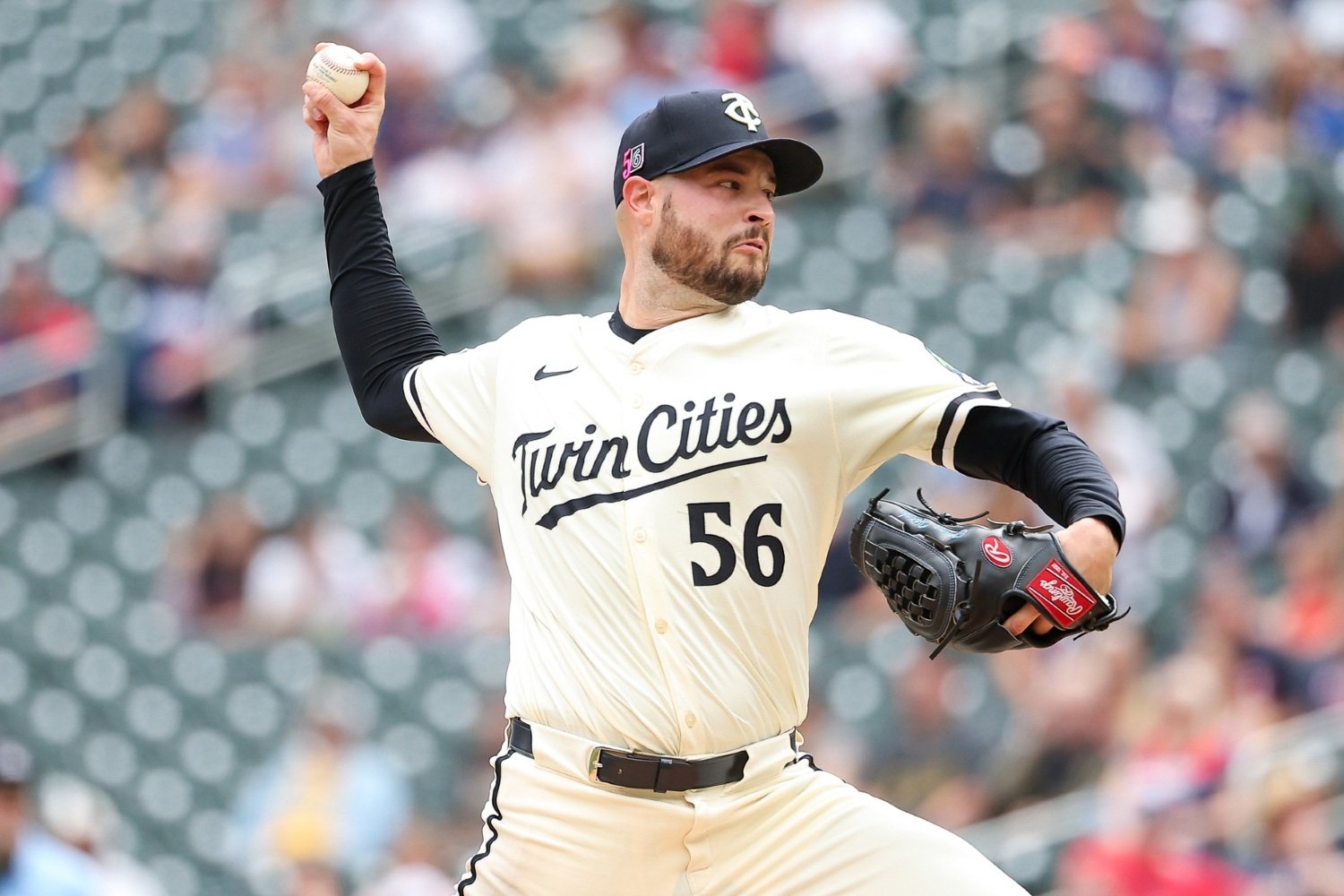
One of the upsides of trading almost half your team at the deadline is that you have space on the roster to try some things. One of the (many) things the Twins have tried is claiming Thomas Hatch (who’s controllable for four more seasons) off waivers. They have done similar things in recent seasons and been rewarded by getting the best versions of players like Willi Castro and Kody Clemens. Will Hatch be next? It’s tough to say. But regardless, he’s an interesting player with an interesting journey.
Heading into the 2020 season, while he was a starting pitcher with the Blue Jays’ Double-A affiliate, Hatch was their ninth-best prospect. After seeing limited action, almost entirely in relief, the Blue Jays designated him for assignment in 2023 and he was claimed by the Pirates. They cut him after the season, and (although he initially signed to play in Korea) Hatch spent 2024 in Japan, playing for the Hiroshima Carp in NPB.
The Carp converted him back to a starter, and worked with him on his pitch mix. He came back Stateside for the 2025 season, where he signed a minor league deal with the Royals. He remained a starter with Triple-A Omaha. He was called up in July, after a stellar month in which he was named the Storm Chasers’ pitcher of the month, then cut again at the trade deadline.
During his time in Japan, and during spring training, Hatch worked to add pitches. He’s throwing a true cutter and a sweeper for the first time. Hatch felt the year of stretching back out and the time with the Royals organization earlier this year allowed him to bring those projects to fruition.
“I used the first half of the year and spring training to work on some stuff, lock in some stuff that I’d wanted to do for a few years as a starter,” he said. “I felt like I was in a good spot.”
Hatch now has a six-pitch mix. That’s quite unusual for a reliever, but it’s a testament to his pedigree as a starter, and his desire to find a way to stick in the bigs. He’s into baseball tech, and understanding the things that drive success.
“Coming back over here [from Japan], it was refreshing to get back in front of TrackMan, Edgertronics, where I could see the ball come out of my hand—pitch tracking, stuff like that,” he said. Hatch has used this tech to develop his pitches, including working on his cutter and changeup.
“That’s one of the beauties of technology, is we’ve discovered that even supinators can get the ball to go arm-side. And even honestly, it’s easier than a pronator for the most part. Usually, pronators are good at ‘riding the ball.’ Not seam-shift changeups, but more so spin-based, because they can get to the inside of the ball, whereas [supinators] are using seam shift to get the ball to go arm side. Which we didn’t know prior to Hawkeye, TrackMan.”
Using this tech (and being thoughtful in his approach) has helped Hatch dramatically increase the active spin and resulting movement in both pitches. Though he’s always used a sinker as his main fastball, working with that technology taught him that he’s a natural supinator, meaning that his arm naturally turns in the direction one needs to produce a good breaking ball. To create a changeuo that works for him has required more engineering. In 2023, his change got 6.4 inches of movement, on average. This season, it’s up to 15 inches.
Meanwhile, the pitch he used to call his cutter has morphed into a true slider—because he’s felt his way to a cutter that better deserves that name.
“It was weird: we called it a cutter, previous to me going to Japan, mostly just as a mental thing. It was a slider. But then I was like, ‘You know what? I need something hard going in to lefties.’ Because two-seams from right-handed pitching to left-handed hitters are not exactly the best pitch to throw, so [the cutter] really keeps people off of fastballs,” Hatch explained. “That’s been a good thing.”
It’s clear that Hatch is a tinkerer. Another example of this is his approach to his changeup, a project he’s embraced with gusto.
“I think the changeup is a kind of a work in progress at this point. That’s the missing piece, I feel like. We’ve been working on splits, changeups.”
If you look at Hatch’s stat line, the results haven’t been pretty. Through three games with the Twins, he has a 5.17 FIP. He walks (sometimes way) too many and doesn’t strike enough batters out to be dominant—but a few of the pieces of a good pitcher are starting to fall into place, even as he nears his 31st birthday.
Results aside, the Twins do have a good track record of tinkering with pitch mix and approach to get the most out of pitchers, particularly those who are tinkerers themselves, and those who like to use data. Hatch is certainly that. With six pitches (and working on a seventh, in the splitter), there’s a lot to work with.
Hatch may not be well-suited to starting, or performing in a bulk role. Knowing the Twins will be getting Pablo López, Simeon Woods Richardson, and David Festa back before long, and acknowledging that the games really don’t matter down the stretch, it will be interesting to see how they deploy Hatch, and whether they convert him back to one-inning relief. On the other hand, he seems comfortable with this wider mix, and his best future might be as a swingman or back-end innings eater.
It’s also been well-documented that the Twins excel at adding velocity. Given Hatch’s slightly below-average pitch speeds, it’s fair to wonder what an extra tick or two could do to his overall effectiveness. Hatch has already shown an ability to limit hard contact (average exit velocity allowed is in the 85th percentile), and with a great ground ball rate, the building blocks are there. Since the Twins need (effectively) a whole new bullpen in 2026, betting on a guy like Hatch to stake a claim just might pan out—particularly since he will be making the minimum for one more season before being arbitration eligible.
Twins Daily’s own Matthew Trueblood contributed to the reporting here.