
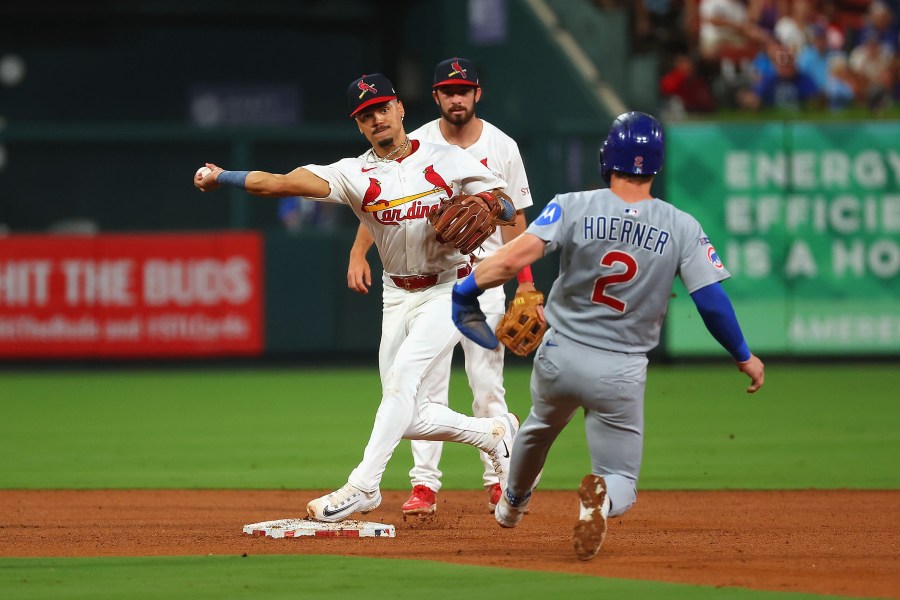
ST. LOUIS – If Major League Baseball expands to 32 teams in the future, divisions could be realigned, according to recent remarks from MLB commissioner Rob Manfred.
Speaking on ESPN’s Sunday Night Baseball broadcast last weekend, Manfred said: “If we expand, it provides us with an opportunity to geographically realign. I think we could save a lot of wear and tear on our players in terms of travel, and I think our postseason format would be even more appealing.”
Advertisement
Such a change would likely keep the American and National Leagues intact, but move from three five-team divisions to four four-team divisions in each league. It would require two expansion franchises and possibly shift some existing teams across different leagues.
While there’s no timeline for when MLB might act, the St. Louis Cardinals, as one of the league’s most centrally located teams, could see big changes depending on future division realignment plans.
In recent days, three potential realignment proposals have surfaced online, each with different visions of how the Cardinals would be grouped in a division.
Proposals In Play
Proposes a four-team division called the “NL Midwest” with the Cardinals, Chicago Cubs, Cincinnati Reds and Chicago White Sox.
Advertisement
The Athletic – Stephen J. Nesbitt
Proposes a four-team division called the “NL North” with the Cardinals, Chicago Cubs, Cincinnati Reds and Milwaukee Brewers.
The Athletic – Jim Bowden (Proposed in 2023)
Proposes a four-team division called the “Midwest” within the Western Conference, rather than a National League or American League. It calls for the Cardinals in a division with the Kansas City Royals, Houston Astros and Texas Rangers.
Considerations
The Cardinals have been in the NL Central division since 1995, when MLB last realigned to its current six-division structure. That move created consistent rivalries with the Brewers, Reds and Pirates, while strengthening the long-standing rivalry with the Cubs.
Advertisement
If realignment happens, it would be in MLB’s best interest to try to keep as many established rivalries together as possible within the same division. It would be difficult to imagine the Cardinals in a division without the Cubs, but something will have to change a five-team NL Central division into a possible four-term “NL North” or “NL Midwest” division. The Pirates, for instance, might be shifted eastward for geographic balance.
Looking strictly at distance, the Cardinals’ nearest opponents are the Kansas City Royals (250 miles west), Chicago Cubs (300 miles northeast) and Chicago White Sox (nearly the same as Cubs). While a division centered on those three foes would be efficient geographically, it would require at least two franchise switching leagues and may complicate alignment elsewhere.
Other options, such as grouping the Cardinals with teams such as the Houston Astros, Texas Rangers, and Colorado Rockies could make some geographic sense, given those teams aren’t particularly close to most MLB markets in distance. But it could diminish rivalries the Cardinals have spent decades building.
The Bigger Picture
Realignment decisions for the Cardinals may depend on how MLB handles borderline teams in certain geographic regions. For instance:
Advertisement
What happens to the Tampa Bay Rays if MLB groups an “AL East” division of the New York Yankees, Boston Red Sox, Baltimore Orioles and Toronto Blue Jays?
Would the Pittsburgh Pirates move into a division with Northeastern teams – like the New York Mets, Philadelphia Phillies and Washington Nationals – if they move eastward?
Would the Atlanta Braves be grouped into a new “NL South” division with the Miami Marlins, a relocated or re-leagued Rays team, and possibly a new expansion franchise, say maybe Charlotte or Nashville, as a domino effect?
For now, nothing is guaranteed and any division realignment plans remain hypothetical. But how MLB balances, history, geography and expansion could dramatically reshape the Cardinals’ divisional placement in the future.
Some baseball insiders suggest realignment might not happen until the 2030s, but if or when it does, MLB will need to weigh what works best while trying not to erase rivalries that have defined generations of baseball.
Copyright 2025 Nexstar Media, Inc. All rights reserved. This material may not be published, broadcast, rewritten, or redistributed.
For the latest news, weather, sports, and streaming video, head to FOX 2.