
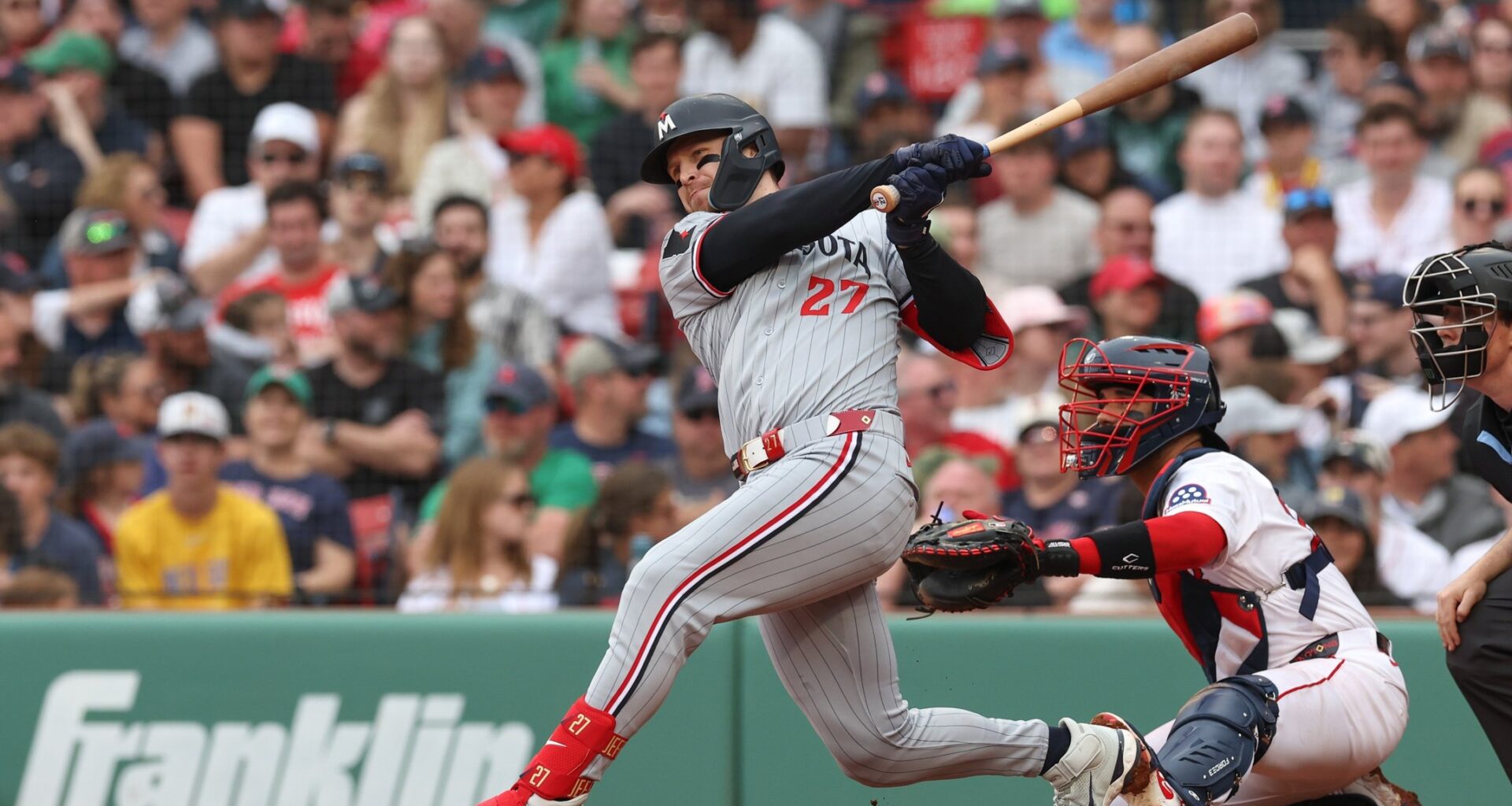
The Minnesota Twins have won eight games in a row, and most impressively they’ve been able to do it without Matt Wallner and Luke Keaschall, who looked like their two best hitters before going down with injuries. Wallner had an .847 OPS before suffering a significant hamstring strain on April 15th. Keaschall went 7-for-19 with five steals in seven games up until a wayward fastball fractured his forearm.
Before they went down, Wallner was routinely leading off and Keaschall had found his way into the No. 3 spot, reflecting the magnitude of these losses in the lineup. Neither is going to be back anytime soon; Wallner is still weeks away and Keaschall probably won’t return until around the All-Star break.
The good news is that these two crucial reinforcements could set up the Twins offense, which has started to click somewhat in their absence, for a big second half. If the pitching staff continues the way it has, that’s a recipe for a lot of winning and maybe a sprint to the top of the division. But in order for this to be in the cards down the line, Minnesota first needs to hang in the race. They need to their offense to keep holding up its end of the bargain.
That doesn’t mean they need the lineup to dominate. They haven’t, and they probably aren’t going to. Even over the course of this eight-game winning streak the Twins have scored more than five runs only twice, and their team .312 wOBA ranks right in middle of the MLB pack, at 15th.
Supported by a staff that has allowed the fifth-fewest runs in baseball, the offense can get by with being merely solid. But they were far from that in the first month as the Twins dug this whole they’re now trying to escape. In order to keep making progress toward that end in the weeks ahead, from my view, they need four players to build upon the success that has helped fuel Minnesota’s turnaround.
But first, I’m going to start by naming a few players I am NOT expecting to lead this charge. Because a couple of them may surprise.
I’m not counting on Carlos Correa. He’s been better of late, in terms of getting some singles to drop, but I’m still not seeing any indicators that Correa is on the verge of recapturing his form as a true impact player on the offensive side. Pitchers are challenging him relentlessly in the strike zone and rarely paying for it. I’ll be satisfied enough with average production from him.
I’m also not counting on Royce Lewis, not right now anyway. He looks out of whack at the plate and uncomfortable on the bases. And while you’d like to attribute that to temporary rust, Lewis’s struggles date back the final six weeks of 2024. He now has one home run in his past 175 plate appearances, and that one barely skimmed over the left field wall at Target Field. Like with Correa, we know full well what Lewis is capable of, but in both cases I’m just not seeing anything to make me believe at the moment.
Finally, I’m not counting on Brooks Lee. He’s had some clutch hits over this winning streak and is coming off an awesome three-hit game, but in general he’s just not showing enough discipline for a guy that lacks standout power. Lee is slashing .232/.277/.347 through 278 MLB plate appearances.
Again: not saying by any means that these three players can’t be key factors — along with Ty France, Willi Castro and even Edouard Julien or José Miranda — but I’m not expecting them to be the top difference-makers. Instead, I’ve got my eyes on these four players, who have already experienced offensive breakthroughs with potential to sustain.
Byron Buxton
Obviously. Even with a league-leading strikeout total, Buxton has been one of the most valuable players in baseball, ranking 16th among qualified players in fWAR. Just writing a sentence that included “Buxton” and “qualified player” makes me feel so happy. He’s slashing .264/.304/.520 this year, including .322/.364/.610 since Keaschall got hurt on April 25th, and he’s 8-for-8 on stolen base attempts with the second-most runs scored in the American League.
Healthy at last, Buxton has easily been the team’s MVP so far, and again: he’s done it while whiffing at an exorbitant rate. Makes you wonder what’s possible if he dials in the strike zone control just a tad. Buxton was showing signs of doing so, tallying seven strikeouts against four walks through his first eight games in May before striking out seven times on Saturday and Sunday.
Harrison Bader
When Bader homered three times with eight RBIs in his first five games as a Twin, it had the clear makings of an isolated hot start. Sure enough, after 10 more games played, he had a .686 OPS and 11-to-1 K/BB ratio. This seemed to match up with the reports on Bader, a defensive stud whose hitting ability and plate presence had largely gone amiss.
But Bader refused to succumb to such a fate. Instead, he got back on track offensively in mid-April and now he has the best OPS on the team here at the one-quarter milestone. In 14 games since Keaschall joined Wallner on the IL, Bader is slashing .405/.490/.571, and after flailing at times early, he’s putting together really solid professional at-bats. During this span, Bader has a 7-to-7 K/BB ratio, and on the season, his 10% walk rate dwarfs his career mark.
He surely won’t maintain at that rate, but if Bader’s evolution in pitch selection is at all legit, he is plenty capable of continuing to contribute at an All-Star level alongside Buxton. So far, this is shaping up as one of the best free agent signings in team history, especially given the stakes.
Trevor Larnach
Through his first 15 games this year, Larnach was sporting lean .189/.279/.208 slash line with just one extra-base hit through 64 plate appearances. Personally, I wasn’t that concerned. Nothing I saw led me to believe Larnach’s talent wouldn’t eventually win out and start translating to results. Now we are seeing it, in timely fashion.
Since Wallner went down with his injury on April 15th, Larnach has produced an .846 OPS that is nearly identical to Wallner’s team-leading mark when he suffered the injury (.847). Larnach has been a vital factor as really the only left-handed bat that presents any kind of threat in the Twins lineup, batting .303 with two homers and two doubles during the current winning streak.
Ryan Jeffers
The signs were there, even as Jeffers stumbled to a slow start the plate. But he has answered the call in the face of these injuries, slashing .271/.370/.457 in 21 games since April 15th. Like the others named above, Jeffers is inspiring a lot of confidence with not just his production but his approach at the plate (15 K and 9 BB in these 21 games).
Overall, his .717 OPS on the season is about average, but that kind of steady output at the position is hard to come by, and too often was for the Twins last year. When you’re getting offensive impact at all from catcher it can greatly benefit a lineup. Helpfully, Christian Vázquez has started to at least find his way on base, with four walks in 18 May plate appearances. Since the Wallner injury, Minnesota’s catchers are top-10 in wOBA, and if that keeps up the offense should be alright.
I’m certainly not giving up on the likes of Correa, Lewis or Lee in the grand scheme, but they all need to show me something. The four hitters above have done so, and they’re helping lift the floor of the offense in the process. If they can keep it up, the Twins are going to keep winning, and if some of the team’s other dormant stars can awaken in time for Wallner and eventually Keaschall to rejoin the fight, there’s a whole lot to like about the lineup’s eventual ceiling.