
It’s another Wednesday night here at BCB After Dark: the coolest club for night owls, early risers, new parents and Cubs fans abroad. Come on in out of the heat. We always have room for a friend. There are still a couple of tables available. There’s no cover charge. The dress code is casual. Bring your own beverage.
BCB After Dark is the place for you to talk baseball, music, movies, or anything else you need to get off your chest, as long as it is within the rules of the site. The late-nighters are encouraged to get the party started, but everyone else is invited to join in as you wake up the next morning and into the afternoon.
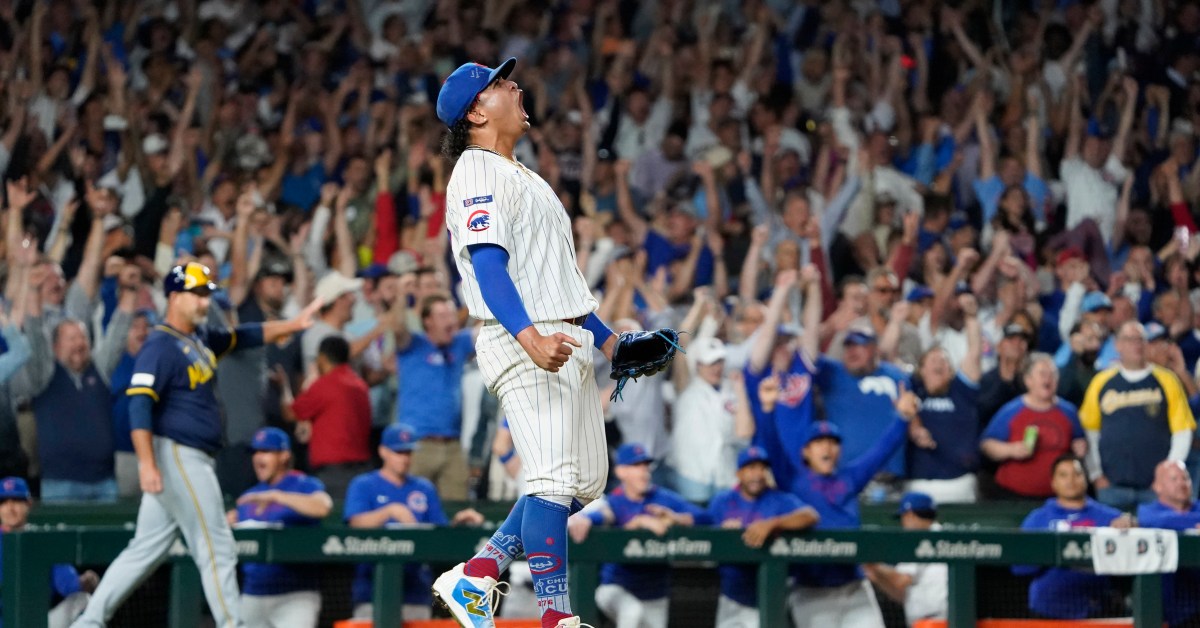
The Cubs won a thriller against the Brewers tonight, 4-3. Wrigley was rocking and the mozzarella sticks were flowing in Colin Rea’s home town of Cascade, Iowa. Michael Busch had a three-run double off hard-throwing rookie Jacob Misiorowski and Matt Shaw hit a needed insurance home run in the eighth. It was the first time the Brewers have lost three in a row since May 10. The Cubs clinched the season series with the Brewers.
I said last night that if the Cubs won the final two games against the Brewers that I’d break out Judy Garland. But I wasn’t thinking that we’re going to be dark tomorrow night (or at least I will be off) and so when the Cubs win tomorrow, I won’t be here to break out Judy. So I’m assuming the Cubs win tomorrow afternoon and:
Last night I asked you if you thought Kyle Tucker was worth an eight-year, $380 million deal. Today, we’ve discovered that Tucker has been playing with a hairline fracture in his finger since early June. Tucker wanted to play through it and to be fair, he had his best month of the season in June. But it appears to have caught up with him in July and August.
In any case, 58 percent of you didn’t think Tucker was worth the money yesterday. I don’t know if that number would change today with what we know now.
Here’s the part where we listen to music and talk movies.
Tonight we’re featuring another concert from Norway, this one from 1971. This is legendary saxophonist Sonny Rollins along with Bobo Stenson on piano, Arild Andersen on bass and Jon Christensen on drums.
I’ve seen two movies recently (not counting Monday’s Crime Wave) and I didn’t care for either one, nor did I have anything interesting to say about them. I am watching another one but despite it being just 96 minutes long, family and other writing obligations kept me from finishing it. So that’s for next week.
So I’m taking a different approach tonight. One of my favorite films is director Nicholas Ray’s 1950 masterpiece In a Lonely Place, which stars Humphrey Bogart and Gloria Grahame. It’s one of those films that every movie lover should be familiar with. I read a story where actress Jenna Ortega listed it as one of her favorites and it made me think that there’s hope for Gen Z yet.
I wrote about In a Lonely Place when we did our noir tournament a few years ago. I haven’t had the chance to re-watch it again recently so I’m not going to write about it again. But if you haven’t seen it, it’s something you should.
But until earlier this month, I had never actually read the Dorothy B. Hughes novel on which In a Lonely Place is based. And by “based” I mean “took the name of the book and the name of the characters and then made an entirely different movie.” Both works have murder in them and they’re both set in Los Angeles, but that’s about it. OK, there is also some basic connecting theme of what we would today call “toxic masculinity,” but that’s a pretty thin connection.
The interesting thing is that I kind of knew this before going into the book. If you’ve ever seen the movie, Bogart plays Dix Steele, a successful Hollywood screenwriter. His agent wants him to write a screenplay based on a hit novel. Dix doesn’t want to, but his agent insists. Not wanting to read the book, he gets the coat check girl from the club to read the book and come back to his apartment after work to give him a thumbnail summary. She agrees and discovers that she loves the book. As she eagerly explains the entire plot of the book to Dix, he just keeps rolling his eyes and predicting the plot before she tells him. After she leaves, Dix takes the book and tosses it in the trash.
So right from the beginning, Ray is saying “Yeah. I’m not going to do the book.” The novel isn’t what you would call “unfilmable,” but it would be tricky. The entire novel is written from Dix’s point of view and much of the drama goes on in arguments in Dix’s head. Dix also leaves out some crucial information in the plot as the story has sudden jumps ahead in time at points.
To film In a Lonely Place, keep it true to the story and still get it past the Production Code in force in 1950, they’d likely have to shift much of the focus of the novel away from Dix and on to his detective friend Brub Nicolai, played by Frank Lovejoy in the film. Brub is a supporting character in the movie, which focuses mostly on the relationship between Dix and Grahame’s Laurel Gray.
In the movie, Dix is a very successful screenwriter with a bad problem controlling his temper. (Many have said that Dix is the part that Bogart is most playing himself.) In the novel, Dix is an a recently-discharged veteran who misses the sense of purpose and danger that the war gave him. His uncle wants him to come work for him at his successful hardware store, a kind of domestic life that disgusts Dix. So his uncle is willing to pay for him to spend a year in Los Angeles writing a detective novel. His uncle figures that the book either will never get written or will be a failure and Dix will have to come back and work in the hardware store, now knowing he couldn’t do anything else.
In reality, Dix isn’t much of a writer and spends very little time doing any. Instead, he wanders aimlessly around Los Angeles, sponging off his uncle and an absent old school friend who is letting him stay in his place while he’s out of the country. While he lives this parasitic life, Dix complains in his head about how awful and unfair life is to returning veterans like himself. Well, mainly himself.
Oh, and there’s a serial killer running around Los Angeles and Dix’s detective army buddy Brub is in charge of bringing the killer to justice. That’s kind of important.
In the movie, there’s only one killing—that of the coat check girl that summarized the book for him.
Both the book and the movie have a romance between Dix and Laurel, but the romance is at the heart of the movie whereas it’s kind of a side plot to the serial killer (and Dix’s inner monologues) in the novel. The movie portrays Dix and Laurel as deeply in love, although Dix has some strong ideas about how a woman should behave around her man. In the novel, the relationship is portrayed much more coldly. Dix and Laurel’s relationship is much more casual and it’s not clear that Laurel even likes Dix at all, but goes out with him just because he’s there and he spends money on her. Dix goes from thinking Laurel is a cheap tramp to becoming very infatuated and possessive of her. And back the other way again in the book.
Brub’s wife Sylvia is also a huge character in the book—as much or more than Laurel, to be honest. In the movie, Sylvia (Jeff Donnell) is barely noticeable.
The voyage of In a Lonely Place from page to screen is interesting in the way that Hollywood just buys a hot book without thinking about how they were going to film it. So they made their own film and stuck the title on it so that they didn’t think they got ripped off paying for the rights. I think they could have filmed In a Lonely Place with some difficulty, but I don’t think audiences in 1950 would have liked it and Humphrey Bogart wouldn’t have played Dix. (For one, the Dix in the book is a lot younger.) But the movie is a must-watch and the book is definitely worth reading. But the plot of one has no connection to the plot of the other.
Just for fun, he’s the trailer for In a Lonely Place.
Welcome back to everyone who skips the music and movies.
Daniel Palencia nailed down a save tonight, thanks in large part to a great defensive play by Nico Hoerner that ended the game.
It’s not the only time Palencia has given Cubs fans Mitch Williams flashbacks in August. While he’s 4 for 5 in save opportunities this month (and the one he failed to convert the Cubs won anyways on Justin Turner’s walk-off home run), he’s been shaky lately. In four of his seven appearances this month, Palencia has given up a run. In six of his seven outings, Palencia has given up a hit. In only one save attempt has Palencia retired the side in order in August.
On the other hand, trade deadline acquisition Andrew Kittredge is 2 for 2 in save opportunities, both of which came when Palencia was unavailable because of his workload. Kittredge has made nine appearances this month and has allowed runs in only one of them. (But that one was a doozy—four runs in a third of an inning against the Reds.) Outside of that one terrible appearance, Kittredge has allowed just two hits and has walked no one over 7.2 innings. Kittredge has struck out ten in those eight appearances.
Of course, it should be mentioned that Palencia has been pitching in the more-stressful ninth inning more than Kittredge.
I’m not going to ask you if Palencia should lose his closer’s job to Kittredge. I think both of them are going to continue to get save chances the rest of the year and in any case, I don’t think Palencia should lose his job after having not blown any games.
But I am asking you which pitcher do you feel more secure with pitching a one-run game in the ninth? Which pitcher would make you bite your nails more: Palencia or Kittredge? Which one would make you feel more confident to the point where you go “We’ve got this” when the inning begins?
Thank you for stopping by this week. It’s been the best week in a while and you’ve contributed to that. Please get home safely. Tell us if you need anything. Recycle any cans and bottles. Tip your waitstaff. And join us again next time for more BCB After Dark.