
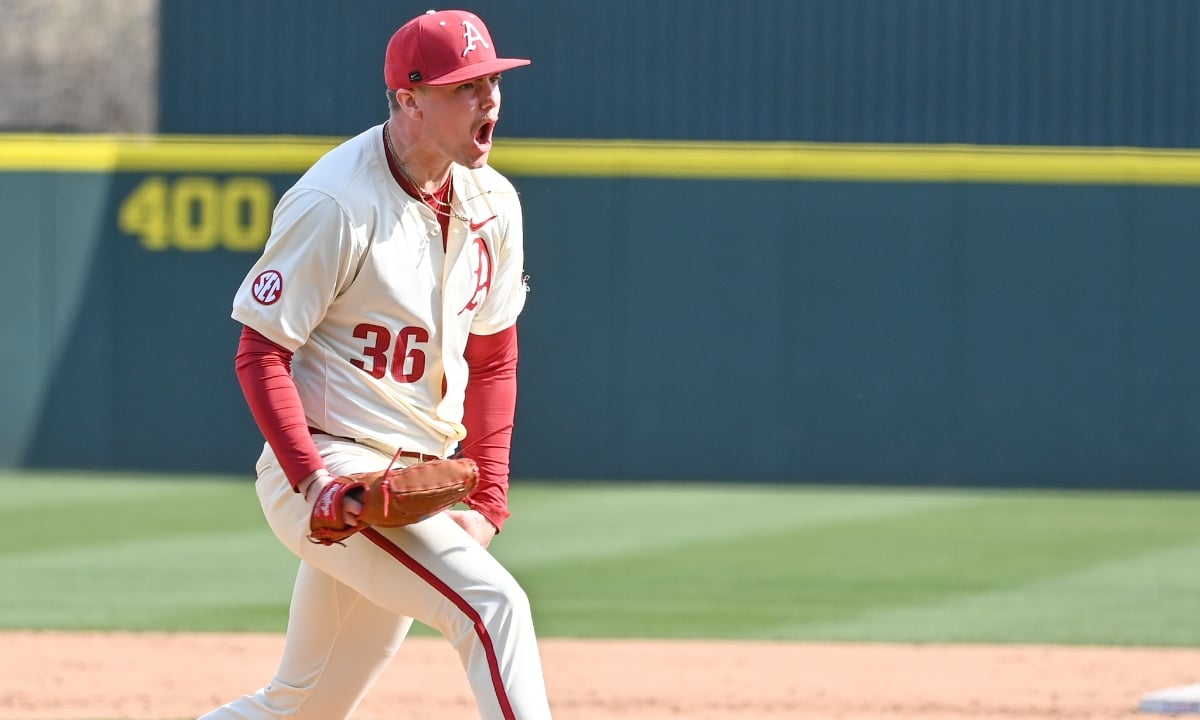
 photo credit: Craven Whitlow
FAYETTEVILLE — In what has become an annual tradition, MLB teams decimated the Arkansas baseball roster last month.
The Razorbacks matched a school record with 11 players drafted and another two signed as free agents. They also lost a trio of would-be newcomers.
It wasn’t all doom and gloom, though.
Left-hander Parker Coil was selected by the Milwaukee Brewers in the 16th round, but chose to play his senior year at Arkansas — a rare move in college baseball, especially since the draft was reduced to 20 rounds in 2021.
Only five of the 459 players selected out of four-year colleges in this year’s draft opted to return to school.
The Edmond, Okla., native gives head coach Dave Van Horn and pitching coach Matt Hobbs a veteran arm on a staff that’s losing 64.3% of its innings from last season, but his return wasn’t always a certainty.
“There was a lot going on behind the scenes, a lot of moving parts, a lot of conversations with Coach and the team and trying to figure things out,” Coil said. “But ultimately I think that God led me back here and paved the way for me to come back and take another step in my career.”
In his first interview since his decision, Coil opened up to Best of Arkansas Sports about those “moving parts” and the factors that led him back to Fayetteville.
MLB Draft Surprise from the Brewers
Going into the MLB Draft, Parker Coil was viewed as a borderline prospect. He put up great numbers in 2025, but was a reliever without an upper-90s fastball who missed half of the season with an injury.
Still, a 1.27 ERA for an elite program like Arkansas figured to garner at least some interest. Sure enough, Coil started getting a few calls as the rounds progressed. None of them were willing to offer what he wanted, though, so he told them he wasn’t interested and was going back to Arkansas.
In the 16th round, the Brewers took him with the 485th overall pick anyways.
“It was a complete shock when I saw my name and got that call,” Coil said. “But it was very cool nonetheless and it’s something I was dreaming about since I was a little kid.”
Coil described it as a “surreal moment,” but admitted to being confused at first.
His agents, Darek Braunecker and Stephen Young with Little Rock-based Frontline, explained he was likely a “flier pick.” By taking him after the 10th round, the Brewers could make an effort to sign him, but if they failed, they wouldn’t lose any of their bonus pool – a penalty for failing to sign those taken in the top 10 rounds.
The next week or so was chaotic as his agents negotiated with Milwaukee. Coil also had to move out of his apartment and figure out if he should sign a new lease with teammates Cooper Dossett and Reese Robinett.
Ultimately, conversations with Matt Hobbs reaffirmed the 21-year-old’s feeling that he should come back to school, as the coach made it clear the Razorbacks really wanted him to return.
“The Brewers were kind of taking their time with whatever, not entirely sure on the money thing yet, but I had a really good feeling in my heart that this is where I wanted to be,” Coil said. “I think about a week or five days before (the July 28 signing deadline) is when I knew and it was set in stone.”
Milwaukee had enough money left in its bonus pool to make a strong offer and Coil said it actually got close to his asking price, but he stuck to his guns even as it made some last-minute calls.
Inside Parker Coil’s Decision
While he repeatedly cited Matt Hobbs as a major reason for his return to Fayetteville, Parker Coil said there was actually a lot working in Arkansas’ favor.
Much of the talk about the House settlement has been on the introduction of revenue sharing, which legalized direct payments to athletes, but its biggest impact on college baseball involves the new roster limits.
Schools are no longer limited to the infamous 11.7 scholarships. They are allowed to award full scholarships to the entire 34-man roster, although athletics director Hunter Yurachek said Dave Van Horn would have 25 to use this season.
Prior to that change, most college baseball players had to pay for at least part of their school out of pocket or with student loans. That’s a big deal to a guy like Coil, who lacks just 18 hours to finish his information systems degree in the Walton College of Business.
“I don’t have to pay for school, so that’s another thing you check off and don’t really have to worry about,” Coil said.
Of course, the money aspect – while not the end all, be all for Coil – is also important.
Seniors have no leverage in contract negotiations and routinely sign for far less than slot value, regardless of how successful they were in college. That’s why juniors almost always sign when they get drafted, even if they could theoretically improve in their final season.
NIL and revenue sharing, coupled with the increase in scholarships, are changing that equation.
Those things will likely never compete with the bonuses players taken in the top 10 rounds receive, but payments from schools, collectives or third parties could make up some of the difference for those taken in the back half of the draft, where bonuses aren’t as big.
“It’s definitely closed that gap and it makes it really hard (to leave school),” Coil said. “Coach Hobbs and I were talking (about how) as a junior probably five years ago, you’re probably not even really thinking about coming back to school because you lose your leverage and you’re probably missing out on a ton of money.”
What it Means for Arkansas Baseball
Back from a fishing trip to Greers Ferry Lake, where he and his father caught some walleye, Parker Coil has put the chaotic last month behind him and is focused on the 2026 Arkansas baseball season.
He didn’t shy away from telling BoAS his goal is to be a starter. He said he believes he has the qualities of a starter and that it’d likely be what he does in pro ball. Dave Van Horn is on the same page.
“He’ll definitely get a look at starting,” Van Horn said earlier this month. “We already know how good he is out of the pen. He can handle the heat. He can handle the pressure. He comes in, he pounds the strike zone, throwing that cutter. He makes you swing. So if he can do that as a starter, that’d be great.”
What Could Set Parker Coil Apart
Developing a fourth pitch, specifically one to complement his fastball, will be “crucial” for Coil’s evolution…
Already a subscriber? Log in here
Keep reading this article for free.
Sign up for a free account to continue reading and get access to the BoAS’ newsletter.
The free account you create gives access to more of BoAS’ stories delivered to your inbox. Unsubscribe any time.
***

***
More coverage of Arkansas baseball from BoAS…