The New York Mets made history yesterday.
Kodai Senga threw 5 and 2/3 innings of one-run ball vs the Pittsburgh Pirates, raising his ERA to 1.22 over his first eight starts of the year. Yes, you read that right, raising.
In the process, Senga joined Clay Holmes, David Peterson, Tylor Megill and Griffin Canning to become the first group of five starting pitchers to have a sub-3.15 ERA and 40-plus strikeouts through their first eight starts, per Greg Harvey on X.
The Mets’ rotation — the same one that most of the baseball world said would be their Achilles heel even before losing Sean Manaea and Frankie Montas — has been nothing short of phenomenal.
Fear The Ghost — BOO!
Senga has been the best of the bunch. After making just one start in the 2024 regular season and three very abbreviated ones in the postseason, Senga looks like the same pitcher who was runner-up to Corbin Carroll in the 2023 NL Rookie of the Year race. The 32-year-old has a deep arsenal and can pump his fastball into the upper-90s, but his signature ghost fork is what steals the show. Senga’s forkball, especially when tunneled of his heater, might be the nastiest pitch in baseball.
Senga’s 1.22 ERA is second only to Max Fried of the Yankees in baseball and over half a run better than Yoshinobu Yamamoto of the Dodgers, the next closest in the NL. He is probably the leading candidate for the NL Cy Young Award (not that it means too much in mid-May, but still).

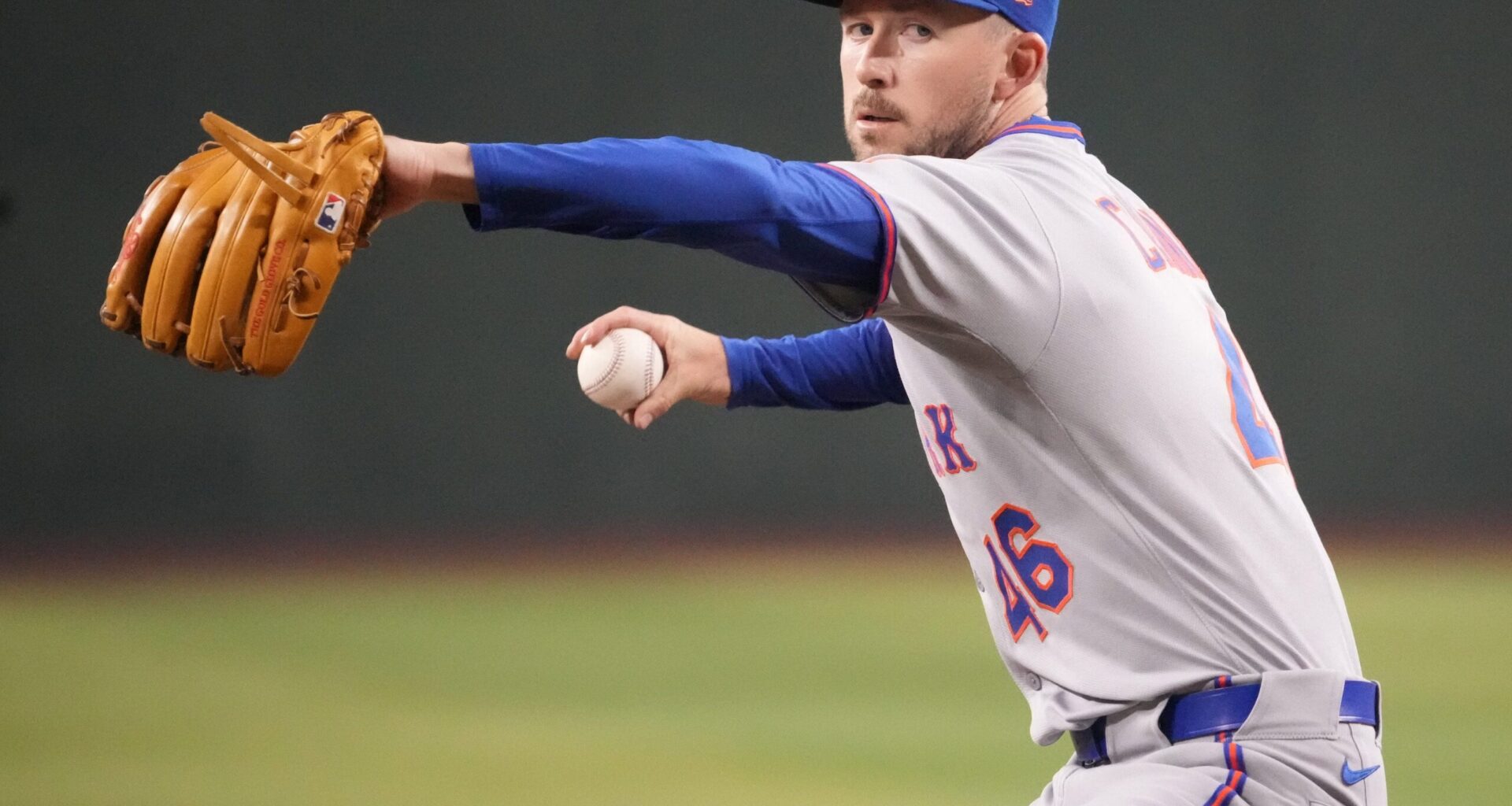
New York Mets pitcher Griffin Canning (46) by Michael Chow
Changing Arsenals
Canning is the next Met on the ERA leaderboards. He’s technically just one inning shy of qualifying — a consequence of often struggling to go deep into games — but will likely officially qualify for the ERA leaderboards after his next start. His 2.36 ERA would be tied for No. 5 in the NL if qualified and he has been maybe the most surprising development on this Mets pitching staff.
Signed to just a 1-year, $4.5 million deal this offseason, Canning was coming off a brutal year for the Los Angeles Angels, where he posted a 5.19 ERA and struck out just 130 batters over 171 and 2/3 innings. He was likely ticketed for a long relief role with the Mets, or maybe even a demotion to Triple-A if the Mets thought they could sneak him through waivers, before Manaea and Montas both went down in spring training.
Instead, Canning has posted the second-best ERA in a Mets rotation that has been the best in baseball. He’s given up hits and home runs at a much lower rate than last season, and he’s up to averaging one strikeout per inning after being well below that in 2024.
The biggest reason to point to for this change lies in his pitch mix. Canning has bumped the usage of his slider way up to the point where it is now his most-used pitch (and it doesn’t hurt that he’s added almost four more inches of break to it). This has helped his four-seam, which is a fine but largely unspectacular pitch, play better and get more swings and misses. His changeup has continued to be a good weapon, and he’s mostly ditched his curveball. He’ll throw it, along with a sinker and cutter, very sparingly, but he’s largely a three-pitch pitcher now, leaning into his best stuff.
The same can be said for Megill, who might finally be breaking out after years of inconsistent results and many opportunities to stick in the Mets rotation. Megill threw the kitchen sink last season, throwing eight different pitches but just one of them (his fastball) over 15% of the time.
It’s a completely different approach for Megill in 2025. His 4-seam fastball usage has pretty much stayed the same, but he’s started leaning on his slider and sinker much more. His slider usage is up from 11% to 23%, and his sinker usage is up from 10% to 23%. He’s already thrown more sliders and sinkers this year than he did last year in just over half as many innings.
Meanwhile, he’s completely ditched his cutter, which was his second-most-used pitch in 2024 and one that got absolutely walloped whenever he threw it. His splitter is also gone (farewell, American Spork) as is his sweeper, which he threw occasionally. He still has a changeup that he throws 7% of the time and a curveball that he throws 4% of the time, but like Canning, he largely leans on three pitches.
Megill had a great start to the season, but he’s surrendered four earned runs in each of his last two outings and 11 total in his last three. With his history of strong starts that have tailed off as the year went on, he’s still going to need to prove this year isn’t like the others.
Ground Ball Buddies
Peterson, the longest-tenured pitcher on the active roster, came into his own in 2024 and has continued it into 2025. His success comes from his ability to induce ground balls. He doesn’t have overwhelming velocity or standout stuff, but he gets hitters to consistently put the ball on the ground.
Among pitchers with at least 100 balls put in play against them, Peterson’s 56.5% ground ball rate ranks No. 6. His ground out-to-air out ratio is fifth-best among qualifiers, and he’s getting batters to chase more than he did last season. His chase rate has risen from 28.8% to 30.5%, moving him from the 51st percentile in 2024 to 74th percentile in 2025. As a result, his strikeout rate and walk rate have both improved from below average last year to about average this year.
Peterson’s also adept at limiting action on the basepaths. A lot of credit has to be given to Mets catchers, who have done a tremendous job throwing out potential base stealers this season, but Peterson’s strong pickoff move is well-documented. He and José Butto are the only Mets pitchers who have picked a runner off this season, and Peterson is the only Mets starter who has yet to surrender a stolen base.
Holmes, the former Yankees closer turned Mets starter, has famously done a great job at getting ground balls and that has continued this season. While his ground ball numbers are actually down from his time as a reliever, he’s still No. 12 among pitchers with at least 100 batted balls against him. He’s actually the third Met on the list, behind Peterson at No. 6 and Canning at No. 10.
The signature sinker is still great and the slider and sweeper are still really good as well, but Holmes’ new kick-change is the star of the show. Like the sweeper before it, the kick-change has burst onto the scene as the new hot pitch for pitchers to add to their arsenals, and no one got more attention while doing so this offseason than Holmes.
So far, it’s lived up to its billing. The kick-change is now Holmes’ second-most-used pitch behind his sinker, and it’s producing absurd results. Batters are hitting just .179 vs it and whiffing 37.7% of the time. It’s the highest whiff percentage of any of his pitches and the fifth-highest individual pitch whiff rate among all Mets pitchers behind Edwin Díaz‘s slider, Buttó’s slider, Senga’s forkball and Megill’s slider.
Through the first month and a half of the season, Holmes’ transition to starting pitcher has been a rousing success. The big question will be if he can maintain that success over a full season’s workload. The Mets ave been careful with him so far. Like Canning, he’s just shy of qualifying, falling just one out short. That’ll change when he makes his next start, but he will likely be teetering on the edge all season as his workload will certainly be intensely managed.
With Manaea and Montas back at some point and all five starters pitching this well, the Mets might have some great-to-have hard choices ahead.