
The Atlanta Braves got to have something in their back pocket following a quiet Winter Meetings. Ever since their big move to send Soler to the Angels, it’s been just a series of small moves.
It’s not that these small moves are necessarily bad moves, per se. Some of them could have landed them key players for next season, and we don’t realize it yet. It would be very on-brand.
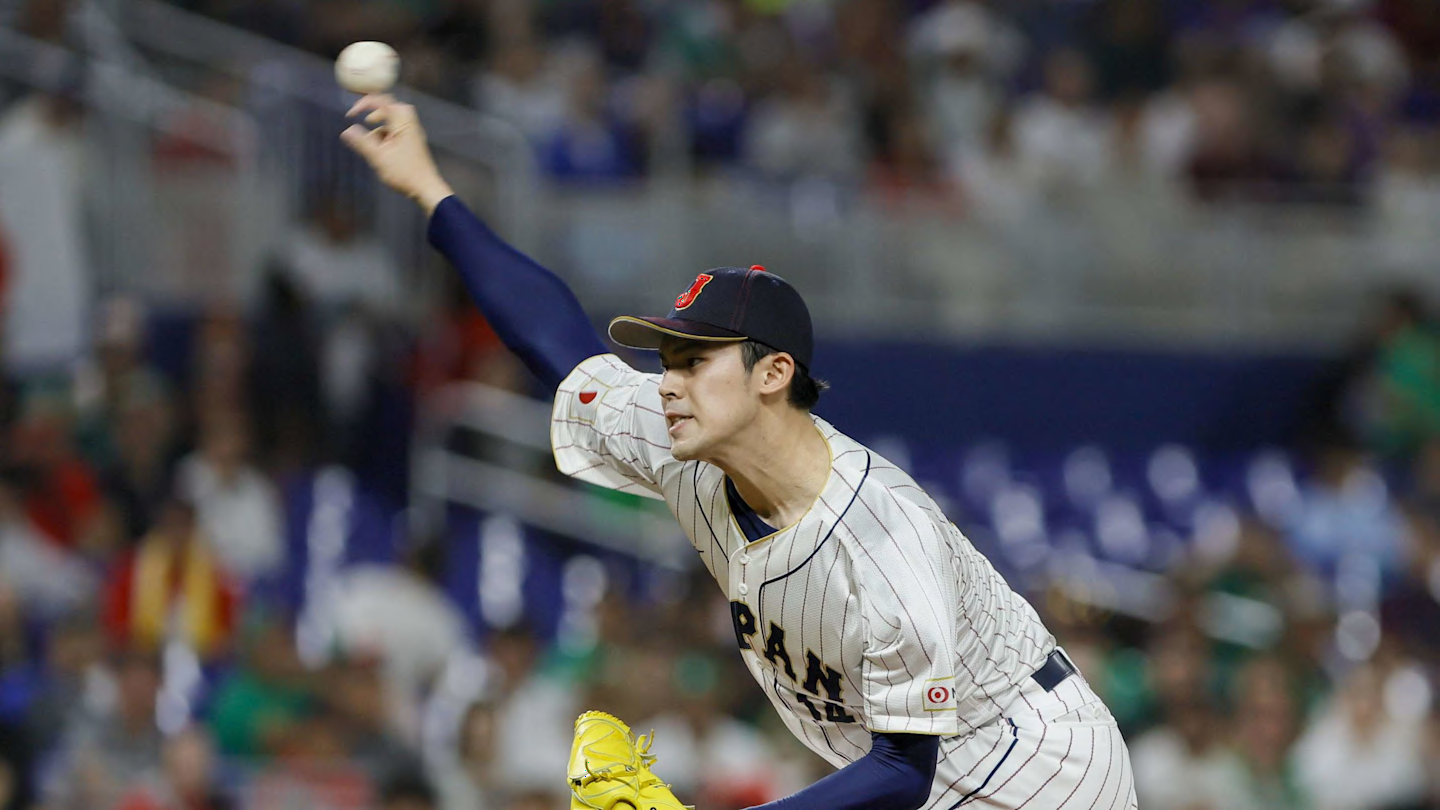
But they need a statement acquisition. A perfect one would be Japanese starting pitcher Roki Sasaki. The 23-year-old righty became available to talk to teams on Tuesday and will be able to until 5 p.m. EST on Jan. 23.
If the Braves aren’t looking into him, that needs to change. It’s an acquisition that would be mutually beneficial.
First, we’ll look into how the Braves benefit and then how Sasaki benefits to show why this move needs to happen.
The obvious first point is that he provides a quality long-term answer in the starting rotation. In his four seasons with the NPB’s Chiba Lotte Marines, Sasaki has a 29-15 record with a 2.10 ERA, an insane 0.894 WHIP and 505 strikeouts over 394 2/3.
Would we see numbers this good once he gets to MLB? It’s possible, but it’s doubtful he would out of the gate.
Even if he doesn’t, he’ll still likely put up strong numbers. Fellow Japanese pitcher Yoshinobu Yamamoto had a 1.21 ERA in his final year in Japan before signing with the Dodgers. While he struggled at first, he finished with a 3.00 ERA and had a 2.51 ERA in his final 13 starts. Not bad for year one.
There is no reason to believe Sasaki couldn’t put up similar numbers. He’ll also arrive in the States at a younger age than Yamamoto (who was 25), giving him more room for growth.
The age that Sasaki is when deciding to come over to MLB provides the Braves with more incentive to pursue him. He’s in a Shohei Ohtani situation, where he’s coming over when he’s too young to be an international free agent. He would be an international amateur. He would be signed with international prospect pool money.
The Braves currently have $6,261,600 in pool money to spend. Even if they blew it all on Sasaki, that would be a solid deal, even when you include that the release fee is 20% of the total guaranteed value of the contract. They would then have the typical six years of control before he’s a free agent.
He would take the spot of a prospect already in the system, sure, but there is more proven talent here. Those prospects could then be used in trades for other upgrades.
It’s easy to assume one of the big clubs, like the Dodgers, is going to easily get Sasaki. He would be able to team up with Ohtani and Yamamoto on the reigning World Series championship team.
But that isn’t looking like the case.
First, I think some people forget he can’t sign a deal like Yamamoto’s, so it’s a much more level playing field.
Second, it doesn’t sound like he wants to go to the top team in the biggest market. His agent, Joel Wolfe, said Sasaki would be better off in a smaller market. He had a tough time with the Japanese media and could be looking to take pressure off.
“I think that there’s an argument to be made that a smaller, mid-market team might be more beneficial for him as a soft landing coming from Japan – given what he’s been through,” Wolfe said.
Now, for those who have basic knowledge of metro demographics in the USA, you would be correct to point out that Atlanta is one of the largest markets in the country. But markets like New York and Los Angeles are entirely different animals than the rest of the country.
Atlanta is half the size of LA and a third of the size of New York City and the media situation would be nothing like in those top cities and Japan. Sure, the Japanese media is still going to come to track him overseas, and nothing should stop them from doing so. But going to an American market with less media pressure would help a lot.
There is also speculation that Sasaki going elsewhere could benefit him in obtaining better endorsement deals. With the Braves, he can be a star that is marketed to almost the entire southeastern US market.
Now, let’s quickly touch up on on-the-field reasons. The Braves’ ability to develop pitching should be a strong part of their pitch (no pun intended) to Sasaki. Let alone have they developed the likes of Max Fried, Spencer Schwellenbach and Spencer Strider, they have also helped incoming players such as Chris Sale revive their careers.
Sasaki would be in a prime position to develop further in the Major Leagues in Atlanta. The Braves just need to be aggressive in making that happen.