
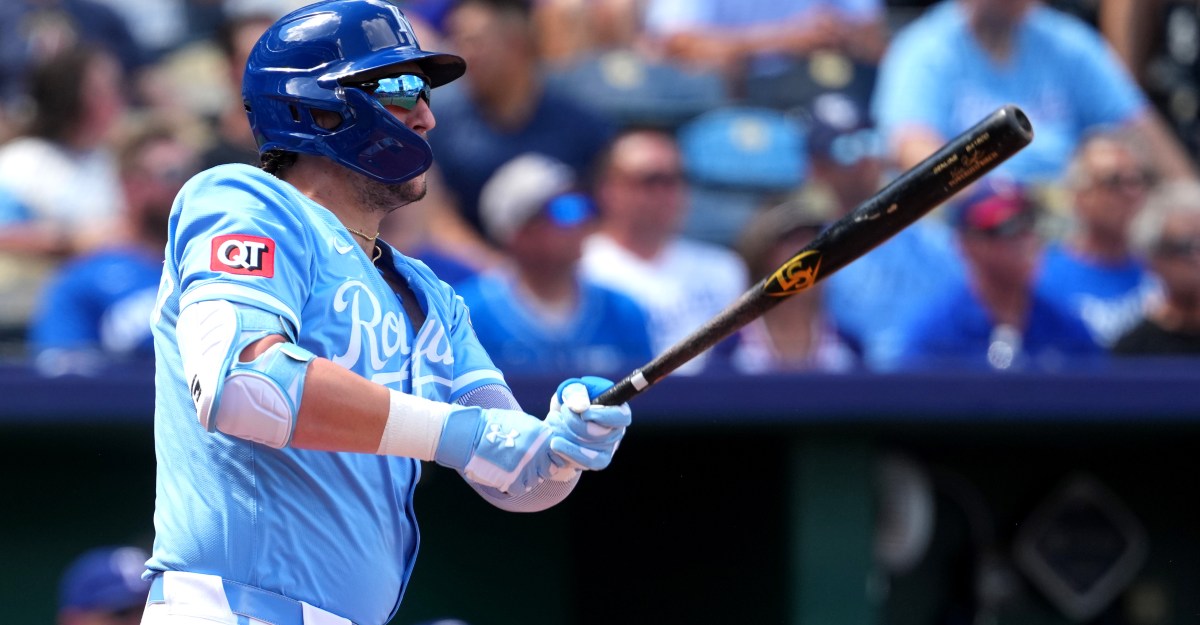
Vinnie Pasquantino hit another home run again over the weekend. He’s been doing that a lot lately, to the delight of Kansas City Royals fans and the chagrin of opposing baseball teams. The large man with one of the most Italian-sounding names physically possible is now at 28 home runs on the year, and every new dinger he socks extends his single-season career high.
But it has been a bit of an arduous road for Vinnie this year. He started off slowly, and had an OPS under .700 all the way through May 25. It wasn’t until this week that his OPS hit .800 for the first time since the opening week of the season. Vinnie remained aggressive throughout, though, and in a variety of interviews, I got the feeling that Vinnie’s conception of the role on the team was one of run producing first and foremost.
A few weeks ago, I got the opportunity to have a conversation with Vinnie in the clubhouse before the game. He’s a popular interviewee with the media and isn’t always available to have a one-on-one chat. But that day, he was. I asked him if he had a few moments and opened with a question: how do you approach being a run producer versus being a table setter?
“There’s not too much thought to it,” Vinnie told me. “If there’s people on base, I need to drive them in. And when there’s not anybody on, I got to get on base. That’s pretty much it.”
The ironic part to that answer is that, after I asked the question, Vinnie sat silently for a few beats to compose his answer. Have a discussion with the Royals first baseman or listen to him discuss hitting and that baseball intelligence is immediately obvious. Keeping it simple while being open to thoughtful consideration and strategy is a needle that Vinnie threads every day.
Another example of this is when I asked him if he keeps his walk rate and strikeout rate in mind when he goes to the plate. “I used to think about it more, but then it got to a point where it was like, all right, my role in the team is driving in runs,” Vinnie said. “I need to worry about bringing runs in. And a lot of times that involves being a little bit more aggressive. It’s like, what’s the job?”
“My pitches per plate appearance have gone up every single year, but the most I walked was my rookie year when I saw the least amount of pitches. I think that sometimes I go up there with a more passive mindset and I end up chasing more because of it later in at bats, because I fall behind in the count. And because I wasn’t as aggressive in the beginning of the at bat, I’m more willing to chase because I feel like I need to swing.”
“The way you get pitched is differently, too,” Vinnie said. “When we get reports, we get reports with guys in scoring position versus guys without scoring position because guys are going to do different stuff on the mound. So it’s just a different approach just because if there’s a base open, they’re going to be more willing to throw balls. If there’s not a base open, they’re going to come after the strike zone.”
In addition to the difference in mindset between driving in runs and getting on base, I asked Vinnie about his mindset about hitting in Kauffman Stadium. Earlier in the year, I had gotten responses from a few other players that they weren’t thinking about the stadium so much at the plate.
But Vinnie surprised me. “Yeah,” he said. “I don’t try to get them on the air as much here. I know that there’s more hits out there and there’s less home runs out there, so you just try to keep the ball a little lower here.”
It hasn’t mattered so much recently, but of course it’s summer. Vinnie mentioned that, too. “Nowadays with it being summer, [the ball] is flying a little bit more,” he told me. “But especially at the beginning of the year, you try to keep it a little bit lower or else you’re going to fall into a lot of traps here just because you’re expecting stuff might be better, but balls aren’t flying. So it’s not going to go out no matter how hard you hit.”
Vinnie’s observations are consistent with the data. This year, 19.5% of his fly balls have turned into home runs on the road, while only 12.5% of his fly balls have turned into home runs at home, a trend that is consistent throughout his career.
Though 2025 isn’t yet over, Vinnie is enjoying the best season of his career. He’s on pace to post career highs in games played, Wins Above Replacement, RBIs, and isolated slugging percentage. He’s also on pace for a career low walk rate and a career high strikeout rate. But in the context of his comments, those numbers all make sense: Vinnie is out to do damage first and foremost, to take good swings in good counts against good pitches. Then, let the chips fall where they may–and the balls fall over the fence.