
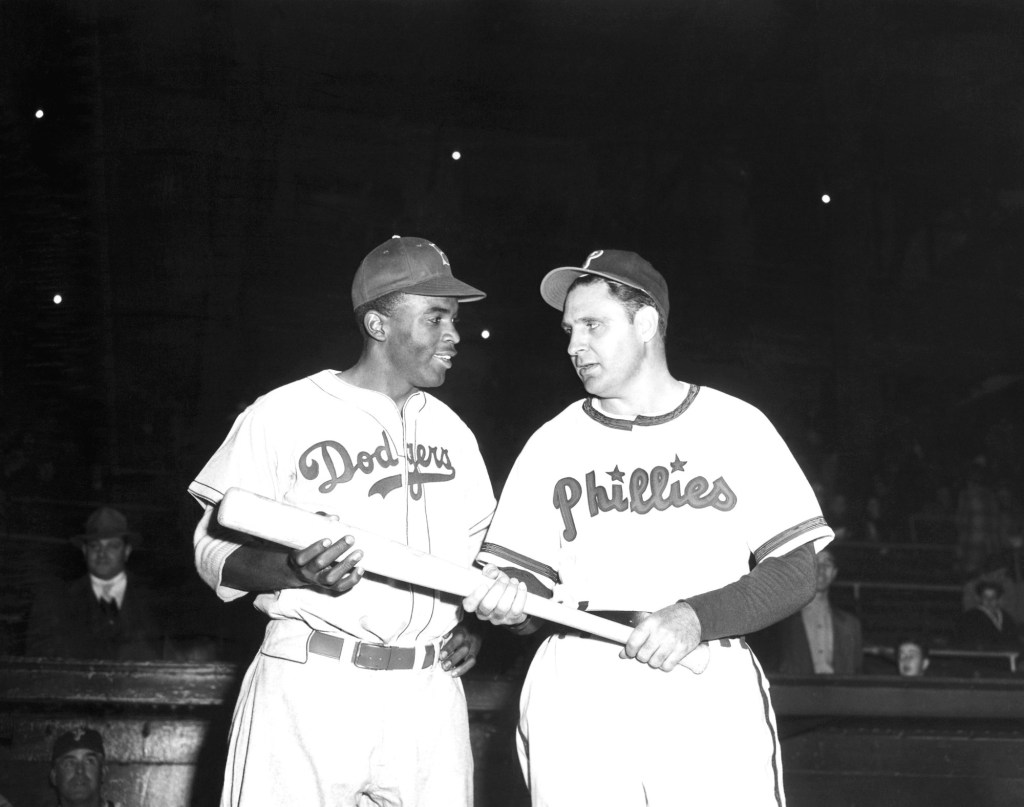
The 1947 Philadelphia Phillies won only 62 of their 154 games. They finished the season tied with the Pittsburgh Pirates for last place in the National League.
I suppose it’s safe to conclude that they weren’t particularly adept at playing baseball.
However, there was one day in August (actually only 12 minutes of one day) that they demonstrated their ability to NOT play baseball. It turned out that that’s what they were good at.
No one noted the anniversary of that day (Aug. 17) when it passed recently. No one was expected to. When it happened it was an ugly, farcical scene that no one really wants to remember.
However, it is not something that should be forgotten.
The nonsense happened during the seventh inning of the second game of a doubleheader between the Phillies and the Brooklyn Dodgers in Philadelphia’s Shibe Park. It happened because Pennsylvania had a “blue” law on the books that said baseball could not be played after 6:59 p.m. on a Sunday.
The National League, with two of its eight franchises in the Keystone State, added its own rule that no inning could begin after 6:44. If the curfew caused a game to be halted in mid-inning, the rules were the same as they were if rain intervened. The score would revert to whatever it was at the end of the last complete inning. If five or more innings were in the books, the result was official.
There was a big clock on the right field scoreboard of Shibe Park, and on that particular afternoon the hands showed 6:42 as the seventh inning began. The scoreboard also showed the teams were tied, 4-4. The Dodgers’ Jackie Robinson grounded out, but Pete Reiser and Gene Hermanski each walked. Dixie Walker singled, scoring Reiser with Brooklyn’s fifth run.
The scoreboard clock showed 6:47. That was the last sane moment of the day.
The Phillies realized that if the seventh inning were not completed in the next 12 minutes, the run the Dodgers had just scored wouldn’t count. They set out to see if they could make that happen.
First, manager Ben Chapman shuffled out to the mound to make a pitching change, replacing Al Jurisich with Charley Schanz. The Dodgers could see what the Phillies were up to, and they decided to fight fire with fire.
Err … make that absurdity with absurdity.
Schanz threw three pitches to Pee Wee Reese that were outside the strike zone, but Reese swung at all of them — striking out as quickly as he could. Both base runners were in motion on the third strike. That is, they were in slow motion, ambling towards the next base and daring the Phillies to tag them out. The Phillies didn’t take the bait.
That opened first base and Chapman ordered Schanz to intentionally walk the next hitter.
That hitter was Stan Rojek, who was standing in the right-handed batter’s box when the first pitch was thrown. By the time the ball reached home plate, Rojek had bolted into the opposite batter’s box and even took a half-hearted swing at it.
Nevertheless, umpire George Barr called the pitch a ball. Then he issued a warning to Rojek: “If you do that again I’ll fine you twenty-five dollars.”
Properly chastised, Rojek stood firm for the rest of the at bat and accepted the free pass, bringing Bobby Bragan to bat. Schanz peered in for a sign from his catcher, then called time, claiming that his glasses had fogged and he couldn’t see the signs. A bat boy was summoned to bring the hurler a towel. After stalling as much as possible, Schantz threw a pitch to Bragan. It was the last one he threw.
As the pitch was released, Hermanski wandered off third, deliberately walking towards home plate. Phillies catcher Don Padgett held the ball in his glove as he stared at the approaching base runner.
“If you don’t tag him,” shrieked Barr, “I’ll fine you a hundred dollars.”
One hundred dollars was a lot of money in 1947. It was much more than a backup catcher on a last-place baseball team could afford to shell out for his part in a charade.
Padgett dutifully stepped into the base path and waited for Hermanski to arrive. That was the third out and the Dodgers sprinted to their positions in the field, hoping to secure three outs before the clock ran out.
There was no chance that would happen.
Harry “the Hat” Walker (Dixie’s younger brother) was the first batter. He settled into the batter’s box, then abruptly called time out because he had forgotten something.
No, I’m not making any of this up.
“The Hat” told Barr he had forgotten to bring his bat.
There’s no record of what Barr’s answer was, but H. Walker was allowed to wander back to the dugout to pick out a piece of lumber.
Eventually he returned to home plate and took a pitch, then stepped out of the box and fiddled with his cap.
He took another pitch and stepped out again. This time he not only fiddled with his cap, but also paused to comb his hair.
He took one more pitch before the big hand on the right field clock moved into a position just short of the 12. The hour was 6:59 and Barr was forced to halt play. The Phillies had successfully run out the clock. The game was a tie, and under the rules it would have to be replayed.
At least, that’s what everybody believed.
Reaction was swift — and predictable.
National League president Ford Frick called the whole display “a disgrace to baseball and a complete travesty of all rules of sportsmanship.”
I’m not sure either man gave much thought to his words before he blurted them out.
Frick was heaping all the blame on the players, but the players had done nothing more than seek the most favorable result for their respective teams. The real culprit was the game’s authorities who allowed rules to exist that rewarded such a farce. Frick might have anticipated this situation and proposed rules to deal with it, but he hadn’t. Nobody else had either.
Now that it had happened, he was willing to blame anybody but himself.
However, Frick’s reaction was more than verbal. He ruled that the game was NOT a tie. He declared that it was a suspended game and that everything that happened in the crazy seventh inning would be allowed to stand. The Dodgers had a 5-4 lead. H. Walker was at bat in the bottom of the seventh with no outs and a two-and-one count. The game would be resumed at that spot when the Dodgers returned to Philadelphia in September.
When the contest resumed, the Dodgers went on to post a 7-5 win — as if it had been just another game. But, of course, it wasn’t.
The official scorer had ruled on some unprecedented occurrences. He decided that Hermanski and D. Walker would not be credited with a double steal. He called the advance defensive indifference. Likewise, Hermanski was not charged with a caught stealing when he was tagged out at the plate.
Here are some other notations:
Reese struck out 67 times that season, which was seventh most in the league. No doubt, that was the only one that was done intentionally.
H. Walker’s 11-year career included 2,981 plate appearances. As far as we know, he remembered to bring a bat with him 2,980 times.
Rojek played eight years in the major leagues and was intentionally walked only four times. One of them occurred that day.
However, the most important take-away from the game was that Frick’s spur-of-the-moment ruling eventually became an accepted procedure. Beginning in 1948, any game halted by a curfew was suspended and resumed at the next opportunity. That was the rule for dozens of games for almost a quarter century.
Pennsylvania did not get around to repealing its blue laws until 1971.
A FEW STATISTICS (Wednesday’s games not included): James Wood of the Nationals leads the majors in strikeouts with 177. His batting average on balls put in play is .404 … The Padres are 26-34 against teams with a winning record … Austin Wynns, formerly with the Reds and now with the Athletics, has caught only 35 games this year. Nevertheless, he has thrown out 11 would-be base stealers … Blue Jays shortstop Bo Bichette leads the majors in hits with 167. Forty of them have been doubles … Cal Raleigh of the Mariners has clobbered 50 home runs — 25 at home and 25 on the road … The Rangers have committed only 41 errors. The Red Sox have been charged with 100. Yet the Red Sox have won six more games than the Rangers … Javier Baez of the Tigers has driven in 35 runs in the 57 games in which he has batted ninth … The Dodgers are 25-11 against teams in their own division. They’re 51-46 against everybody else … The Phillies are 12-15 in games in which Rafael Marchan has started at catcher … According to Baseball-Reference.com, Cubs center fielder Pete Crow-Armstrong has passed Rays shortstop Taylor Wells as the most dominant fielder in the major leagues. B-A gives Crow-Armstrong a defensive WAR (wins above replacement) rating of 2.5 … Antonio Senzatela of the Rockies has given up 171 hits — the most in the majors. Astonishingly, his hits-per-inning rate is higher on the road than it is in Coors Field … Randy Arozarena of the Mariners leads the majors in times hit by a pitch — 22. His career total is 93, which ranks him 128th on the all-time list … Jeremy Pena of the Astros has a .348 batting average with runners on base … Clay Kershaw of the Dodgers is 5-0 in August with a 1.88 ERA.
Former Hall of Fame voter Jay Dunn has written baseball for The Trentonian for 57 years. Contact him at jaydunn8@aol.com