
Every night during the season, the person directing a Major League Baseball broadcast makes thousands of tiny cinematic decisions. With a panoptical array of cameras covering every square inch of the diamond, they soak up all of the details hiding in plain sight. You’re already familiar with the touchstones: A tight zoom toward the sweaty brow of a beleaguered pitcher, a wide shot of a leadoff batter’s coiled stance, or a sweep across the stands to capture the giddy-drunk fans during the seventh inning stretch. But John DeMarsico, who directs games for the New York Mets, takes it all much further. What if a baseball broadcast could look like Spielberg? Or Coppola? It’s not as crazy as it sounds.
Over the past few years, DeMarsico began mixing in homages to the Hollywood canon during those listless evenings battling the Phillies, in the same way Tarantino might weave in a not-so-subtle nod to John Ford during a bloody action sequence. You know it when you see it: Maybe DeMarsico will cut to an overhead shot of Citi Field from the crown of the Statue of Liberty, in a way that evokes Planet of the Apes. Another night, he frames Edwin Díaz’s slow trot to the mound like Dorothy’s first steps from black and white into the Technicolor world of Oz, or he squares up former manager Buck Showalter like Zendaya, simmering from the grandstand in Challengers. However, DeMarsico’s most frequent inspiration might be Sergio Leone’s spaghetti westerns. When angled correctly, a showdown between a batter and a pitcher can look a whole lot like the quickdraw duels in The Good, the Bad, and the Ugly.
Woke up to thousands of new followers. Here’s a crash course on the things we do here for the new folks #Baseballiscinema pic.twitter.com/LzsPb8UcUW
— John DeMarsico (@JohnDeMarsico) May 12, 2025
There is more of an overlap than you might think between Criterion Channel obsessives and baseball dorks, which explains why earlier this week, some of DeMarsico’s most memorable homages spread through the internet like wildfire. (“Dudes rock,” said one Twitter user, savoring a particularly well-executed De Palma tribute during a game against the Cubs.) I was similarly enamored, so I called up DeMarsico to ask him about how he’s melded his love of movies with his love of the Mets, why he believes baseball is the world’s most cinematic sport, and the one homage he’d someday love to integrate into his repertoire if conditions and technology allow. This interview has been edited and condensed for clarity.
learning that the director for the Mets’ broadcasts is a huge film nerd is so cool. guy will just put random shots that look like this mid-game because he’s a DePalma fan. dudes rock so hard. pic.twitter.com/u5ByDjI5Bl
— balta (@BGarcN2) May 12, 2025
Luke Winkie: What’s your background in film and TV? How did you end up working in sports broadcasting?
John DeMarsico: I grew up a die-hard Mets fan, and I played baseball my whole life. But I was also obsessed with movies and film culture. I studied film in school, but I had no idea that I’d ever be stepping inside a TV truck, let alone the TV truck for my favorite baseball team, the Mets. I ended up interning for SNY, the network that I currently work at, in 2009, and was hired shortly after my internship. That’s where I really went to school. I went to the Bill Webb baseball directing school. Bill Webb was my predecessor and the first kind of rock-star baseball director. He directed the World Series on Fox for two decades.
He was a real maverick. The way that people watch baseball in the year 2025 is really thanks to him. He had an elevated style. He was a guy that took a lot of chances, and I learned my craft from him. When I took over in 2019, I brought a little bit of my own personality and personal philosophies into what I’d already learned from Bill.
Was Bill Webb a film nerd? Did you guys talk about movies at all?
He didn’t know the first thing about movies. He probably went to the movies once a year. But he spoke cinema, even if he didn’t know it. He covered the games, but he was most interested in elevating the drama and telling a story. He’s the guy who embraced taking shots of fans in between pitches, in tense moments. You’d have the mom praying in the stands, a woman clutching her necklace, a father and son locked onto the field. And he’d take those tight shots of the pitchers where you only see their eyes, the brim of their cap and the top of their gloves, and it would really elevate the moment. He was using cinematic language within the context of a baseball broadcast. With my film background, I saw it right away. I said, “Wow, dude.” I thought, This is filmmaking. When I got into the role, those things became part of the grammar of the way I tell stories.
When you took the reins, what made you comfortable pushing the envelope further, and including some genuine cinematic homages in the game broadcasts?
The homages are fun and they’re a big part of what we do at SNY. But it really is about that bedrock foundation of making every single cut have cinematic intention. There are so many moments over the course of a baseball game, and baseball is a unique sport when it comes to television because you have the time to implement cinematic devices. There’s time between pitches, there’s time after foul balls, there’s pitching changes. It’s not constant movement. In order to implement all of these cinematic bells and whistles, you need moments of stillness to set things up. And that was actually the first kind of lightbulb moment for me. The confrontation between the pitcher and the batter, those moments of stillness before the pitch is thrown, and it harkens back to the Western genre, the showdown at the O.K. Corral, mano a mano. I love the American Westerns, but I’m drawn a little bit closer to the Italian Westerns. They’re just so highly stylized, and it’s sort of my taste. When there’s a big moment in a baseball game, the crowd’s going to let you know when it’s a big moment. They’ll get up and tell you, and you’ll feel it in the truck. It’s my job as the director to take that moment and turn it into an event for everybody watching at home and try to elevate it.
One of the shots you directed that went viral mirrored a famous scene in Apocalypse Now, where a G.I.’s head is blended into a sunset filled with helicopters. In your version, of course, the G.I. is a baseball player, and that sunset is the outfield. That’s a pretty radical shot to include in a sports broadcast. How did it come together?
I love the smell of napalm in the morning https://t.co/N5m18DlgiV pic.twitter.com/24kuKilAcL
— John DeMarsico (@JohnDeMarsico) May 13, 2025
When I consume cinema, I’m constantly taking notes, thinking, Hey, this may work in a baseball broadcast. And I have a really incredible crew. I sit in front of a monitor wall, look at all the monitors, and call the shots verbally. There’s a technical director named Seth Zwiebel who sits beside me and physically presses the buttons and pulls the levers and makes things go on the air. He takes my ideas and makes them a reality. He’s a magician with all of my crazy ideas, and once we build something, we have it forever. All of those subtle dissolve effects are in our back pocket to implement at any time.
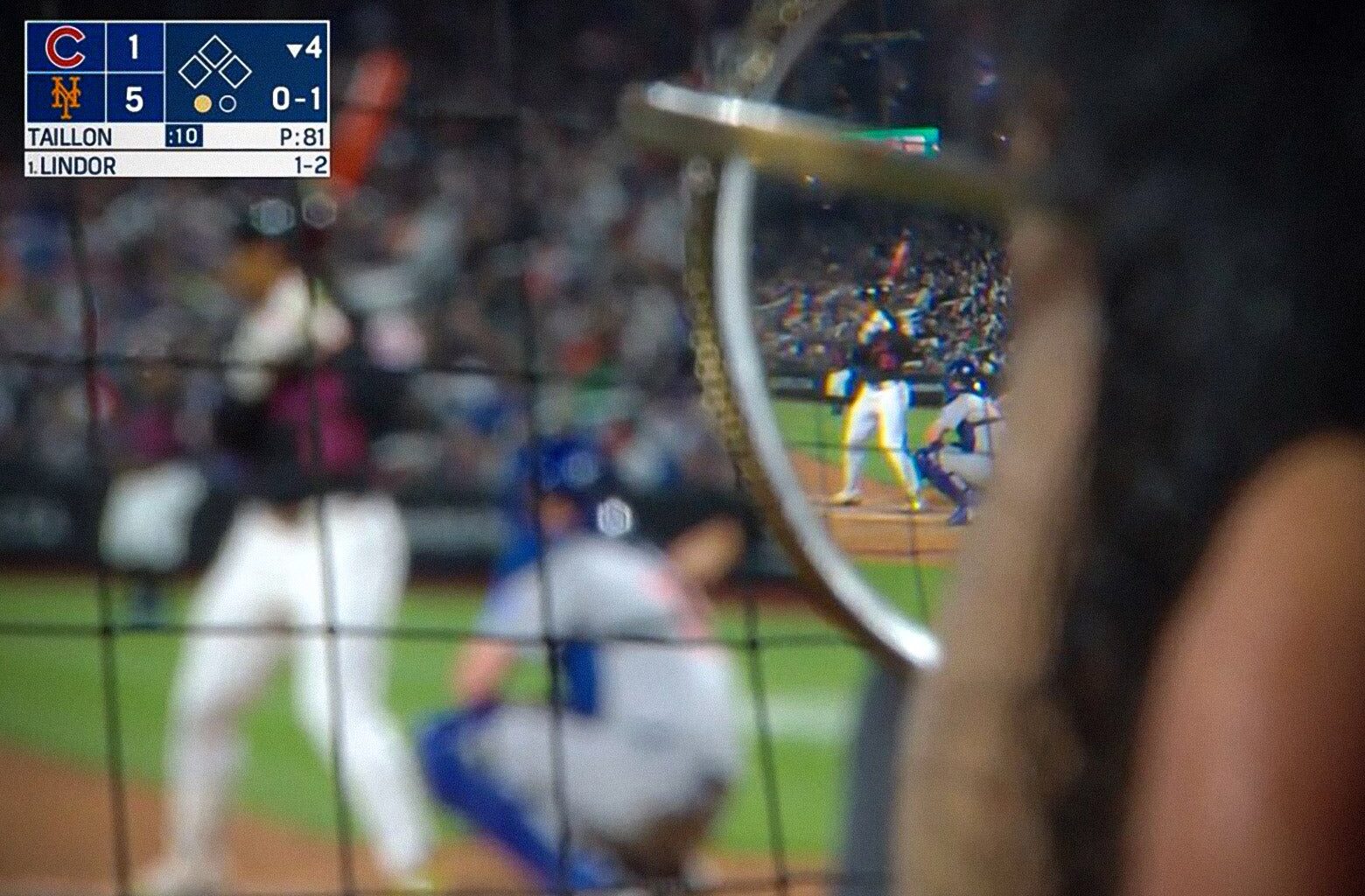
Another shot that went viral is this crazy De Palma homage, where we’re seeing a batter in the box through the glasses of a fan behind home plate. There’s some real artfulness to that composition. How did that happen?
A+ camerawork 🎥
A+ defense 💪
Everything about this video is 🔥 pic.twitter.com/1foy4aMqZ8
— MLB (@MLB) May 13, 2025
We have a guy with a handheld camera who roams the ballpark and looks for interesting angles that the hard cameras mounted in some places can’t get. He goes on the field and shoots the players warming up, and when they hit home runs, and in the dugout. So that shot is literally our cameraman sitting behind home plate in position just in case Francisco Lindor hits a home run. He sees out of the corner of his eye someone wearing wide-framed eyeglasses. I go, “Set up that shot and we’ll use it.” The guy kept moving and moving, and I finally said to our cameraman—and this is a bit of TV magic—”tap him on the shoulder and tell him to stand still and look to his left for 20 seconds.”
It was the perfect framing. It didn’t really do anything storytelling-wise, but our job as TV professionals is to occasionally jar viewers out of their seats every once in a while. Also, shots like that keep the crew motivated. Who’s going to top that? How can we do better tomorrow? And so when you’re doing a game every day, it’s really important to keep stuff like that part of the vernacular of what we’re doing here.
Were you given carte blanche to go crazy with that experimentation? I’m curious to know how you developed the confidence to really challenge what was possible or expected in the context of a sports broadcast.
It’s a combination of a lot of things. It’s my predecessor Bill and the gravitas that he brought to the director position before me. He set a precedent where he had carte blanche to do what he wanted, because he was Bill Webb—he was the Steven Spielberg, the Martin Scorsese of the baseball world. And so he was able to take chances like nobody else and without any repercussions. And he would try things in the regular season that may not have even worked, but he wanted to perfect them for the postseason and the World Series. He was doing the biggest games on the biggest stage. And so following in his footsteps, you’re already given a certain amount of space to work in. Second of all, it’s our producer, Gregg Picker, and the trust that he has for all of the creative people working on our broadcast, whether it be the announcers in the booth or us in the truck.
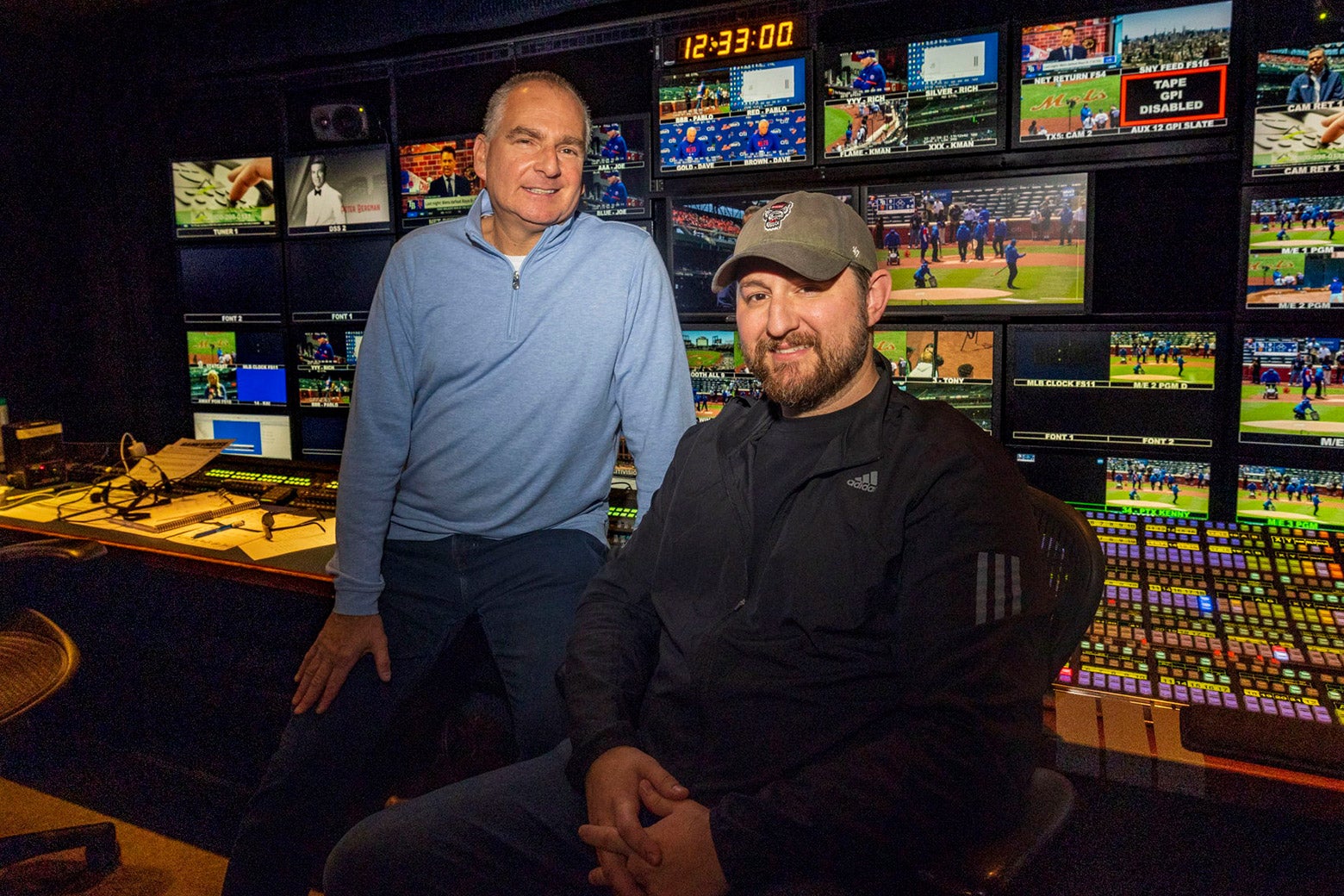
Producer Gregg Picker (left) and director John DeMarsico inside the production truck during a game at Citi Field.
Alejandra Villa Loarca/Newsday RM via Getty Images
That’s how we’re able to take those chances and try things that may or may not work. And that’s the beauty of baseball, because if it doesn’t work today, there’s literally a game tomorrow. And listen, I’m not going to sit here and tell you that I haven’t raised a few eyebrows with people wearing suits and ties at SNY. But the coolest part is it’s been almost universally embraced by the fans.
What’s your take on the pitch clock? In general most fans are happy the games are moving faster, but I imagine, for someone in your role, you might miss some of the simmering tension that defined the baseball broadcasts of earlier eras.
I was wholeheartedly against the pitch clock because of what you said. Major League Baseball was bragging about how they were going to cut 30 minutes out of the games. In my mind I was like, “Those 30 minutes are where SNY shines.” But we all fell in line, and you know what? Overall it’s made baseball a better product. I have a bigger problem with the further mechanization of baseball when it comes to robot umpires. You know what I mean? We’re still trying to get viewers, we’re still trying to entertain them. And shooting and taking a shot of an umpire on the phone with somebody at MLB headquarters, trying to figure out whether a guy was safe by a fraction of a centimeter, is not an exciting shot, and it’s not good TV. It used to be when you had an exciting play at first base, you could take a shot of the umpire punching the guy out, then you get a shot of the batter reacting, the pitcher reacting. It’s taken the most exciting part of the game and turned it into a police procedural. You have to be careful if you’re Major League Baseball not to mechanize the game to the point where there’s no humanity left.

Alex Kirshner
Donald Trump Just Made Another American Institution Bend to His Will. It’s Especially Ugly.
Read More
Is there one specific type of shot you want to get into a Mets game that you haven’t been able to yet? Do you have any white whales?
The Greatest Star Wars Show Just Ended by Making One of Its Heroes Do the Unthinkable
It’s One of the Weirdest Mistakes in Movie History. I Spent Months Investigating How It All Went Wrong.
This Content is Available for Slate Plus members only
Critics Savaged Her Novel. It Sold Millions Anyway. Her New Book Has Something to Say to Them.
Judy Blume’s Most Controversial Book Is Now a Netflix Series. There’s a Radical Change.
Man, with the crew that I work with, I really feel like it’s all on the table. It’s just a matter of finding the moment to do it. There’s one thing that I’ve tried to do for years and I’ve never gotten it to really work. It’s the dolly zoom. You know the shot in Jaws where Brody’s on the beach and he sees the shark and the background is coming closer to his face as they push it? That shot is my white whale, and it’s really hard because I don’t have any room for the dolly track at Citi Field. It would have to be a handheld zoom, and I can’t get it right. I may have to think of ways I can do it synthetically. It would be great in a moment of high tension for the pitcher on the mound.
It’s really easy to visualize. I can totally imagine a dolly zoom in a baseball movie at the bottom of the ninth and a full count.
That’s the thing. All of this stuff makes sense within the context of sports broadcasting. It’s just a matter of taking what’s available and doing it. Baseball is cinema, and at SNY, we take that very, very seriously.
Get the best of movies, TV, books, music, and more.