
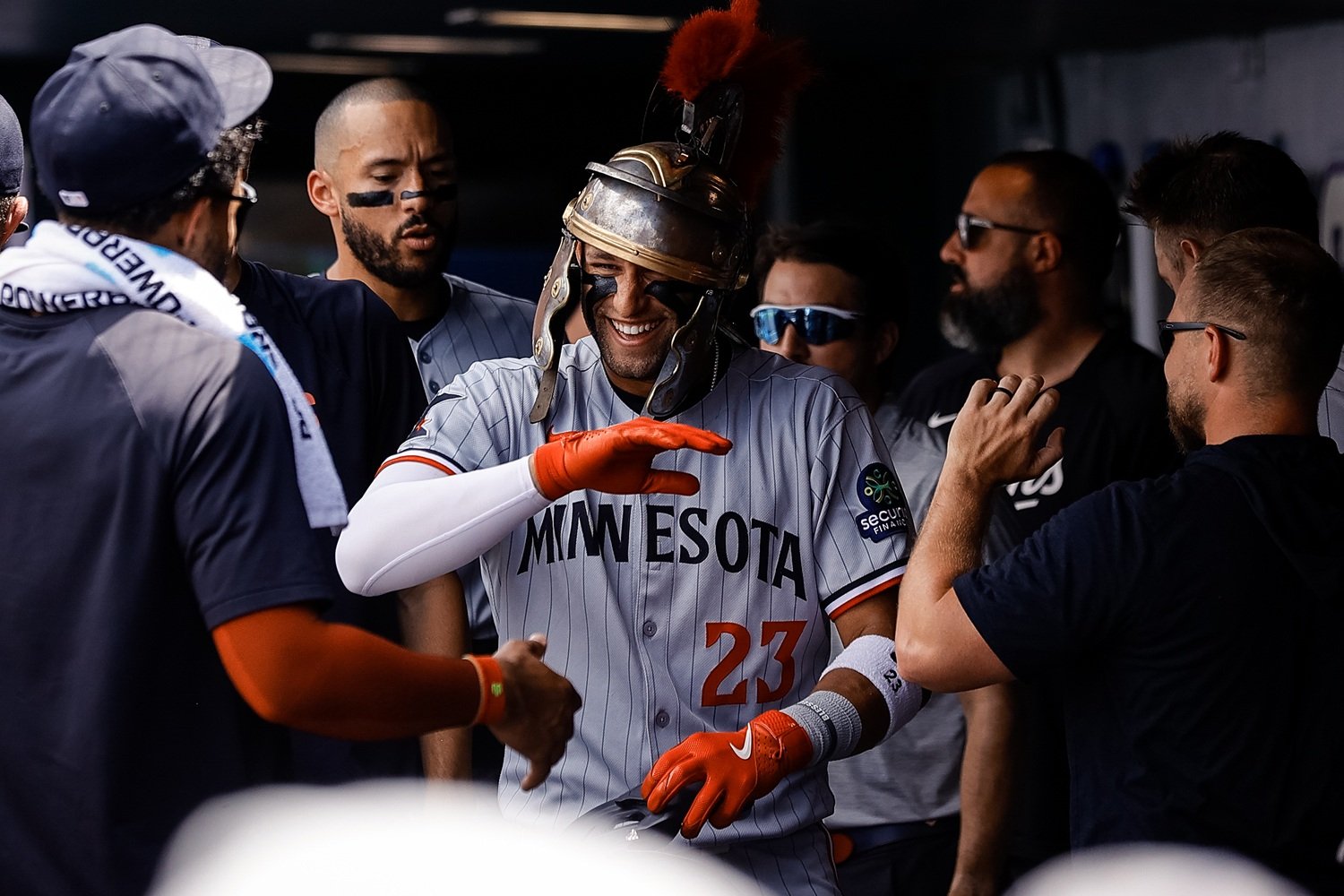
Of all the next generation of potential Minnesota Twins stars, none has created a flurry of debate more than Royce Lewis . Like many recent Twins, part of his story has been one of perpetual injury, limiting his play. But when he finally arrived, few could deny the sheer talent he quickly demonstrated. An overall #1 draft pick, Lewis’s initial numbers succeeded beyond any other recent prospect promotions in the club. He also cemented a legendary status with his two home runs in the first Minnesota Twins playoff win in 18 years.
More so, Lewis has acted like a star. He has an effervescent smile and charisma that lifts the team up. Before the 2024 season, Jake Mintz of Cespedes Family BBQ declared him the most likely MLB player to appear on The Bachelor. (Royce is happily married; don’t expect to see him there.)
But as Lewis’s struggles became less a product of unfortunate injuries and more prolonged as an issue of technique, he has also made comments that have raised eyebrows. Rather than simply dismiss the comments as those of someone who perhaps could use more media training, they deserve nuance to understand the context in which a player like Lewis has come to see the system in which all he can control is his swing.
First, the comments.
September 2024: As the team collapses and plays its way out of a playoff berth, Carlos Correa suggests that several players failed to step up. Lewis retorts to the media, “It falls on the players, but I didn’t think it fell on just us” further qualifying, “especially the young guys – the cheap guys is the best way to put it.” During these final two months, Lewis slashed an abysmal .207/.265 /.337 .
February 2025: During the offseason, Lewis appears on Inside Twins. A harmless fan question asks about whether Lewis would make “day in the life” TikToks as Bryce Harper has done (though many of us have concerns due to Harper’s interest in Raw Milk). “If I was lucky enough to sign a contract like Bryce, I’d love to do stuff like that…maybe for me I’ll join him one day, but for right now I’ll focus on baseball.” The implication is that, as a rookie with concerns over arbitration, Lewis must focus on developing his earning potential, while stars on contracts like Harper can do whatever they want.
August 2025: After a trade deadline that sent away 38% of the active roster, Lewis was suddenly hoisted into a leadership role despite his young age. His struggles are continuing through all 2025 with starts and stops of promise. Although his defense had significantly improved, cameras caught Lewis bashing his helmet after another flyout to the left field fence against the Athletics.
Lewis hit a grand slam and make a highlight reel worthy throw to the home to tag out a runner the next night, but his mind earlier in the day was on changes to his swing. As he tells the media scrum, anxiety over arbitration and how the Twins might use it against him are concerns:
Quote
It’s always hard. I know (Michael) Harris (II) just did a significant change. Being under contract probably helps because he knows what he’s making that year and the year after. For someone like me, I’m fighting (to take) care of myself and my family. I don’t want to put any of those stats in jeopardy. I’m trying to do what’s best as fast as possible. But feeling like I’ve been on an island, it’s kind of tough.”
To break down these incidents, I want to consider this from two angles. Is Royce right about what matters to Royce? But more so, is Royce right about what matters to all baseball players and the league?
On the personal performance, it’s strange to think Royce would feel worried about trying to adjust his swing. He spent the entire offseason improving his defense, enough to cement that as his position for some years, especially after the team tried to push him into learning second base on the fly. And given that so little of his swing has worked this season, what’s a week going to do in arbitration? Obviously, due to his previous injuries this year, a week of plate appearances does represent a significant amount of work. But as Aaron Gleeman noted, “It doesn’t even make logical sense to avoid adjustments and help.”
But the bigger question in all of this is how Lewis seems to believe his entire career is in peril without an extension. Michael Harris II was looking like an all-time dud earlier this season before turning it around—and notably did it by adjusting his swing. But for Lewis, it’s a secured contract that would enable such a choice.
This is where Lewis remains generally right about baseball: new rookies emerge every year and often outplay the rest of the league. Until the recent bonus pool was added in the 2022 Collective Bargaining Agreement, the most they could earn over three years was approximately the minimum salary. While arbitration years finally see increases, the process remains notoriously contentious. Attorneys on both sides argue before someone who might never watch baseball, much less understand advanced statistics. Josh Hader famously discussed how the Milwaukee Brewers used the “Blown Save” stat to lowball his salary despite an otherwise stellar record.
At the same time, numerous teams have shifted their strategy toward early extensions: rookies such as Jackson Merrill, Jackson Chourio , and other players not named Jackson have seen extensions even before seeing a single pitch. These players essentially trade away the worries that Lewis continually has called out—having to feel the weight of responsibility to perform while knowing each swing could determine your earnings—in exchange for losing likely millions by forgoing the free agency payout. (Notably, Lewis’s agent is Scott Boras, who has consistently pushed his players to go to free agency rather than sign an extension.) And yet, the Minnesota Twins have not engaged in this trend with pre-arbitration players since Jorge Polanco and Max Kepler. Instead, they now trade players before they can each the second year of arbitration.
Free agency remains a quandary for baseball; players on monster contracts rarely play better than their arb years. On average, Harper had better seasons in Washington than he has in Philadelphia. Beyond the fact that contracts like Harper’s are meant to cover half the years with the back half as a prayer for average play, the real issue is that teams should be paying much more during those arbitration years that set up their contracts in free agency. And unless players fight for the best numbers possible, it can limit other future free agents. Pair this with an impending CBA fight after the 2026 season where the owners seem dead set on limiting free agency through the use of a salary cap, and it only adds to the complication.
Baseball’s experts have often discussed ways to fix this system, whether getting to free agency earlier or—as Travis Sawcheck noted—revisit an old idea proposed during the 1994 strike to essentially turn arbitration offers into an open market. Dave Cameron once proposed a safety net for players as a way to avoid the whims of arbitration. And there does seem to be a growing divide in player sentiment between the union’s focus on the top 1% and those players belonging to a shrinking middle class, playing season to season on one-year deals.
But the question is how to fix the issue. The obvious answer would be for Royce to go back to doing what he did in 2023: smash a record number of grand slams again. More importantly, none of us should be out there criticizing Lewis for speaking out on the issues that concern him. For every media-trained player who only sees it as their job to say the most boring comments of all time, Lewis is speaking to what—intentionally or not—many of us worry about: player treatment in the league, especially on a team that has more often than not valued cheapness rather than the quality of their play. And for Lewis, every play can be another highlight to be played during a trial that his own trusted confidants, who are the ones trying to “fix” his swing, might use against him.
However, if Royce wants to find a solution, there is a way: it involves thinking beyond himself. His Pittsburgh Pirates colleague Paul Skenes , who is currently on minimum salary on an equally ownership kneecapped team, ran for and won a spot the MLB Players Association negotiation committee for the upcoming CBA. (Pablo Lopez currently serves as the Twins’ player representative.) Players like Skenes realize that Lewis’s problems are not just those of his own unfortunate circumstances; they represent those of all players—not to mention more and more workers among all trades—who live in a state of precarity. If Lewis wants to secure a more stable future, perhaps the answer lies beyond his swing.