
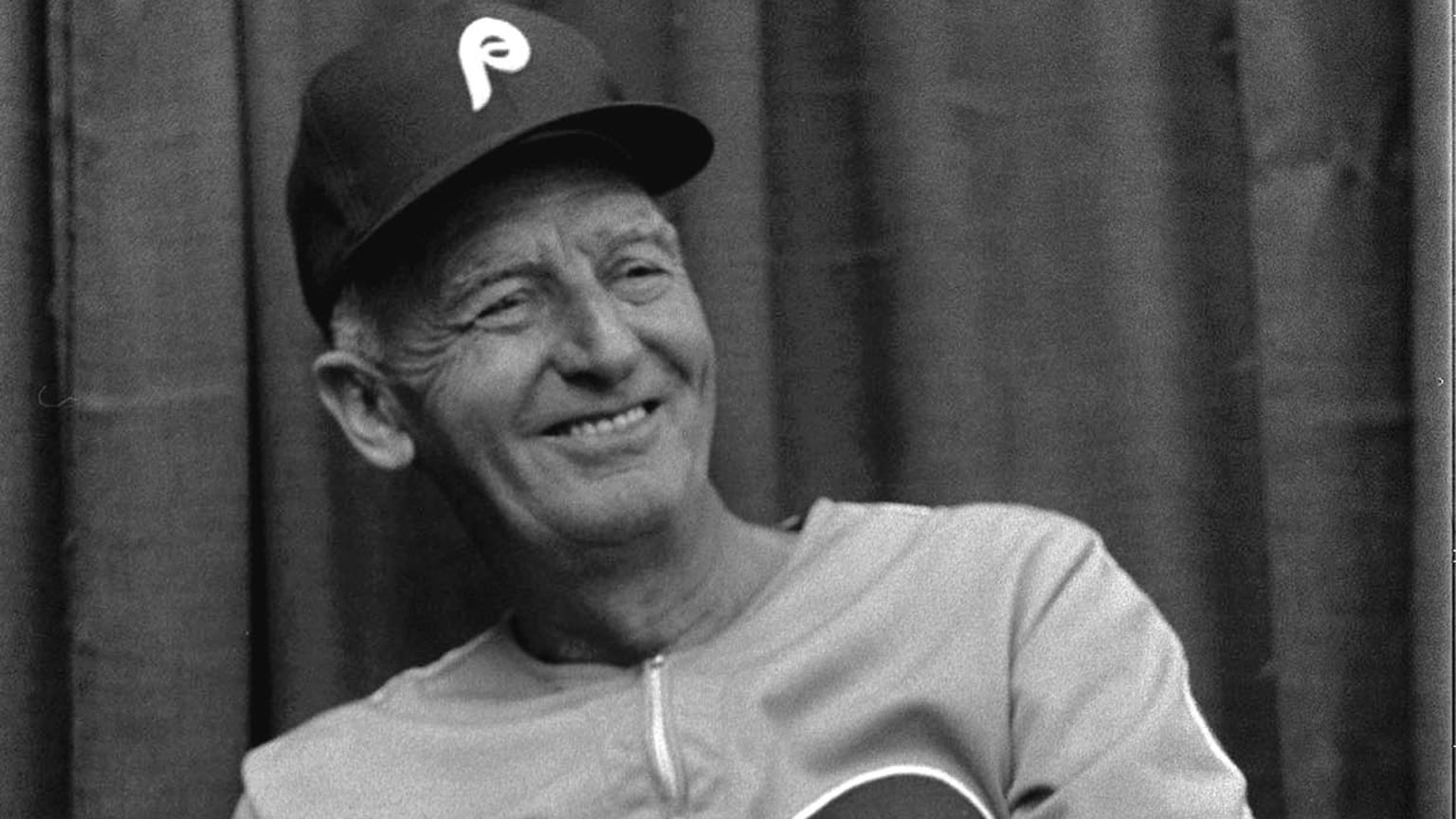
(Editor’s note: In the late summer and early fall of 1980, the Phillies worked their way out of a desultory stretch of baseball and went on to win the National League East Division, the National League Championship Series and their first World Series. Four dates in September and October were particularly important. Over the next month, Billy Penn will look back on a historic stretch for the Phillies — while hoping that maybe we’ll see another memorable run.)
The Phillies had their own Pope.
He was Paul Owens, who as scouting director and then general manager had worked miracles transforming the Phillies from perennial losers into one of baseball’s best teams in the 1970s.
Owens got his nickname from slugger Dick Allen, who thought he resembled the Catholic Church’s pontiff at that time, Paul VI.
The Phillies had won three consecutive National League East division titles from 1976 to ‘78, but had not reached the World Series in any of those years. Owens signed an all-time great player, Pete Rose, in 1979, hoping he’d be the missing piece, but injuries held the team back. There were rumors that Owens would break up his aging but still potent team after the ‘79 season, but he decided to keep them together for one more try at a championship.
Owens frequently travelled with the team. In late August of the 1980 season, he watched the club lose two out of three in San Diego, including a 10-3 thrashing. What galled Owens was Gold Glove outfielder Garry Maddox lost two fly balls in the sun that fell in for hits. Maddox wasn’t wearing sunglasses — they were in his pocket. (He later apologized to manager Dallas Green.)
The next day, Sept. 1, the Pope had a sermon he wanted to deliver, and told Green he wanted to address the players.
The players were used to Green yelling at them, but Owens had kept away from the locker room, letting Green chew the team out when it played badly. Now it was his turn. When Owens appeared, it meant he had something on his mind. And he did.
“Dallas is there all year, but Pope, whenever he came down, people kind of paid attention,” outfielder Del Unser said.
Owens told the team that despite winning three NL East Division titles, they hadn’t gotten past the National League Championship Series, and how people in the organization had told him to break the club up, as it was getting older. He told them he ignored breaking the team up, because he believed in them — but things would change if they didn’t start playing better. He reportedly challenged two players to a fight.
When Owens was finished, the players sat there in silence. Then Green tore into the team anew. But it was the Owens tirade that was memorable.
“I remember those discussions like it was yesterday,” said Dickie Noles, a pitcher on that team.
“If you knew Pope, you kinda knew it was coming,” Noles said recently. “You knew that he was not happy. We had not played that well. We had some things that happened in San Diego. We went up to San Francisco and the first day there he fired” at the team.
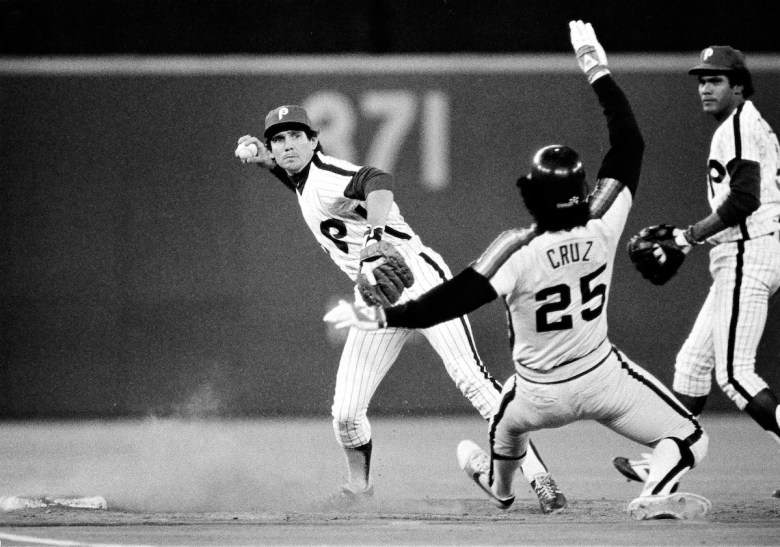 Phillies Larry Bowa throws to first as Houston Astros Jose Cruz begins to slide to second during the fifth inning of the first game of the National League playoffs at Philadelphia, Oct. 7, 1980. (AP Photo)
“He kind of didn’t single out too many people other than the veterans,” said Noles, who now works for the Phillies as a substance use counselor. It is an observation shared by Unser and pitcher Bob Walk.
“We all knew we were playing like crap, and I mean there’s so many veterans on that club. I mean some really good rookies too, but I mean it was largely old guys. And you just know there’s something missing,” Unser said.
Walk, who was called up to the team in May and wound up winning 11 games that year, said he doesn’t remember Owens ranting and raving.
“The thing I do remember is that he was mainly talking, I think, to the veteran guys that had been on the team for three or four years,” said Walk, now a broadcaster for the Pittsburgh Pirates. “I believed in you guys and I’ve kept you together for one more year. This is your last shot at trying to win it all.”
Recently, Bowa said Owens had “a lot of fire in him. He didn’t like when we didn’t play well. It’s one thing getting beat, but when you’re making mental mistakes and stuff like that, he didn’t like that at all. I think between Paul Owens and Dallas Green and, of course, Pete (Rose) coming over, those are the kind of guys that sort of kick-started us.”
Pope’s origins
Paul Owens was born in Salamanca, N.Y., and was a sergeant in an engineering unit during World War II. He met his wife in Belgium. After he graduated from St. Bonaventure College in 1951, he began his minor league career.
In his first season with the Olean Oilers of the PA-Ontario-NY League, he hit .407 to win the league batting title.
When he retired, Owens had batted .374 and won three batting titles, but was probably too old to be considered a prospect. So he went into minor league coaching and scouting.
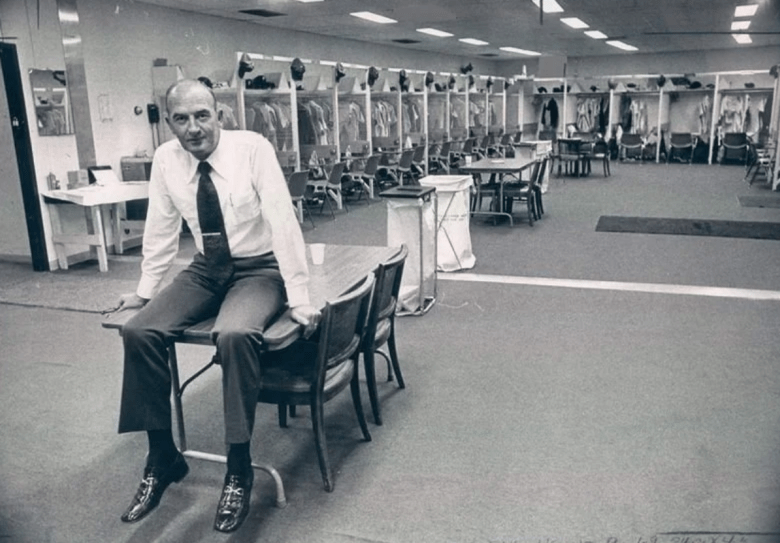 Paul Owens in the Phillies clubhouse.
In 1965, Phillies owner Robert Carpenter named him director of scouting. Owens said he would do it on one condition — that he could make changes.
Carpenter agreed, and Owens rebuilt the minor league system, which produced players such as Mike Schmidt, Greg Luzinski, Larry Bowa and Bob Boone. In 1972, Carpenter named him general manager, and Owens traded for important players, including Tug McGraw, Bake McBride and Maddox, and, of course there was the free-agent signing of Rose.
The Green deal
In August 1979, the Phillies fired their manager of seven years, the soft-spoken Danny Ozark, and replaced him with Green, who had been director of the team’s minor league system.
“I think Danny Ozark did a great job as a manager, because we had a team that might have been tough to manage. Then they decided to go in a different direction. They brought Dallas in. Obviously his personality is not like Danny Ozark, and it caught a couple of people off-guard, guys that, I’m not gonna say sensitive, but they don’t like being confronted like that, and it affected them a little bit,” Bowa said.
“It didn’t bother me because I came up through the minor system and I was around coaches and managers back then, (and) if you didn’t do things right, they let you know in front of everybody and that’s just the way it was. Now you can’t do that. You’ve gotta take people behind closed doors. You gotta make sure you don’t raise your voice and things like that so it was different.”
Green also upset veteran players by giving their playing time to younger ones, such as catcher Keith Moreland and outfielder Lonnie Smith.
The Pope made news
After the tongue-lashing, the Phillies had a game to play, against the Giants, with Steve Carlton on the mound (who did not have his best stuff), and they won, 6-4. But that was not the story in the next day’s press coverage.
“The Phillies are in first place. Hold the drum rolls and flourishes, please, until the tongue-whipping Paul Owens gave them yesterday stops echoing in their ears,” Hall of Fame baseball writer Bill Conlin wrote in the Philadelphia Daily News.
“Sunday afternoon’s 10-3 horror show in San Diego was still etched on their minds when The Pope mounted the clubhouse pulpit and blistered them with a graphic pregame sermon,” wrote Jayson Stark in the Philadelphia Inquirer.
Hal Bodley, in the Wilmington News-Journal, wrote, “Owens was loud and emotional and profane during his lecture. He forgot about sensitive feelings and criticized Larry Bowa and (Gary) Maddox in front of their teammates for their performances of late.”
Bodley quoted Bowa: “The Pope’s the general manager and he has every right to come down here and say what he said. He jumped on (Maddox) and me. We have not been playing well.”
Green told reporters, “Owens isn’t the kind of GM who storms into the clubhouse every day. His players know he cares about them. And so they listen when he fires up his speech-making engines … I think we’re closer together as a ballclub right now than we have been in a long time.”
After the game, Rose told reporters, “He said we played the last five months for somebody else. And now he wants us to play the last month for him and (team president Ruly (Carpenter). They’re the ones who put this team together. They’re the ones who stuck with this team over the winter.
“You know, not all general managers will scold a team. But Pope’s more like a player’s general manager. He’s such a fan. And he loves so many guys on this team. He signed them up. He put them through the minors. He’s more like a father to the team than a general manager. … I think he means more to this team than other general managers do to theirs.”
Scolding had an impact
What effect did that talk have on the team? The Phils went on to win 23 of their last 34 games, culminating in the NL East division title.
“I think it had a ton to do with it,” Unser said.
“Anytime you have a meeting and the team goes off, you gotta think it could go the other way, too,” Bowa said recently. “We could have gone the other way, but yeah, I could see some players saying that it had a positive effect on us. I could see that very easily.”
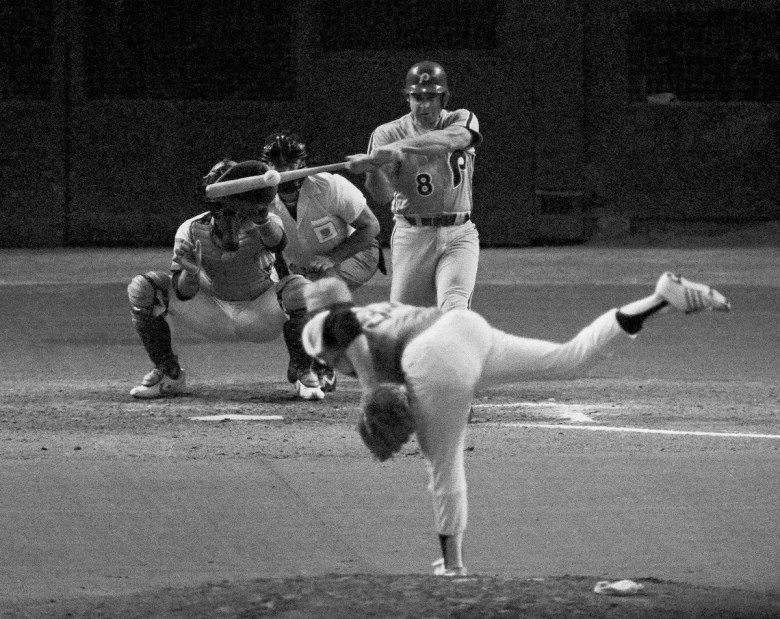 Phillies catcher Bob Boone (8) connects a pitch from Astros pitchers Nolan Ryan during second inning action in Game 5 of the National League playoffs at Houston, Oct. 12, 1980. (AP Photo/Bill Haber)
After winning the division, the Phils faced the Houston Astros in one of the best playoff series ever. Four of the five games went into extra innings. In game five, the Phillies trailed, 5-2, with all-time strikeout king Nolan Ryan on the mound to start the eighth inning. An improbable rally put the Phils ahead, 7-5. Houston tied it up, but the Phils won it in the 10th inning.
They went on to win the World Series against the Kansas City Royals in six games. It was the team’s first-ever championship, and made them the last of the original 16 Major League Baseball franchises to win it all.
“Those poor kids”
As an epilogue, of sorts, to the Pope’s locker room appearance, there’s this: The timing of Owens’ tirade meant that some of the players on the receiving end of it had nothing to do with it at all.
On Sept. 1, major league rosters expand, and teams can add up to 15 players. The Phillies called up four: pitchers Marty Bystrom and Mark Davis, catcher Don McCormack and infielder Jay Loviglio.
When Owens told Green he wanted to address the team that day, Green asked him if he wanted to include the players who joined the team that day.
“Have they got a P’ on their uniform?” replied Owens, and the new quartet were in the locker room when Owens began his speech.
If it damaged them, they didn’t show it. Bystrom went 5-0 and was named NL Pitcher of the Month for September, and Davis went on to win a Cy Young Award for the San Diego Padres.
Years later, when Owens talked about that day, he thought of those young players.
There they were, he said, in the major leagues for their first day, and the general manager yells at them and the manager yells at them. He then bowed his head, shook it, and said, “Those poor kids.”
Next: On Sept. 29, 1980, the Phillies played a game that had fans thinking they just might do it this season.