
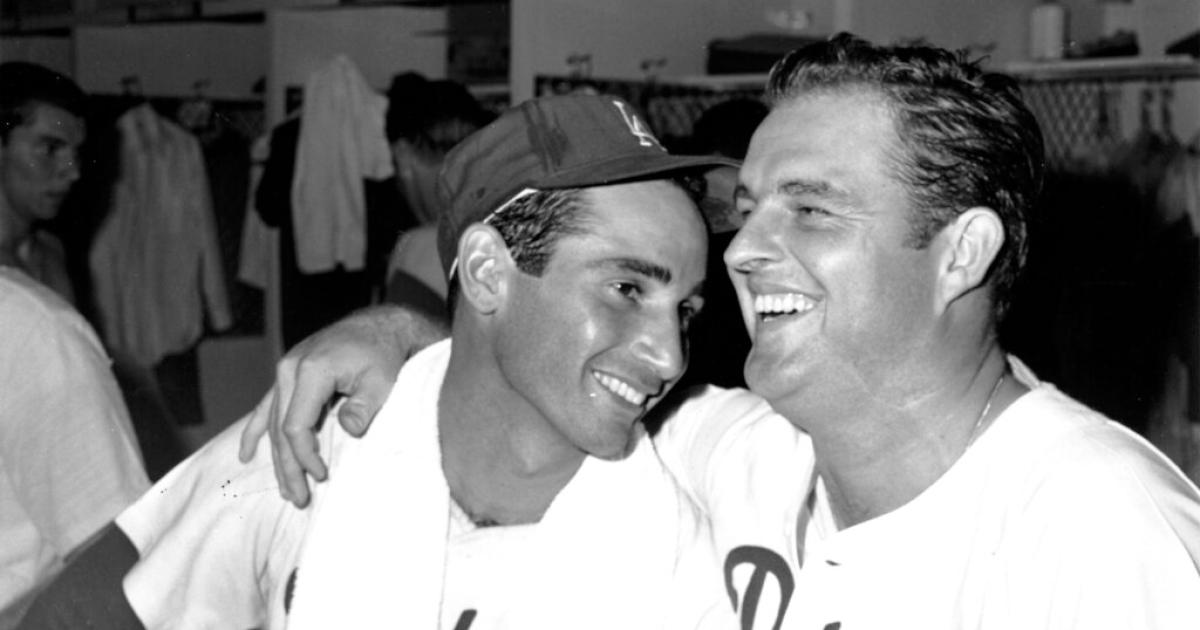
Hi, and welcome to another edition of Dodgers Dugout. My name is Houston Mitchell. Here’s a bonus edition of the newsletter as we continue to look at the top 10 Dodgers at each position.
Newsletter
Are you a true-blue fan?
Get our Dodgers Dugout newsletter for insights, news and much more.
Enter email address
Sign Me Up
You may occasionally receive promotional content from the Los Angeles Times.
Top 10 starting pitchers
Here are my picks for the top 10 starting pitchers in Dodgers history, followed by how all of you voted. Numbers listed are with the Dodgers only. Click on the player’s name to be taken to the baseball-reference.com page with all their stats.
1. Sandy Koufax (1955-66, 165-87, 2.76 ERA, 131 ERA+, 7-time All Star, 3 Cy Young Awards, 1 MVP award)
I went back and forth between Koufax and Clayton Kershaw, who are among the greatest pitchers of all time, not just with the Dodgers. Ultimately, I decided that the fact Koufax had to pitch deeper into games (knowing Kershaw could have done the same if he was asked to as often) and had more unbelievable individual pitching performances than Kershaw lifted him to the top. Koufax also had a mystique about him, sort of like Joe DiMaggio did for the Yankees. Granted, it was easier to create a mystique when games were rarely on television. But still. He pitched a three-hit shutout in Game 7 of the 1965 World Series on two days’ rest, using only his fastball because it hurt too much to throw his curve. It helps a bit that we never witnessed his decline phase, like we did Kershaw, because he retired at the height of his career. We will never see his likes again.
2. Clayton Kershaw (2008-current, 221-96, 2.52 ERA, 155 ERA+, 11-time All Star, 3 Cy Young Awards, 1 MVP award)
Kershaw has seemed to scuffle along with injuries for so long now that he might actually be one of the most underrated great pitchers of all time. Considering he pitched primarily during a hitters’ era, his numbers are amazing. Has he had his postseason struggles? Sure. But how many years would the Dodgers have not even made the postseason if they didn’t have Kershaw? When we get to the fan voting below, keep in mind that five people left Kershaw off of their top 10 entirely because he was “terrible in the postseason.” And while I never like to comment on how the readers vote, to leave Kershaw out of the top 10 is crazy. There’s Koufax and Kershaw, then there’s everyone else.
3. Dazzy Vance (1922-32, 1935, 190-131, 3.17 ERA, 129 ERA+, 1924 NL MVP)
Charles Arthur Vance was born March 4, 1891 in Orient, Iowa. When he reached high school, he started pitching for a semipro team in the area and had what was described as a dazzling fastball. That’s where he got his nickname, Dazzy.
Vance started playing professionally in 1912 in the class D Nebraska State League and quickly moved up the ranks, winning 26 games for St. Joseph (Mo.) of the class A Western League in 1914. Near the end of the season, he started four games in six days and hurt his arm. There were no MRIs then to determine his injury, but, because of how he described the way his arm felt, it is believed he suffered a torn UCL. Back then, the solution for these things was to rest your arm for a couple of weeks and try again.
He bounced around baseball for a few years before joining the Yankees in 1918 and posting a 15.43 ERA. They got rid of him quickly and he ended up pitching in New Orleans.
And that’s when fate stepped in. Vance was playing poker and after winning a hand, he banged his elbow against the edge of the table while celebrating. The result was immediate excruciating pain. He couldn’t straighten his arm and couldn’t stand the pain. The only option was exploratory surgery. What the surgeon did has been lost to the annals of time, but after he was done and Vance recovered, his arm was 100% again. No pain when he threw. “It was an odd thing,” Vance said. “My arm came back just as quickly as it went sore on me in 1915. I awoke one morning and learned I could throw without pain again.”
Vance won 21 games for New Orleans in 1921.
After the 1921 season, the Brooklyn Dodgers were interested in a New Orleans player, but it wasn’t Vance. They wanted catcher Hank DeBerry. The Dodgers sent scout Larry Sutton to attempt to get DeBerry from the Pelicans, who told Sutton they had to take Vance too in order to get DeBerry.
Ebbets acquiesced and agreed to take Vance too. And with that, the Dodgers acquired one of their best pitchers ever, a pitcher who didn’t really star in the majors until he was 31. Vance also used a secret weapon: He wore the same sweatshirt for every game and had cut the sleeves into several strips lengthwise, so when he released the ball, the batter often lost sight of it briefly as the tattered sleeves flapped with the pitch. Vance, of course, denied doing this on purpose. When opponents demanded he buy a new shirt, as Graham recounts in his book, Vance responded, “Oh, no! This is my lucky shirt. I’ve had it since I was in New Orleans, and I ain’t even washed it.”
Vance died of a heart attack on Feb. 16, 1961 and is buried at Stage Stand Cemetery just outside Homosassa Springs, Fla.
4. Don Drysdale (1956-69, 209-166, 2.95 ERA, 121 ERA+, 9-time All Star, 1962 Cy Young Award)
Drysdale teamed with Koufax during the 1960s to form one of the most dominating pitching duos in history.
In 1962, Drysdale won 25 games and the Cy Young Award. In 1965, he won 23 games and helped the Dodgers to their third World Series title in L.A. In 1968, he set a record with 58 consecutive scoreless innings, a record that was broken by Orel Hershiser in 1988.
Drysdale was also one of the last of the breed of pitchers who weren’t afraid to knock a batter down to get his point across. His 154 hit batsmen is still the modern National League record. Or, as Mickey Mantle once put it, “I hated to bat against Drysdale. After he hit you he’d come around, look at the bruise on your arm and say, ‘Do you want me to sign it?’”
Drysdale himself talked about his rule for knocking down batters: “My own little rule was two for one. If one of my teammates got knocked down, then I knocked down two on the other team.”
During the 1961 season, the second-place Dodgers were playing the first-place Reds and trailing 7-2. Drysdale was not happy. He asked to come into the game as a reliever, and everyone knew why. Manager Walter Alston sent him in the game. Drysdale came into the game in the fifth inning as a reliever and got out of a jam. Then he attempted to send a message in the sixth inning. He knocked down the leadoff batter, Don Blasingame, who popped to third. He knocked down the next batter, Vada Pinson, and was warned by plate umpire Dusty Boggess to stop. Pinson doubled. The warning went unheeded. Drysdale knocked down the next hitter, Frank Robinson, and then hit him with a pitch.
Drysdale was ejected, given a five-day suspension and fined $100. He decided that the next time the Dodgers were in Cincinnati, home to NL president Warren Giles, he would pay the fine in person. On July 19, the day a three-game series at the Reds was starting, Drysdale went to a bank and got $100 in pennies (that’s 10,000 pennies). He went to Giles’ office and put the bag of pennies, weighing 55 pounds, on Giles’ desk and said “paid in full” and walked out.
Drysdale’s radio call of Kirk Gibson’s World Series homer in 1988 is truly one of the great calls of all time. You can listen to it here.
On July 3, 1993, Drysdale was in Montreal for the Dodgers-Expos series when he died of a heart attack in his hotel room. People became concerned when he failed to show up for the bus ride to the stadium for that day’s game and hotel employees found him in his room. He was only 56.
Vin Scully was told of Drysdale’s death but couldn’t say anything about it on the air until Drysdale’s family could be notified. Once they were, he told Dodgers fans the news, saying, “Never have I been asked to make an announcement that hurts me as much as this one. And I say it to you as best I can with a broken heart.”
5. Don Sutton (1966-80, 1988, 233-181, 3.09 ERA, 110 ERA+, 4-time All Star)
Sutton is one of those guys who put together a remarkable string of good seasons but none that were truly great. He led the league in ERA once (in 1980, 2.20) and in shutouts once (nine in 1972) but never finished higher than third in Cy Young voting and received Cy Young votes in just five seasons (from 1972 to 1976) of his 16 with the Dodgers.
None of that is meant to downplay Sutton. Part of putting together a winning team is finding guys who will give you good season after good season after good season. Sutton did just that for the Dodgers, finishing with double-digit wins each year from 1966 to 1980 and with an ERA better than the league average in 10 of those 15 years.
Sutton often gets overlooked when people talk about great Dodgers, but he said it didn’t bother him. “I am 100% convinced that if I had spent most of my career anywhere but with the Dodgers, I would not have the record, not have the Hall of Fame, not have the life I enjoyed,’” Sutton told The Times’ Bill Plaschke in 2017. “All those Dodger people gave me all of that. It’s my alma mater, and all the good I had in baseball came from them.”
Sutton was inducted into the Baseball Hall of Fame in 1998 and had his number (20) retired by the Dodgers the same year.
“I don’t have any fantasy or thought of being the best pitcher in Dodger history,” Sutton said in 2017. “But I would like to think I got everything I could get out of what I was gifted with.”
Sutton died on Jan. 18, 2021 at 75.
“My mother used to worry about my imaginary friends ’cause I would be out in the yard playing ball,” Sutton said in his Hall of Fame induction speech in 1998. “She worried because she didn’t know a Mickey, or a Whitey, or a Yogi, or a Moose, or an Elston, but I played with them every day.”
6. Fernando Valenzuela (1980-90, 141-116, 3.31 ERA, 107 ERA+, 6-time All Star, 1981 NL Rookie of the Year, 1981 NL Cy Young Award)
I wrote a lot about Valenzuela after his passing, but suffice to say it’s hard to explain to new fans today exactly how much Fernando meant to the city, and the excitement he brought to the stadium when he pitched. There may not be a more loved player in Dodgers history, and he brought in a legion of Latino fans to the stadium, fans who remain dedicated to the team to this day. I was attending Carnegie Junior High in Carson when he first started pitching, and every student there, no matter what race they were, was talking about him and several of us would cut school during the playoffs to listen to the Dodgers on the radio.
In 1981, the Dodgers averaged an additional 7,000 fans for every home game when Fernando started.
Perhaps Dodgers Hall of Fame broadcaster Jaime Jarrín said it best when he said just after Valenzuela died: “With Fernando, something different happened: People from Mexico, Central America, South America who were totally indifferent to baseball suddenly became baseball fans to the point that the Dodgers created an incredible fan base with extraordinary economic power. All thanks to Fernando’s magic.”
7. Orel Hershiser (1983-94, 2000, 135-107, 3.12 ERA, 116 ERA+, 3-time All Star, 1988 Cy Young Award)
In all the talk about the amazing 1988 season Hershiser had, people often overlook that he was just as good in 1989. Let’s compare the two seasons.
Category: 1988 / 1989
ERA: 2.26 / 2.31
FIP: 3.18 / 2.77
ERA+: 149/ 149
IP: 267 / 256.2
WHIP: 1.052 / 1.181
K/9IP: 6.0 / 6.2
BB/9IP: 2.5 / 2.7
The biggest difference, of course, was that 1988 was a World Series year, he had the consecutive innings streak and he went 23-8 in 1988 and 15-15 in 1989.
So, 1988 is perceived as a much greater year when both seasons were almost equally great.
Orel Hershiser finished the 1988 season by pitching 59 consecutive scoreless innings over seven starts, including 10 innings of shutout ball in his final game of the season. The streak included five consecutive shutouts and, during the seven starts that encompassed the streak, Hershiser made 757 pitches, or 108 pitches per start.
It would never happen today. Sure, some great pitcher may break the streak, but not in seven starts. With today’s focus on pitch counts and not facing a batter three times in a game, it would take about 12 starts to do it.
Hershiser broke the record of Drysdale, who was a Dodgers broadcaster that season.
“I really didn’t want to break it,” Hershiser said after the game. “I wanted to stop at 58. I wanted me and Don to be together at the top.” But Drysdale, on hand to see his record broken, would have none of that. “I’d have kicked him right in the rear if I had known that. … I’d have told him to get his buns out there and get them,” the late Dodgers great said.
Hershiser took part in our “Ask…..” series in 2019. You can read that here.
8. Don Newcombe (1949-51, 1954-58, 123-66, 3.51 ERA, 116 ERA+, 1949 Rookie of the Year, 1956 Cy Young Award, 1956 NL MVP award)
Newcombe could have been a two-way player if the Dodgers would have let him. In 1956, he went 27-7 with a 3.06 ERA in 38 games, 36 starts and 268 innings with 15 complete games. At the plate, he hit .234 with six doubles, two homers and 16 RBIs. He won the Cy Young and MVP awards after the season. He was Rookie of the Year in 1949 and was the first player to win all three major baseball awards. He went 20-5 during the Dodgers’ World Series championship season in 1955. That year, he hit .259 with nine doubles, seven homers and 23 RBIs. How good a hitter was Newcombe? He pinch-hit 88 times in his career. In 1962, he signed with the Chunichi Dragons in Japan, as a hitter, not as a pitcher. In 81 games, he hit .262 with 12 home runs and 43 RBIs. Newcombe struggled with alcoholism for years but stopped drinking in 1967. He worked for the Dodgers for years, helping athletes and others across the country in their struggles with sobriety. “What I have done after my baseball career and being able to help people with their lives and getting their lives back on track and they become human beings again means more to me than all the things I did in baseball,” Newcombe said in 2008.
Maury Wills, who Newcombe helped deal with his own substance abuse problems, once said, “Don Newcombe saved my life. He was a channel for God’s love for me because he chased me all over Los Angeles trying to help me and I just couldn’t understand that — but he persevered — he wouldn’t give in and my life is wonderful today because of Don Newcombe.” Should Don Newcombe be in the Hall of Fame? If you go strictly by the numbers, no. But if you consider he missed part of his career because of the ban against Black players, and part of his career because he served two years in Korea during the Korean War, and you consider all the baseball players he helped after retirement, then a strong case can be made for Newcombe.
9. Nap Rucker (1907-16, 134-134, 2.42 ERA, 119 ERA+)
Nap Rucker left the majors 109 years ago. That’s amazing when you think about it. He played the game in a different era and a different world. He completed 186 of his 274 starts and also had 14 saves in 62 relief appearances. In 1910, he completed 27 of his 39 starts, and in 1911, he went 22-18 with 33 starts, 15 relief appearances, 23 complete games and four saves. You may look at his record and think, “What’s the big deal about this guy?,” but he played on some really bad Brooklyn teams. While he was going 22-18 on 1911, the rest of the team was going 42-68. He struck out 16 Cardinals during a game in 1909, a record that stood until 1933. Unfortunately, all that pitching took a toll on his arm, and in his last three seasons he needed a lot of rest between starts to be effective. He pitched only one regular-season game in his final season and retired after pitching in the 1916 World Series. He moved to Roswell, Ga., and became a scout for the Dodgers, discovering future Hall of Famer Dazzy Vance. He ran for mayor in 1934 and won easily and died at age 86 in 1970.
10. Johnny Podres (1953-1955, 1957-66, 136-104, 3.66 ERA, 107 ERA+)
Podres pitched for four of the Dodgers’ World Series title teams (1955, 1959, 1963 and 1965, though he didn’t pitch in the ’65 World Series) and was MVP of the 1955 World Series, the first title for the Dodgers, when he went 2-0 with a 1.00 ERA, good for two complete-game victories over the New York Yankees, including a 2-0 shutout in the decisive Game 7. He was often overlooked on the team, overshadowed by Koufax or Newcombe or Drysdale, but he was a key pitcher for the team for 12 years. He made six World Series starts and went 4-1 with a 2.11 ERA.
The next 10: Carl Erskine, Bob Welch, Burt Hooton, Burleigh Grimes, Claude Osteen, Ramón Martínez, Jerry Reuss, Jeff Pfeffer, Brickyard Kennedy, Tommy John.
The readers’ top 10
2,198 ballots were sent in. First place received 12 points, second place nine, all the way down to one point for 10th place. For those of you who were wondering, I make my choices before I tally your results. Here are your choices:
1. Sandy Koufax, 1,797 first-place votes, 25,233 points
2. Clayton Kershaw, 358 first-place votes, 19,083 points
3. Don Drysdale, 14 first-place votes, 16,485 points
4. Don Sutton, 12,189 points
5. Fernando Valenzuela, 27 first-place votes, 11,789 points
6. Orel Hershiser, 11,270 points
7. Don Newcombe, 7,313 points
8. Dazzy Vance, 5,745 points
9. Johnny Podres, 3,657 points
10. Carl Erskine, 2,339 points
The next 10: Claude Osteen, Hideo Nomo, Tommy John, Burleigh Grimes, Bob Welch, Burt Hooton, Jerry Reuss, Zack Greinke, Ramón Martínez, Nap Rucker.
Top 10 relief pitchers
Who are your top 10 Dodgers relief pitchers of all time (including Brooklyn)? Email your list, in order from 1 (your selection as the best) to 10 (the 10th best) to houston.mitchell@latimes.com and let me know. Remember, we are considering only what they did with the Dodgers.
Many of you have asked for a list of players to consider for each position. Here are the strongest reliever candidates, in alphabetical order.
Pedro Báez, Ronald Belisario, Don Bessent, Joe Black, Joe Blanton, Jim Brewer, Jonathan Broxton, Giovanni Carrara, Hugh Casey, Bobby Castillo, Tim Crews, Darren Dreifort, Rube Ehrhardt, Caleb Ferguson, Terry Forster, Larry French, Eric Gagné, Jim Gott, Brusdar Graterol, Ed Head, Matt Herges, Brian Holton, Charlie Hough, Steve Howe, Jay Howell, J.P. Howell, Ken Howell, Jim Hughes, Kenley Jansen, Joe Kelly, Clyde King, Hong-Chih Kuo, Clem Labine, Al Mamaux, Mike Marshall, Bob Miller, Pete Mikkelsen, Joe Moeller, Guillermo Mota, Tom Niedenfuer, Antonio Osuna, Erv Palica, Alejandro Peña, Ron Perranoski, Evan Phillips, Tot Pressnell, Paul Quantrill, Howie Reed, Phil Regan, Pete Richert, Ed Roebuck, Takashi Saito, Jeff Shaw, Larry Sherry, Dave Stewart, Ross Stripling, Vito Tamulis, Blake Treinen, Alex Vesia, Todd Worrell.
And finally
The final inning of Sandy Koufax‘s perfect game, as called by Vin Scully. Watch and listen here.
Until next time…
Have a comment or something you’d like to see in a future Dodgers newsletter? Email me at houston.mitchell@latimes.com. To get this newsletter in your inbox, click here.