
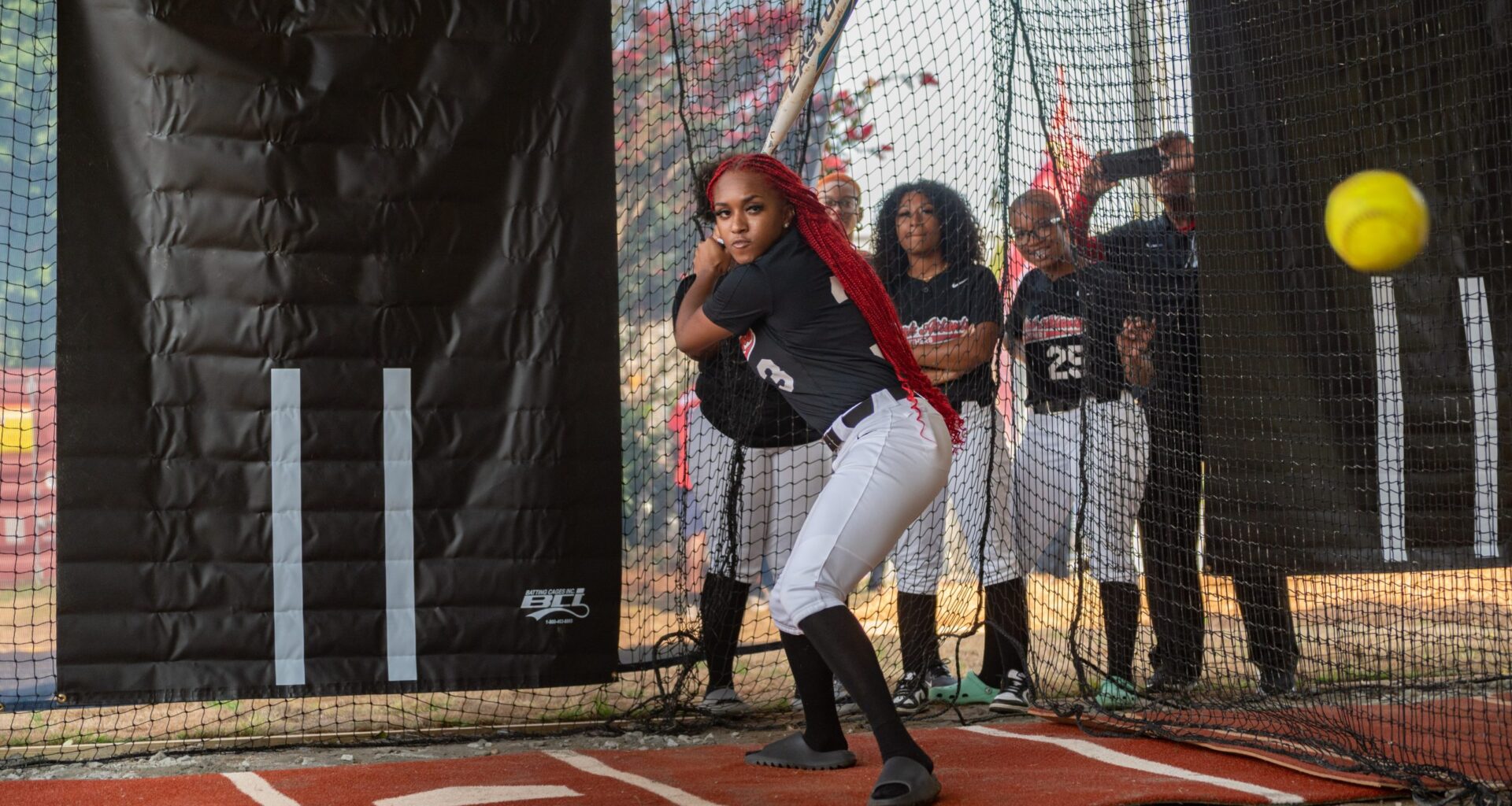
Cydney Cooper has been playing softball since she was 5 years old. Playing the sport in South Carolina came with being the only Black girl on the team, or one of a few Black players.
As a shy, dark-skinned girl, Cooper said people often thought she had an attitude, but she was just quiet and shy. When it came time for her to choose where she wanted to further her academic career, it was a no-brainer that she wanted to attend a historically Black college or university.
“Me coming here was meant to be,” the senior psychology major at South Carolina’s Claflin University said. “I felt like it was my duty, lowkey.”
Like many other Black students at the height of the Black Lives Matter movement in 2020 and afterward, Cooper wanted to take her talents to an HBCU.
Around the time Cooper decided it was her duty to attend a school that had a community that looked like her, the Atlanta Braves and Truist Bank were thinking of ways to honor Hank Aaron.
The baseball legend, known for his 755 home runs during his 23-year career, passed away at the beginning of 2021 at 86 years old.
Before Aaron passed, he worked with the Braves, with whom he spent 21 years, to invest in Black baseball and Black colleges. Danielle Bedasse, the vice president of community affairs for the Atlanta Braves, said his death was taken hard by the Atlanta and baseball community.
Aaron wasn’t an HBCU grad, but the South was his home. Born in Alabama and playing the majority of his career in Atlanta, he was surrounded by the culture and impacts of the HBCU community.
It only felt right that the Braves continued his legacy through uplifting Black colleges and their baseball and softball programs, Bedasse said.
In 2021, the team launched Homers for Hank in partnership with Truist. For every home run the Braves hit, Truist donates $755, the same number of home runs Aaron totaled throughout his career, to support Black colleges and the baseball and softball programs. These funds are used to donate equipment or technology to historically Black colleges and universities. Some schools have received equipment to boost their athletic programs.
But Homers for Hank is just a small piece of a larger puzzle. Today, a little over 6% of the Major League Baseball players are Black, according to the MLB.
This year, six colleges — Claflin University, Alabama A&M, Albany State, Benedict College, Jackson State and South Carolina State — will receive equipment and upgrades to facilities.
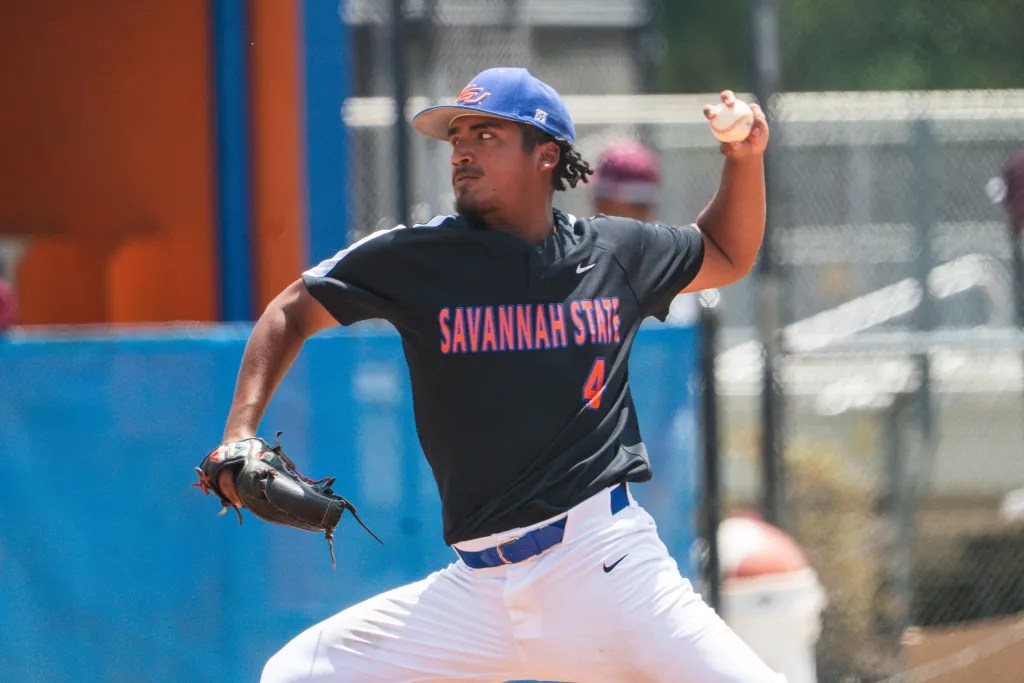 A Savannah State pitcher delivers a pitch during a game against Morehouse College on April 26. (Lyndon Terrell for the Atlanta Braves)
The program has raised over $1 million, helping out southern colleges in the Atlanta University Center, Tennessee State, Savannah State, Tougaloo College and Tuskegee University.
At the same time, baseball at Black colleges is facing steep financial hurdles, often overshadowed by the revenue and attention devoted to football and basketball or the competitive athletic atmosphere at predominantly white institutions.
“In all of the social things that are happening in the world, this is the one thing we can actually solve,” Bedasse said. “We can make a difference in our sport and our game, and really look at leveling the playing fields and creating equitable access and opportunities.”
Leveling the playing field
When Ricky Holden took the coaching job at Claflin University in Orangeburg, South Carolina, he said all the softball equipment could fit in a tiny shed at a field that the university didn’t even own.
“Is that all the equipment y’all have?” he remembered saying when he opened the shed door. “We can produce, but we can’t produce at high levels.”
The first thing he did was purchase more softballs for the team, which can range anywhere between $5 to $10 each.
When Holden applied for the Homers for Hank program, he kept it simple, asking for a pitching machine and equipment. Now, the softball program needs more than just a tiny shed.
That’s where Homers for Hank is stepping up to the plate.
Supported by the Henry Louis Aaron Fund, Homers for Hank Together said they are continuing the legacy of Hank Aaron by creating baseball experiences across the South.
The programs led by the Braves in partnership with Truist Bank frequently hold youth baseball/softball initiatives in hopes to remove barriers and draw kids from underrepresented communities into the game. One of their annual initiatives, The 44 Classic, hosts the top 44 high school baseball players to showcase their talents.
Their initiatives also go beyond playing baseball. Through the Hank Aaron Fellowship program, athletes participate in a yearlong fellowship to learn the operations of the front office in the major leagues. While applicants do not have to be from marginalized backgrounds, women, Black people, and Latinos are encouraged to apply.
When Truist and the Braves agreed on the Homers for Hank partnership, the original agreement was for five years. This year marks the fifth year of the program.
Willie Washington, athletic director at Benedict College, can relate to doing a lot with little.
He’s been the athletic director at the college for 35 years and has seen the baseball and softball programs grow. With the grant from Homers for Hank, they’ll be able to keep the grass cut and install netting for the field, as required by the Southern Intercollegiate Athletic Conference.
A part of Washington’s job as the athletic director is to look for funds and donors to support its sports programs.
“We will go out to companies, corporations, and businesses and will apply [for any grants],” Washington said. “Some will say they’re able to assist, and some will say not at this time.”
Washington said that’s what his office does, except, like many other smaller colleges, it’s just him in his office.
Benedict has received several grants from the National Collegiate Athletic Association to fund personnel and internships within the athletic department.
How Black colleges have always been ahead of the curve
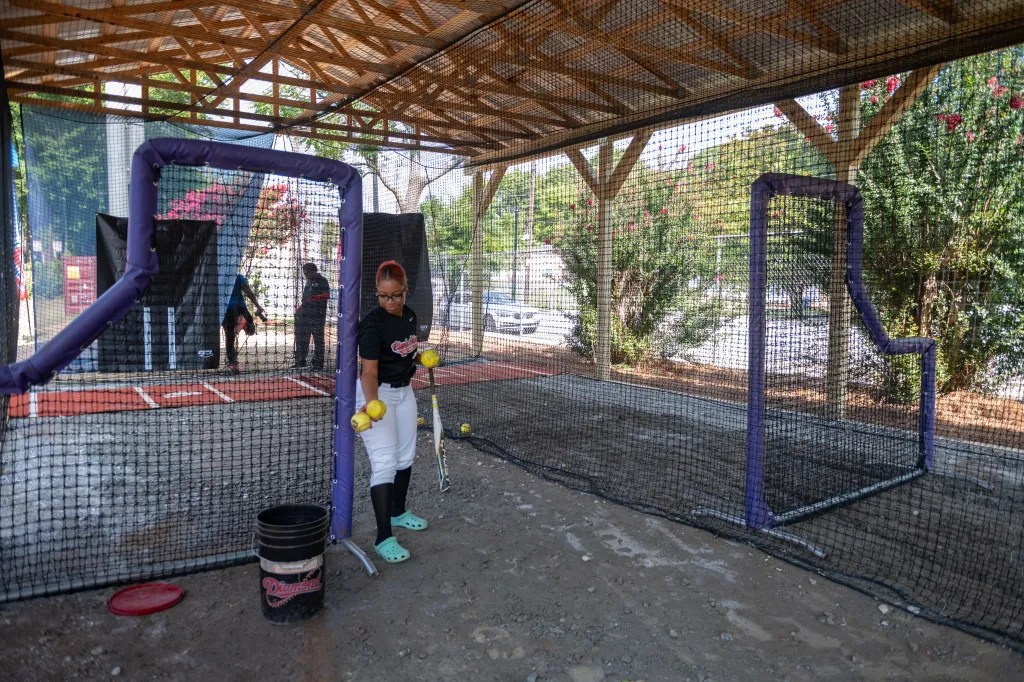 Clark Atlanta softball players check out the new batting cages gifted by Homers for Hank in 2023. (Courtesy of the Atlanta Braves)
Derrick E. White, a historian and scholar of Black studies in sports, said the question is whether philanthropy efforts toward Black colleges will continue under the current administration.
“In the current political landscape, this could be an attack on DEI, even though Hank Aaron’s legacy is untouchable in some ways,” White said.
The Trump administration’s attack on diversity, equity, and inclusion has caused several programs to roll back their commitments to marginalized groups in higher education. The U.S. Supreme Court’s 2023 landmark decision to end race-conscious admissions has been used to end scholarship programs targeted at marginalized communities, especially those for Black students.
The inequity and lack of funding for nontraditional sports at Black colleges extend beyond baseball and softball. Black colleges and their struggles with keeping nonrevenue generating sports have consistently been a roadblock. In June, Fisk University announced its gymnastics program will end after the 2026 season, citing financial reasons, scheduling, and recruitment.
In some cases, like Howard University’s golf team, that program is kept alive through philanthropic efforts. In 2019, both men and women’s golf were brought back through a six-year financial commitment by NBA star Stephen Curry.
Philanthropy at HBCUs keeps non-revenue-generating sports, like baseball and softball, alive, White said.
The upside, he said: Black colleges have always been ahead of the curve.
Unlike predominantly white institutions, White pointed out that Black colleges make do with very little, dating back to the 20th century when Morgan State University carried lacrosse in the 1970s, Howard University carried soccer in the 1920s, and other Black colleges competed in swimming since the 1900s.
Billy Hawkins, a professor at the University of Houston looking at race, politics, and sports, said the next few years will be a test to see which corporations are really committed to diversity.
“We have to recognize that our interactions and engagement with white people — white institutions and white capitalists — have always been an economic relationship,” he said.
Within the next few years, partnerships like the Braves and Truist will rely on Black faces being in the right places, Hawkins said.
The most recent “photogenic” Black face was Deion Sanders’ tenure as the head coach for Jackson State University’s football team, Hawkins said. The partnership brought a spotlight to Black colleges, resulting in ESPN still being present on HBCU campuses, even after Sanders left JSU in 2022.
“It’s going to take bold initiatives from corporations that understand the long game,” he said. “This is three years of regressive politics that we have to deal with, but when you look at the Black buying power, it’s projected to be $3 trillion by 2030.”
With corporations still investing in programs like baseball and softball at HBCUs, they will get a return on their investment, he said.