

Payroll isn’t just a Twins problem—it’s the primary factor shaping every MLB team’s roster, even without a salary cap. You might feel that’s unwarranted, and if so, feel free to vent in the comments of the dozens of stories we’ve had on ownership. But our focus is going to be more practical.
Given that payroll is an important factor for the Twins, what are the hard numbers for 2026 and what do they mean? To do that, we’re going to do some back-of-the-napkin figuring, approximating the numbers the front office will also be using as this offseason begins.
But first, here is some context about the Twins’ payroll.
Payroll for this year’s 26-man roster is approximately $115 million. It started at around $140 million, but about $25 million of that was traded away during the fire sale.
Last year’s payroll was closer to $130M. So the Twins went into this year raising payroll about $10-15M, but when they failed to compete, they lowered it by another $10-15M.
The year before that, the Twins had a payroll of over $150 million. It was “right-sized” by ownership following that 2023 season. That remains the high-water mark of payroll in the Twins’ history.
The median payroll for an MLB team in 2026 will likely be around $170M.
So where do things sit? To figure that out, we’ll look at the Twins’ team as they enter the offseason. Essentially, we’re assuming they won’t bring back any free agents, make rational decisions on players under arbitration, and must pay MLB’s minimum salary (~$800K) to someone for each roster spot.
We call it our “back-of-the-napkin” figuring because some of these estimates are imprecise: we generally know how much players are likely to earn in arbitration, but the exact numbers may not be known until the offseason is over. Doing all that, the answer is … (drumroll, please):
The baseline Twins payroll is about $95M. Here are the back-of-the-napkin figures:
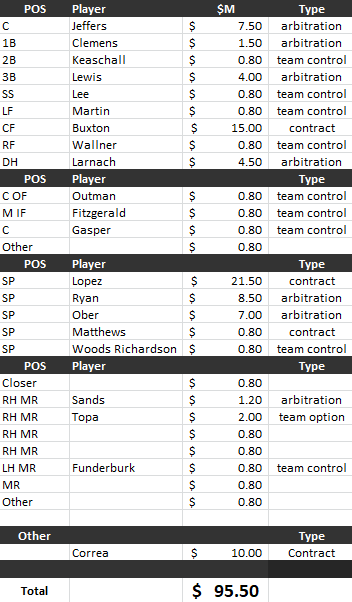
It’s essential to note that this is a starting point, not an endpoint. If the Twins add some free agents, they will add to that number, as they did last year when adding Harrison Bader, Danny Coulombe, and Ty France for $10.25M.
Of course, they could also trade away some of these guys, too, as they did the year before when they traded away Jorge Polanco to free up additional money. A glance at the numbers above shows why there is so much speculation about whether the Twins might trade away pitchers like Pablo Lopez or Joe Ryan: doing so could lower their payroll to $65M.
All of which leaves us short one very important number: what is the Twins’ payroll budget for 2026? That is something the team has been increasingly less willing to share, which makes it harder for fans and media to see the context around the offseason moves they make.
The difference between an $85M payroll, a $115M payroll, and a $145M payroll becomes obvious when looking at the details. At $85M, the Twins likely need to cut further. At $115M, they can tread water, making modest additions. At $145M, they’d have up to $50M to shop, enough to chase one premium free agent or even multiple difference makers.
Without that piece of information, it is very difficult for us to evaluate what the Twins will be up to this offseason. However, that information tends to leak out during the offseason as they engage in meetings with free agents and other teams. When it does, we’ll see whether the Twins plan to scrape by, tread water, or reload in earnest.
Let us know in the comments what you think will happen and what you think should happen.