
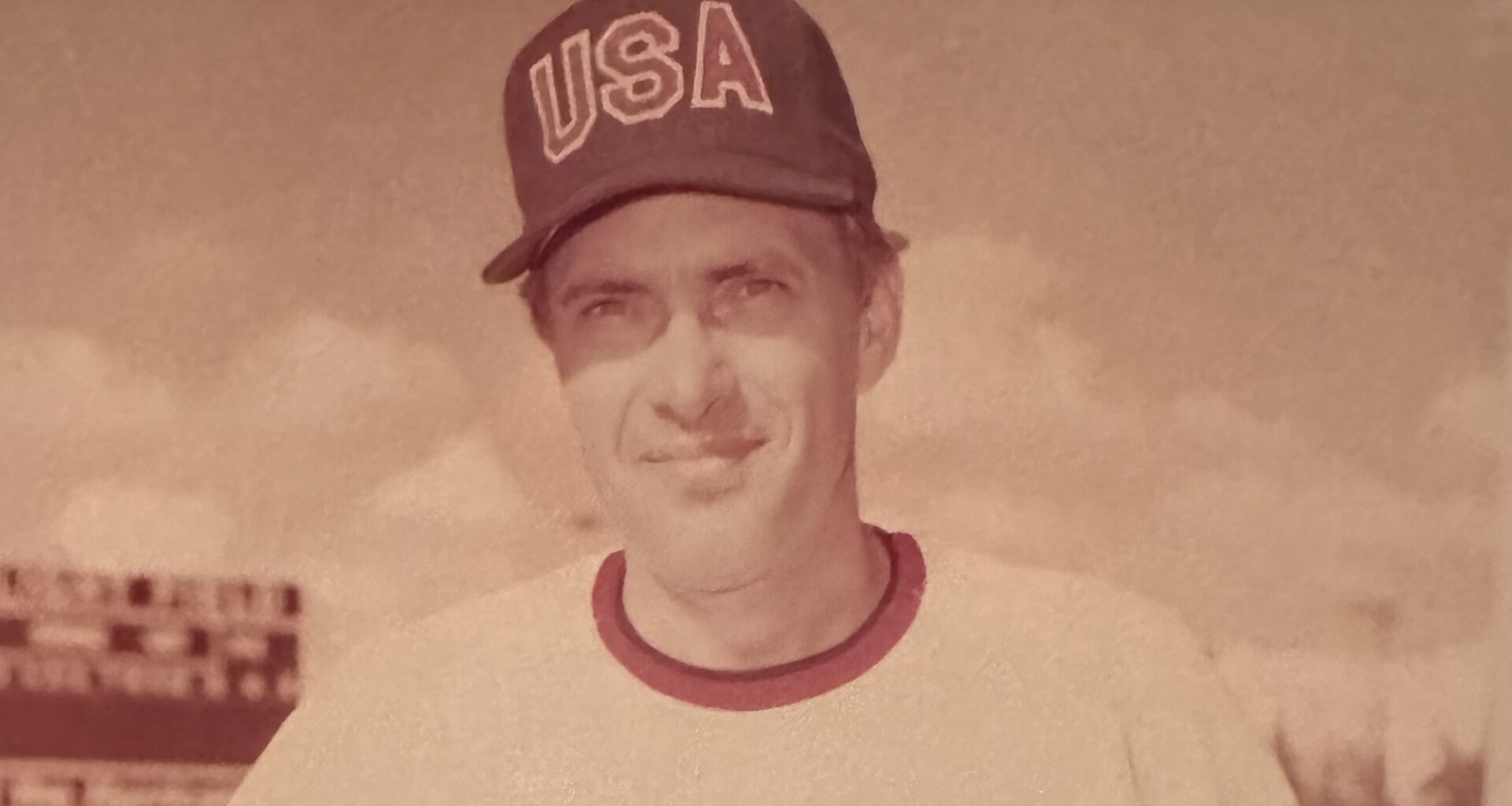
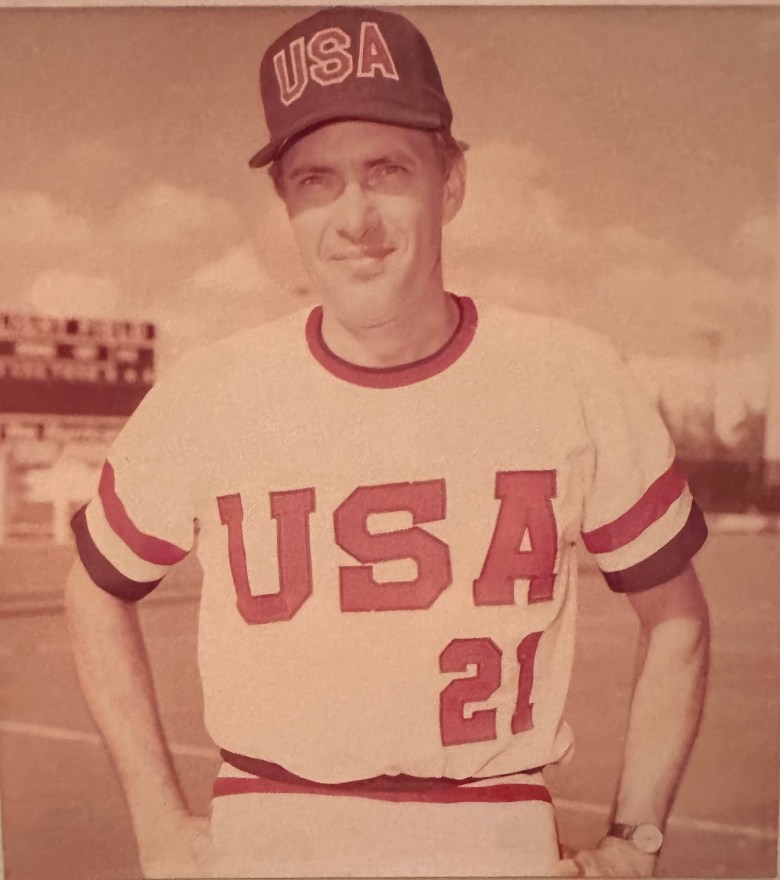
 In 1973, Dr. Record was an assistant coach for the World Champion USA team that competed in Managua, Nicaragua. In 1976, he was the head coach of the World Champion USA team that competed in Taiwan. (Photo provided by Record family)
OPINION|
It’s been 50 years, but every baseball season I think about my baseball coach at Phillips University in Enid, Oklahoma: the late Dr. Joe Record.
Dr. Record was a Phillips lifer. He graduated from Phillips in 1949, then earned his doctorate from Peabody College for Teachers at Vanderbilt University. His first job at Phillips was in 1951 as an assistant basketball coach. He started coaching baseball in 1953 and continued through 1981, compiling a 29-year record of 649-294 (.688 winning percentage), with two trips to the NAIA (Small College) World Series in 1973 and 1975. He passed away Sept. 20, 2008, at age 80.
Dr. Record was named NAIA Coach of the Year, inducted into the NAIA Hall of Fame, and coached the United States team in the World Games in Taiwan, the equivalent of today’s Olympics. He and his wife, Lois, now 96, were married 60 years. A remembrance is here.
I pitched two years for the Phillips Haymakers. In 1975, my last year, we were 35-15 and went to the eight-team NAIA World Series. We had 19 players: 11 position players, seven pitchers, and one who played both. There were six freshmen, three sophomores, four juniors, and six seniors. My brother, Lance, was a junior catcher that year. Another brother, Eric, was a freshman pitcher. I was a fifth-year senior pitcher. Of the 19 players, 14 had started at Phillips as freshmen and five were transfers. Dr. Record’s goal was to find freshmen who could start all four years.
Dr. Record simplified the complicated
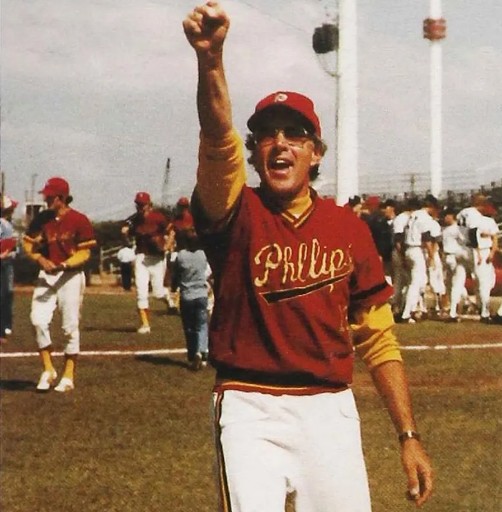 Dr. Record celebrated after Philips won the Area Tournament in 1973 to earn a spot in the NAIA World Series. It was Phillips’s first trip, followed with a second trip to the World Series two years later in 1975. (Photo provided by Record family)
Beyond the wins and losses, I learned a lot from Dr. Record during those two years. He was not only smart, but wise. He simplified complicated topics.
At the beginning of the year, he talked to us about the “minimum equipment check.” In other words, nothing fancy. “You need to have webbing in your glove, spikes on your shoes, a few balls and a few bats. That’s it.”
“When you guys hit long fly ball outs, you strut back with your chest out. When you hit bloop singles, you shake your head and cuss. I’m beginning to wonder if you understand the goals of the game.”
“There will be some games we face a pitcher who has great stuff, and we’ll be lucky to hit a foul ball. That’s when we need to change our approach and manufacture runs: bunt, steal, hit-and-run, sacrifice, anything to score runs.”
He expected players to spend the off-season and fall practice improving and expanding their skillsets. Once the season started, it was too late and would elicit this terse comment: “You’re talking about next year.”
We were not old enough – maybe not mature enough? – to fully appreciate one of Dr. Record’s most profound statements: “One of the greatest skills an athlete can have is the ability to stay healthy.” I have come to appreciate that observation more as years passed.
Dr. Record coached third base most of his career and even simplified signs. For permission to swing on a 3-0 count or steal a base, he used his right hand. With his right arm hanging casually by his side, an open hand meant “yes” and a closed hand “no.”
More than once, he offered sage advice. Our Phillips team locker room was several steps below “great,” but it was infinitely better than where Dr. Record and the assistant coach showered and changed. I asked him why he didn’t dress with the team. “I don’t want to overhear any idle conversation that might affect how I manage the team,” he replied.
Dr. Record could be entertaining
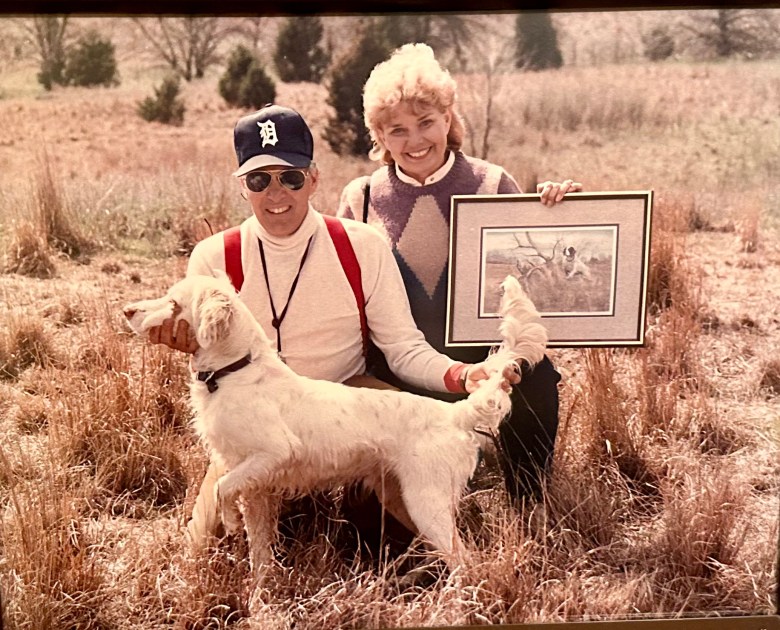 Dr. Record trained English Setters and competed in field trials. Here Dr. Record is with one of his dogs and his wife, Lois. (Photo provided by Record family)
Dr. Record added some fun on road trips, especially with meals.
We traveled in car caravans and usually ate at fast food restaurants. Before we ordered, Dr. Record would look at the menu and declare, “Your limit is $1.77.” (Remember, these were 1975 prices when quarter-pound cheeseburgers were 70 cents and fries were a quarter.)
On our spring trip to Texas, he offered: “If we win this doubleheader, I will take you to a great all-you-can-eat barbecue restaurant. If we don’t win both games, we’ll go someplace else.” I don’t know if he would have followed through on that, but it didn’t matter since we won both games. At the restaurant, the smiling wait staff brought the first set of plates neatly arranged with ribs and other meats. By the fourth round, the plates were sloppily piled high, delivered by a frustrated wait staff. For them, it must have been a locust-like experience.
My most memorable moment with Dr. Record
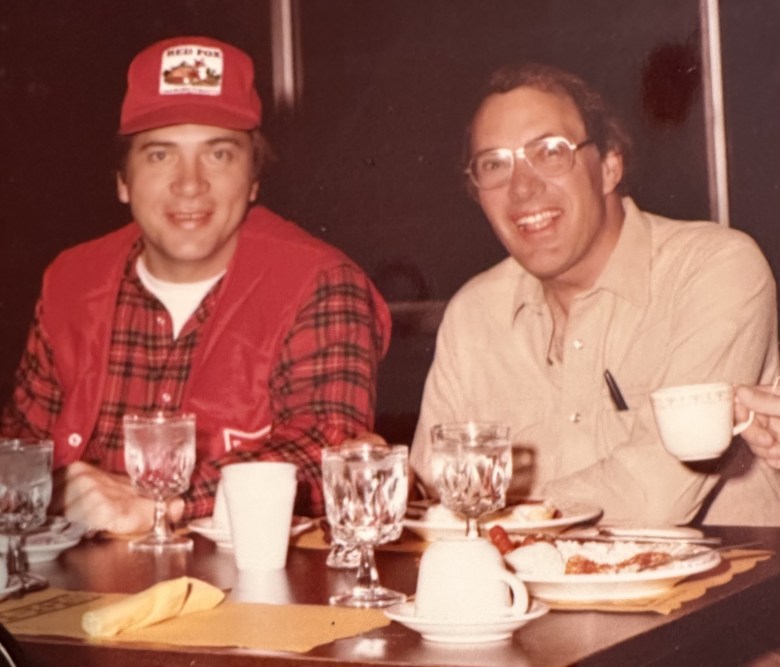 Dr. Record recruited Hall of Fame catcher Johnny Bench out of Binger (Oklahoma) High School and Bench had committed to attend Phillips. In the end, Bench decided to sign with the Cincinnati Reds out of high school rather than go to college. Dr. Record and Bench remained friends, and Dr. Record invited him to attend the Grand National Quail Hunt in Enid, including this one in 1980. (Photo provided by Record family)
What I remember most from Dr. Record is the pep talk he gave me.
It was a rainy day in the spring of 1975, and we were taking batting practice in the outfield so as not to damage the infield. It was early in the season, and we had played a game the day before. I was the No. 2 starter, and I had been the starting pitcher in that game. I didn’t pitch very well and was relieved early in the game. We did end up winning, so I didn’t get a loss.
I was standing by myself in the outfield shagging batting practice. Dr. Record left the third base dugout and came toward me. He walked with purpose. When he got to me, he said: “Paul, it’s up to you. You can either pitch like you did yesterday, and we can have a decent season. Or, you can pitch like I know you can and we can have a great season.” Then he spun around and walked back to the dugout.
Wow. Dr. Joe Record was the kind of coach you didn’t want to disappoint. He knew what made me tick, just as he did all his players. He hit a nerve. I’m pleased to say I did do better on our way to the NAIA World Series.
At Dr. Record’s celebration of life, his former players presented a plaque. It read:
“Your leadership, wisdom and guidance have made us champions also in the game of life.”
Well said… and true.
Paul Kincaid, an Independent, lives in Springfield. He spent 39 years in higher education public relations and governmental relations, and served as Chief of Staff to three University Presidents. The final 28 years were at Missouri State University. After retiring from Missouri State in 2014, he served eight years as Executive Director of Jobs for America’s Graduates-Missouri. He owns and operates his consulting company, Kincaid Communications, LLC. Email: Paul.K.Kincaid@gmail.com More by Paul Kincaid