
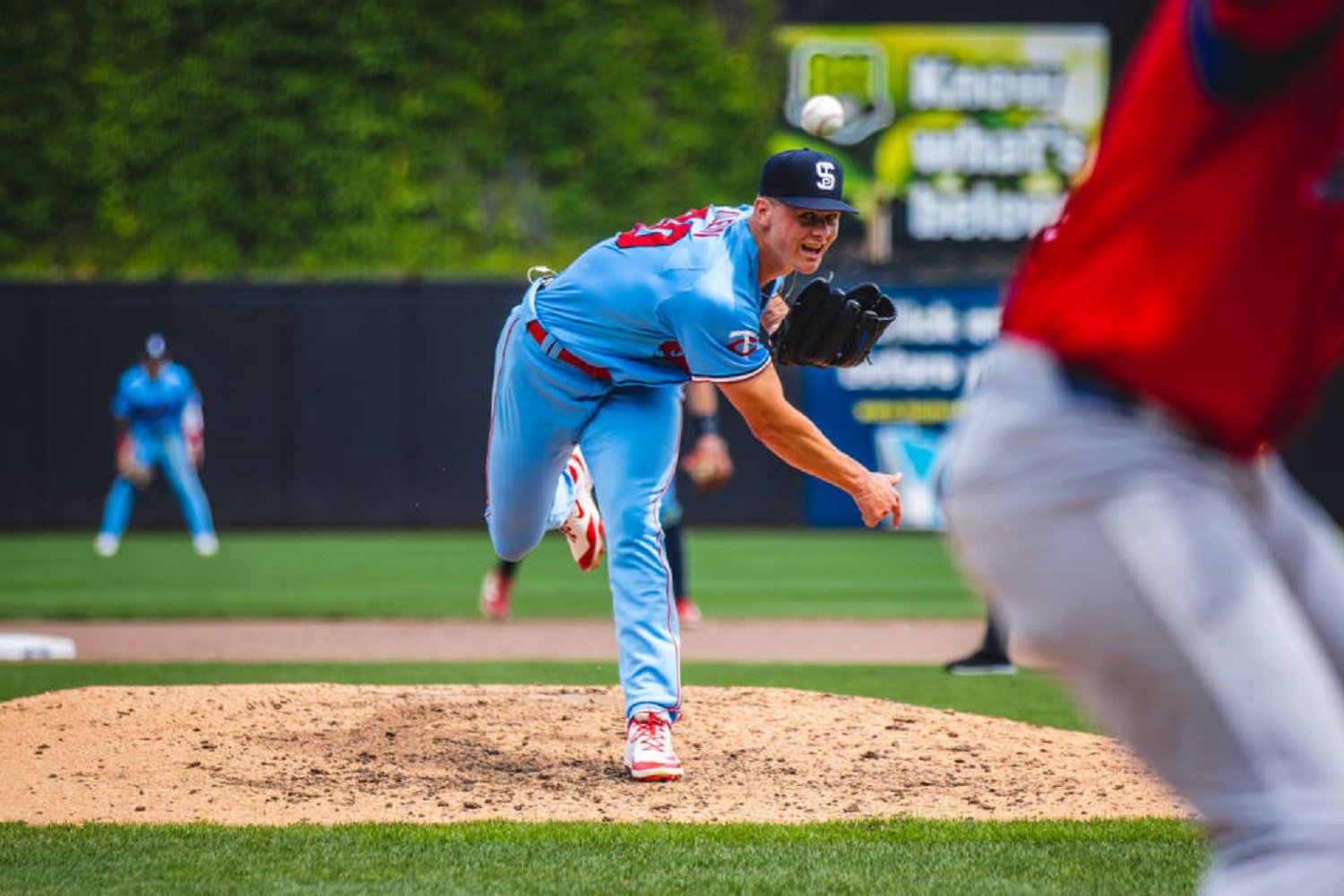
Image courtesy of Rob Thompson, St. Paul Saints (Photo of John Klein)
Each week, standout performances from across the Minnesota Twins farm system shine a light on the next wave of potential big leaguers. This week’s hot sheet highlights a slugging infielder, a rising right-handed starter, and a pitcher quietly carving up Triple-A lineups. Together, they represent the mix of youth, development, and depth the Twins continue to build throughout the organization.
IF Billy Amick – Cedar Rapids Kernels
How He Got Here: The Twins selected Amick in the second round (60th overall) of the 2024 MLB Draft out of the University of Tennessee. The 22-year-old has quickly emerged as one of the most advanced bats from that draft class, showing the ability to hit for both average and power while adjusting to professional pitching. Last season, he played 18 games at Low-A, where he posted a .763 OPS with nearly as many walks (12) as strikeouts (15). It wasn’t eye-popping numbers, but it showcased his college experience.
Hitting the Hot Button: Amick tore the cover off the ball this past week, hitting .480 (12-for-25) with four doubles, two home runs, and seven RBI in seven games. He also showed strong plate discipline, drawing five walks and posting a 1.461 OPS. For the season, he has hit .316/.423/.464 (.887) with a 12.6 BB% and a 26.1 K% in 58 games. Defensively, he has split time between both corner infield positions. Already one of the most dangerous hitters in the Cedar Rapids lineup, Amick’s ability to impact the game both with extra-base power and consistent contact has him climbing the organizational ladder quickly.
RHP Jose Olivares – Cedar Rapids Kernels
How He Got Here: Olivares, a 22-year-old right-hander from Venezuela, signed with the Twins as an international free agent in January of 2021. Last season, he made 13 appearances (10 starts) with Fort Myers and posted a 3.33 ERA with a 1.33 WHIP. After developing steadily through the lower levels, he’s now becoming a key arm in the Kernels’ rotation and flashing the swing-and-miss stuff that could carry him further.
Hitting the Hot Button: In his latest start against Quad Cities, Olivares was dominant, allowing just one run on one hit over six innings. He walked two and recorded a career-high 10 strikeouts, showcasing the ability to both command his fastball and finish hitters with secondary pitches. During the 2025 campaign, he has a 4.38 ERA with a 1.36 WHIP, having pitched over 90 innings for the first time in his career. His outing capped off a strong run of development, and he continues to position himself as one of the more intriguing under-the-radar arms in the system.
John Klein – RHP, St. Paul Saints
How He Got Here: Klein, now 23, signed with the Twins as an undrafted free agent in 2022 and has steadily pitched his way into relevance in the upper minors. Last season, he spent the entire year at Cedar Rapids, posting a 4.57 ERA with a 1.40 WHIP. While he wasn’t a highly touted addition at the time of his signing, his performance in the upper minors has forced evaluators to take notice.
Hitting the Hot Button: Over his last four outings with the Saints, Klein has been excellent, posting a 2.65 ERA across 17 innings. During that stretch, he has recorded 26 strikeouts compared to just five walks while holding opponents to a .523 OPS. Before his promotion, he pitched 80 2/3 innings at Double-A with a 3.12 ERA (3.21 FIP), 27.4 K%, 6.9 BB%, and 65% strikes. His consistency and ability to limit damage make him an increasingly valuable depth piece, and his recent performance suggests he could soon be on the radar for a big-league look.
Amick’s middle-of-the-order presence, Olivares’ swing-and-miss upside, and Klein’s consistency at Triple-A highlight the different ways talent is developing in the Twins system. Performances like these underscore the depth across multiple levels and provide a glimpse of the impact players who could help the Twins in the near future.
Which player’s performance stands out the most? Can Klein have a role with the 2026 Twins? Leave a comment and start the discussion.