
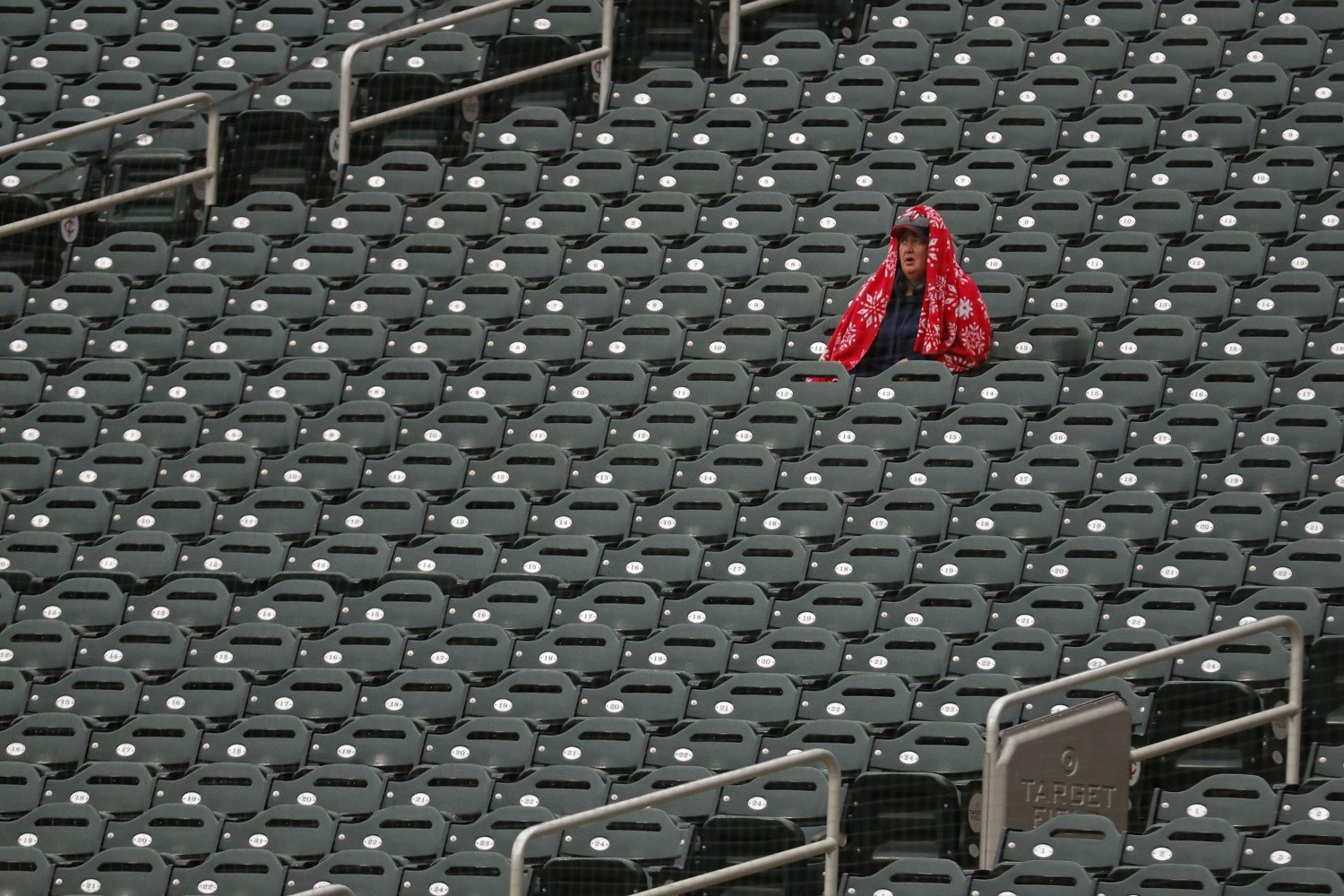
At the onset, I want to make myself clear; I love my favorite baseball team, and I’m not being malicious or trying to rub the organization’s nose in it. I had the thought a few weeks ago, and I’ve been turning it over in my head.
If you consider how involved each team is in the modern baseball landscape, their history as a franchise, and how prominent they are in the culture, I think that the Twins are the least relevant team in baseball.
Please understand, I don’t mean the worst team in baseball, or the worst organization in baseball history. I mean: If you were to start talking about baseball with a stranger, how long would the conversation go before the Minnesota Twins were mentioned? The Colorado Rockies are more notable than the Twins right now, for instance, because their losing ways are so extreme. You could probably throw the West Sacramento Athletics, Chicago White Sox, and Pittsburgh Pirates into that pile, as well—they’re so bad that they’re relevant. There’s relocation intrigue in one place, and the specter of a wasted generational megastar in another.
On the flip side, obviously, there are a ton of teams who are clearly more relevant to baseball than the Twins, based on historical success, their market size, or any other unsubtle reasons. The Braves and Cubs, America’s national cable teams, fall under that category. So do the historically entrenched Boston Red Sox, Los Angeles Dodgers, New York Yankees, and Philadelphia Phillies. Some combination of market size, history, and recent success also exclude the Houston Astros, New York Mets, St. Louis Cardinals, and San Francisco Giants.
There are some less successful teams and prominent teams that are also, nonetheless, more central to the conversation than the Twins. For instance, despite their recent struggles, the Detroit Tigers and Baltimore Orioles (even if these aren’t the original Orioles) carry a certain legacy as the current iterations of original American League teams.
The Texas Rangers, without their recent World Series, may be in a similar relevancy class as the Twins, but it’s hard to ignore a Commissioner’s Trophy awarded in the past five years. Dallas-Ft. Worth is also an enormous market, even if it doesn’t always feel like one in the baseball world. Likewise, their opponents in that series (the Arizona Diamondbacks) were vaulted a bit more into the spotlight. They’re also helped by their success in the recent past—and an iconic look. In the modern game, the attachment of spring training to Arizona also makes the growing Phoenix area play up as a baseball market. When baseball things happen there, they leave a heavier footprint in the national conversation than the sheer market size might imply.
It’s not just about how good or bad the team is when we’re talking about relevance. The iconography of the Diamondbacks franchise, especially in their 1990s teal and purple, has staying power. The Milwaukee Brewers’ iconic ball-and-glove logo, the Florida Marlins’ teal caps, the Athletics’ Kelly greens, the Padres’ brown, the Royals’ baby blue. There are certain logos, insignias, and color schemes that lock into fans’ heads—and even the general population’s.
The Twins do not have that type of staying power. The Twins’ ‘TC’ and ‘M’ are not fashion statements, like the classic Yankees or Mets ‘NY’, Dodgers ‘LA’ (formerly, ‘B’, or even the White Sox ‘SOX’ or the Pirates ‘P’. This isn’t because the logos aren’t good, exactly. Maybe the problem is having gotten caught in between, and now using two different cap and cornerstone logos so evenly. Either way, the brand is diminished. With the exception of City Connect uniforms, all of the teams listed above wear the same logo on their cap every night.
So, what do the Twins bring to the table? I think we’ve spent enough time on high fashion, but I hope that what I’m trying to say about cultural consciousness is getting through. They have been successful in the worst division in baseball over the last quarter-century. They won two World Series in 1987 and 1991. They have a handful of Hall of Famers wearing their caps—Harmon Killebrew, Tony Oliva, Rod Carew, Bert Blyleven, Kirby Puckett, Jim Kaat and Joe Mauer. With the exception of Carew, though, it’s a group that doesn’t get brought up often. They had a few stars in their recent past—Byron Buxton, Carlos Correa, Mauer, Justin Morneau, and Johan Santana likely being the most prominent. But you know who the most famous Minnesota Twin of the 21st century is, for most of the world’s baseball fans? David Ortiz.
They haven’t been great recently, but they haven’t been comically bad, either—at least since the 2011-2016 run that placed them at the bottom of the American League. They have existed for a while in a middle ground that doesn’t command much attention. Even their 0-18 playoff losing streak isn’t a talker anymore, now that it’s over. The Mariners and Pirates can tell you how quickly the extra notes in national columns and the buzz from other fan bases die down, once you go from an active streak of historical playoff absence or anguish to a merely recent one.
I’ll speedrun the teams I feel are in contention for the most irrelevant team in baseball, and why I think they’re more relevant than the Twins. The San Diego Padres are one of the most exciting teams in baseball right now. The Cincinnati Reds are the “first” professional baseball team, they have an iconic look, they had a great Big Red Machine run, and they once employed Ken Griffey Jr. They also currently employ Elly De La Cruz, an objectively worse version of Buxton but a much more famous player, which is illustrative. The Washington Nationals play baseball in the nation’s capital, but they’re probably close to the Twins in relevance, if you ignore their recent World Series and their Expos history. They have a chance to tumble into the cellar in this regard, but it hasn’t happened yet.
The Angels are on the Twins’ level of recent success, but they recently employed the best two players in baseball (and still have one of them, a surefire, utterly fascinating future Hall of Famer), making them a national punchline, and they even had a more popular children’s movie than Little Big League. (We all know Little Big League is a better movie, but we’re matching up Luke Edwards and Timothy Busfield against Joseph Gordon-Levitt and Danny Glover, here.) They also play in a huge market and are a semi-serious threat to sign a big free agent every winter.
I like to think of the Milwaukee Brewers as a sister team to the Twins, matching their lack of historic success and star power (Robin Yount, Paul Molitor, and Ryan Braun stack up pretty evenly with Killebrew, Puckett, and Mauer), but they’re much more successful right now and boast an iconic logo. They’re going to draw over 2.5 million fans to the park this year, not counting some October sellouts.
The Miami Marlins and Tampa Bay Rays also live in the Twins’ domain. However, their newness (and some bold fashion choices in the short history of each) plays in their favor. The Marlins have been so bad that they’re relevant—and have still won two World Series more recently than Minnesota. Tampa Bay has current events (their ballpark being damaged), recent success, and narratives about analytics attached to them. There are a lot of similarities between the Blue Jays and Twins, but it’s probably a little egocentric to pretend that an entire country’s only team is less relevant than one of the medium-market US-based teams, and they certainly have more star power, with Vladimir Guerrero Jr. Even if half of Canada rejected the Jays as merely Toronto’s or Ontario’s team, that’s a big-market behemoth. And they, too, have two World Series wins more recent than the Twins’.
Within the division, Cleveland and Kansas City seem to be the best contenders for least relevant team in baseball. However, Cleveland was the subject of perhaps the most famous baseball movie of all time; have been more successful in the recent past; and have been the subject of national debate over their name for decades. (Not all relevance is good relevance, but it’s a thing.) They also have the longest World Series drought, by far, dating back to 1948. That’s a narrative that will capture attention every time they’re good. The Twins, Orioles (last title: 1983) and Pirates (1979) haven’t yet reached that level where the losing becomes part of the lore.
Kansas City would probably best Minnesota, but they did win a World Series in the past decade, and like I said above, they have an iconic look. They also have Bobby Witt Jr., and while they haven’t yet secured funding for it, a new ballpark is on the horizon.
If there’s an American League sister organization to the Twins, it’s the Mariners. They have both struggled to have any postseason success for decades, and they exist in secondary markets. But the star power associated with the Mariners, such as Randy Johnson, Alex Rodriguez, Ichiro, or Griffey, far outshines the Twins. Their teal is iconic, and they’re more involved in the national discussion, whether that’s in their MVP candidate Cal Raleigh or their yearly high-profile fight against the Astros and Rangers for a playoff berth.
The Twins’ best case for national relevancy, at least since they were knocked out of the postseason in 2023, was when they were up for sale. Now, even that bit of intrigue has been canceled—not consummated, but called off. There’s no way to become more invisible to the baseball world than to not pay off even when you do promise something of interest.
But that’s just my opinion. How wrong am I? Do you think the Twins are more top of mind than any other franchise? I appeared on Locked On Twins with Brandon Warne to discuss this topic a few weeks ago, if you’d like to give it a listen.