
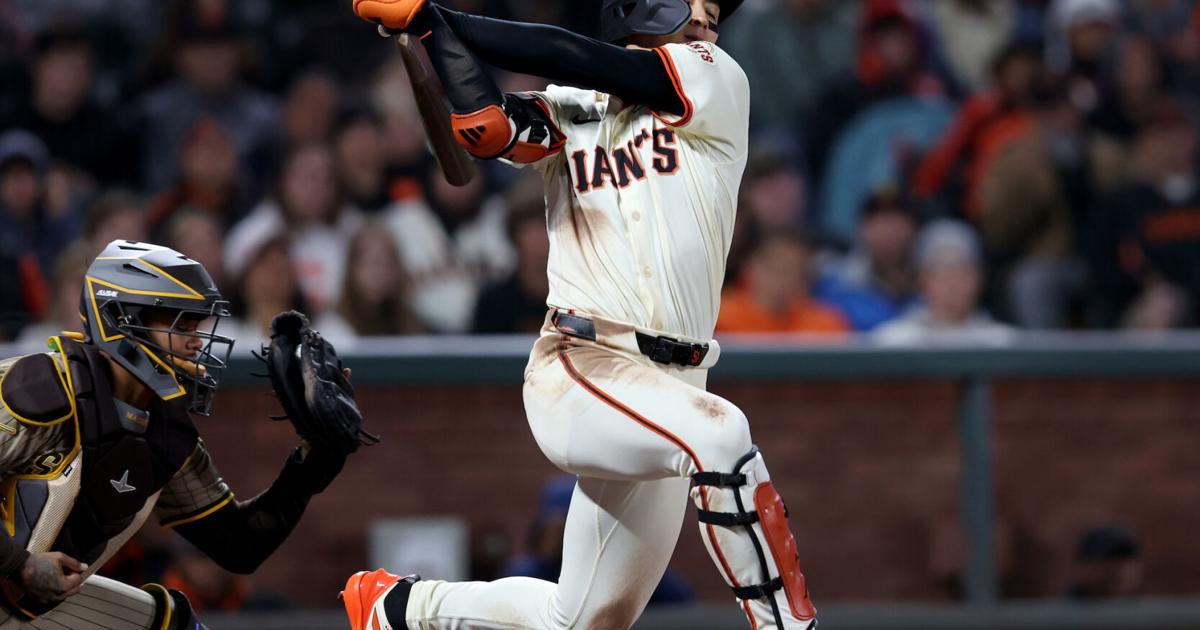
The way Jung Hoo Lee was playing early in the season — going off at Yankee Stadium especially — he looked like a lock for big things this year.
The San Francisco Giants center fielder’s first full season in the majors didn’t keep following that trajectory. After missing most of last year with a shoulder injury, he’s still learning the league, adapting from the KBO style of play, and the team is figuring out how to ensure he stays strong and effective through a longer schedule with fewer built-in days off.
He was batting .319 at the end of April. Two months later it was .240 after he hit .231 in May and .143 in June.
“June is when I hit bottom,” Lee said, with Justin Han interpreting.
That Yankees series from April 11-13, which included three home runs, might bear some of the blame. Lee pulled all three, and as the Giants’ offense continued to show minimal results, his swing started to get bigger. His launch angle was up, and so were his strikeouts. He was lofting a lot of flyballs that died at the track when what the team wanted to see was line drives, even grounders, which Lee, with his speed, can turn into hits.
“What I did a lot was I tried to pull the ball a lot,” Lee said, “and then that’s when maybe the swing got a little bit big. I was focusing more on getting a good result every at-bat, and the more and more I feel like I put more importance on just having a good result, that’s when I started to kind of get a little bit different and got away from what I should have been doing.”
Hitting coach Pat Burrell noted that Lee had some success pulling the ball, which isn’t necessarily a bad thing — but it’s not really Lee’s game. He is at his best when he’s hitting to all fields. The hitting coaches pored through video of Lee from the KBO and they all agreed that he needed to work on going the other way.
“But the more and more time we spent in the cage, the more we talked about maybe trying to go oppo a lot, and maybe that’s where I found my mechanics,” Lee said. “Everything is a bit more natural.”
“This is a very tough league and they make adjustments,” Burrell said. “With Jung Hoo’s speed, we just want to make sure that when he gets balls away from him, he utilizes left field because there are so many hits for him there. He’s embraced it 100%.
“He’s coming out the other side. It’s just perfect timing.”
Lee got advice all over the place, but one conversation from his rough June stood out. Manager Bob Melvin realized Lee was trying to take too much on himself in a month in which the team hit .224 and nosedived the final two weeks, going 4-11 to drop into third place, eight games behind first-place Dodgers in the NL West. On June 13, they’d been tied atop the division.
“Bob came up to me and said, ‘Try to take it easy. Don’t take it so hard,'” Lee said. “That might be something that anybody could say, I guess, but it felt like those two sentences kind of really brought things into focus — if you try too hard, everything’s just going to be harder. That really helped.”
Lee pumped the brakes on trying to belt everything, and while his homers dipped — his shot Monday night was his second of the second half — his singles and doubles per plate appearance rose, and his second-half average stands at .308, his OPS at .799.
Another difference in the second half: Lee’s workload is a little lighter. The KBO included Mondays off, and over the course of the season, Lee’s already light frame got thinner. He’s getting more rest these days after young outfielders Luis Matos and Drew Gilbert came up and have been swinging the bat well. Gilbert, a good center fielder, has especially helped as an option to plug in for Lee.
Melvin has tried to maximize Lee’s breaks by combining them with the team’s days off to give him back-to-back rest days, and that has paid dividends. Since the start of September, Lee has gone 13 for 30 with two walks and a 1.069 OPS.
“He’s looked like a different person,” Melvin said.
For young players and foreign players alike, learning how to endure the relentless schedule without losing strength can be difficult, especially for those who tend to drop weight over the long season.
“He’s missed some time over the last couple years, and this is really the big test physically to see how he’s maintaining,” Burrell said. “Nobody can really help with that, you have to go through it, and if you’re an honest self-evaluator, you understand you have to do something different, whether it’s with nutrition or workload or a combination. You only learn it by doing it.”
That holds true for the obvious: Lee hasn’t seen many opposing pitchers much, a time or two at most, and while the KBO is a good professional league, no place in the world has the quality of pitchers found in the majors.
“It’s just such relentless velocity,” Burrell said. “And if there are times you don’t feel super confident you can get to the fastball all the time, it can be very challenging.”
Lee said the most important thing for him is his preparation, especially when it comes to knowing the pitchers’ release points, and he’s learning that even the best of the best can’t dot pitches in areas that give him trouble all the time. They’re going to make mistakes, and he’s going to be ready.
“They have a whole sheet on how to face me, but if you think about it, it’s not like they can make a borderline pitch in my cold zone every single time,” he said. “And now I’m starting to see some pitchers a second and third time and I know my approach.”
This is a big year for Lee. He’s setting a foundation for next season, and if he can stay healthy, strong and consistent, that will be a major plus for San Francisco, because he can set the tone offensively. When Lee scores at least one run this season, the Giants are 35-15. Two or more: 17-0. Let’s say it again: The Giants don’t need him to hit homers. They need him to get on base.
This offseason, unlike the past two, Lee will not have to spend his time rehabbing. He can have a regular routine.
“Since I had such a long slump this season, I learned that to be a better player, you have to make the slumps as short as possible,” he said. “I want to upgrade myself, on and off the field, and every single day I’ve learned something this year, it’s been very meaningful — and the season isn’t over yet.”
© 2025 the San Francisco Chronicle. Visit www.sfchronicle.com. Distributed by Tribune Content Agency, LLC.