
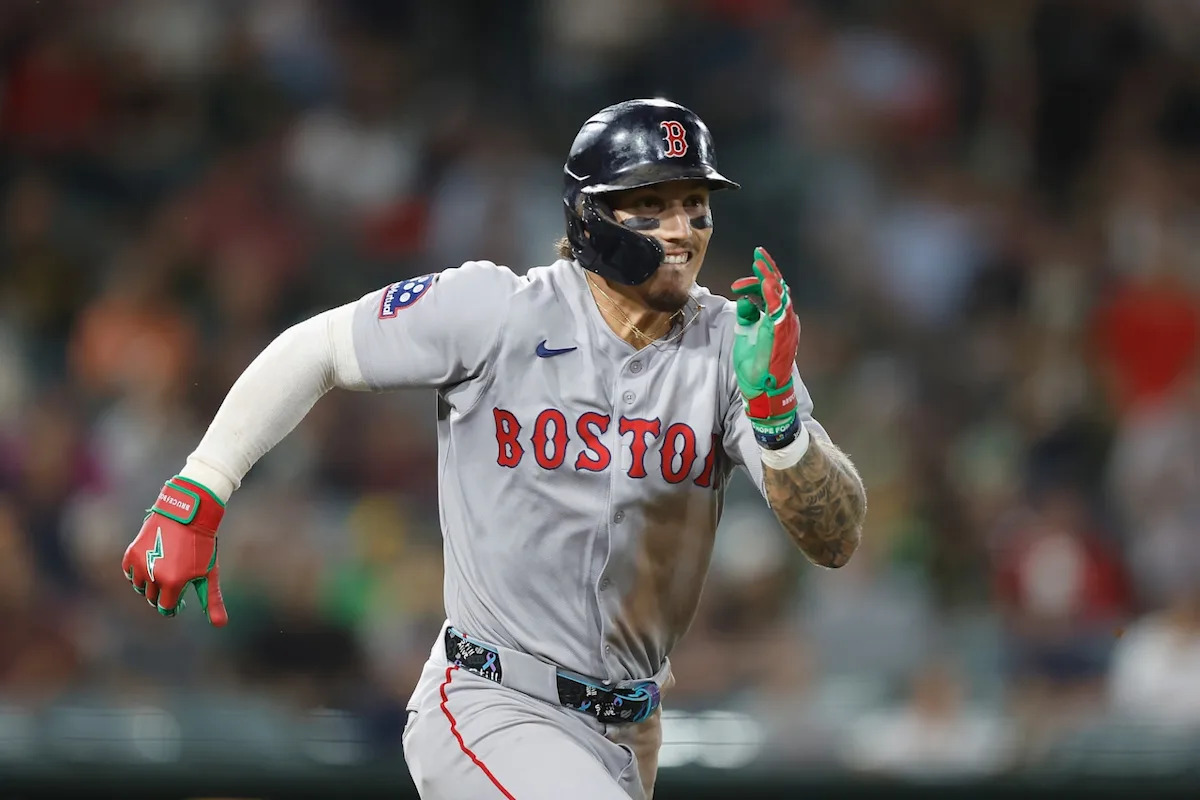
We don’t yet know against whom the Red Sox will be playing in the postseason and we don’t yet know where.
But we can be reasonably certain that, for the first time since 2021 the Red Sox are going to be part of baseball’s playoffs.
Advertisement
Entering Thursday’s action, the Sox’ chances stood at greater than 95 percent to qualify for the postseason. With just 15 games remaining, it would take something like a 5-10 slippage for the Sox to fall out of the picture.
Regardless of where they finish in the seeding, however, the Red Sox are going to be taking part in October baseball. Beyond the matter of opponent and location, they have some things to figure out
Here are six of them:
1) What do they do with the back end of the rotation?
In the best-of-three wild card round, the Red Sox can get away with using just three starting pitchers — Garrett Crochet, Brayan Bello and Lucas Giolito. Anyone else who’s made starts in recent weeks will be in position to contribute out of the bullpen.
Advertisement
Of course, the Red Sox can’t be content with merely reaching the wild card round; their aim is to go deeper. And the deeper they go, the more starting pitching they’ll need.
In a best-of-five Division Series, the Red Sox would need a fourth starter since there’s nothing to suggest they’d be willing to go with Crochet on three days’ rest for Game 4.
The Sox have a number of options for that spot and could choose from among Payton Tolle, Kyle Harrison, Connelly Early, and presuming he returns to full health, Dustin May.
They could also opt for a bullpen game, but that would depend on getting deep starts from the other members of the rotation in the first three games.
Advertisement
There’s time to figure this out, and the final 15 games will serve as the proving ground.
2) They need to identify a fourth high-leverage reliever.
Three spots are set lefty Justin Wilson, righty Garrett Whitlock and closer Aroldis Chapman.
Because the postseason only twice features a schedule that includes three games in as many days — the middle three games in both the LCS and World Series – teams can lean on their bullpens in ways they couldn’t possibly do in the regular season.
Still, in those particular pockets, the Red Sox (and other teams) will want dependable options in the late innings. If the Sox use Wilson in the seventh, Whitlock in the eighth and Chapman in the ninth, they can’t count on having any of them available for a third straight day.
Advertisement
In a perfect world, Justin Slaten would emerge as that fourth trustworthy high-leverage. But since returning from a IL stint with shoulder inflammation, Slaten hasn’t looked like himself. In six games since being sidelined, Slaten has an ERA of 11.81 and has allowed 12 hits in just 5.1 innings.
That needs to improve in the final two weeks for Slaten to be part of the circle of trust.
Frankly, there aren’t a lot of options on the staff — unless you count lefty Steven Matz. But it would be better for the Sox to identify another righty, giving them late-inning balance.
3) Who’s on second?
For now, the Red Sox are essentially platooning Romy Gonzalez and David Hamilton.
Advertisement
Hamilton is obviously the best defender, but despite talk of improved at-bats after some time spent in Worcester — he’s hitting .333 since being recalled — he’s still far from an impact bat. And the fact that he’s 3-for-6 in his last half-dozen stolen base attempts is another red flag.
With the loss of Roman Anthony — for now — the Sox have abandoned the use of Ceddanne Rafaela at second, since the outfield has been thinned. Should Anthony return, that could change.
For now, however, the Red Sox will have to choose between a sub-average defender in Gonzalez – -3 runs defensive runs saved at second — or Hamilton’s inconsistency at the plate.
4) Is there a No. 1 catcher?
Advertisement
A few months ago, this wasn’t even a question: Carlos Narvaez had earned that title as he surpassed Connor Wong.
But lately, the distinction hasn’t been so obvious. Narvaez has slumped badly offensively (.666 OPS in the second half), along with an uptick in passed balls and wild pitches, a function, perhaps, of his knee injury which has restricted his mobility.
Concurrently, Wong has improved in recent weeks. His OPS in the first half was shockingly low (.384) vs. a slightly more respectable .666 after the All-Star break.
Also, Wong has become the designated catcher for Brayan Bello, as the two have paired well together. That virtually guarantees that Wong is going to play at least once every three games.
Advertisement
Do the Red Sox need to anoint a No. 1 catcher for the postseason? Or will they continue to mix-and-match right into October?
5) Who hits leadoff until Anthony returns?
Against righthanders, the choice is pretty clear: Jarren Duran.
But against lefties, it gets a lot more complicated; Duran’s on-base percentage against them is just .255.
And, should the Red Sox face the Yankees in the wild card round, as now seems likely, they’ll probably face lefties in each of the first two games: Max Fried and Carlos Rodon.
From among righthanded hitters, the Sox would probably opt to go with Gonzalez. But Gonzalez could be playing first base in such matchups, with Nathaniel Lowe on the bench, and that would mean the lefty-hitting Hamilton as the starting second baseman.
Advertisement
Other options at second — and perhaps to lead off – would be the righthanded Nate Eaton or the switch-hitting Nick Sogard. But neither is established as an everyday contributor.
6) Which players make the roster?
During the regular season, teams usually split their 26-man roster evenly with 13 pitchers and 13 position players. But in the first round (wild card), with just three games, many teams opt to go with slightly smaller pitching staffs.
The Red Sox could probably get away with as few as 11, but the guess here is that they go with 12, leaving 1 spots for position players.
Let’s count, for now, Wong as the backup catcher. He’ll get one of the five bench spots, as will Rob Refsnyder and Hamilton. (For these purposes, we’re counting Gonzalez to be among the “regulars” either at first or second and Masataka Yoshida as the more-or-less regular DH).
Advertisement
That leaves two spots from among the following: Eaton, Sogard, catcher Ali Sanchez and let’s call it a wild card — someone like Jhostynxon Garcia, Kristian Campbell or Abraham Toro off the Worcester roster.
It might be tempting to count out Sanchez, but if the Red Sox are truly concerned about Narvaez and his knee, they might see the value of a third catcher.
Both Sogard and Eaton are better bets, thanks to their versatility. Eaton can play the outfield and third, while Sogard can play second, short and third, and in a pinch, also the outfield.
_______________
As noted here several weeks ago, the days of relievers winning the Cy Young Award seem to be long gone.
Advertisement
Aroldis Chapman, good as he’s been, isn’t going to change that — not after the season Tarik Skubal has had, and starters – given their workload and importance – should always take precedence over relievers.
But he could follow the recent trend of relievers getting down-ballot support.
It is, however, conceivable that Chapman could finish in the Top 5 in the A.L. balloting. There’s recent precedent: last year, Cleveland’s Emmanuel Classe finished third behind Skubal, with Texas’s Kirby Yates eighth and Cleveland’s Cade Smith tied for ninth.
In the National League, Ryan Helsley was ninth.
In 2023, Edwin Diaz was ninth in the NL. In 2021, Chapman’s current teammate, Liam Hendriks, then with the White Sox, was eighth.
Advertisement
This isn’t just a very good season Chapman’s enjoying — it’s among the most remarkable in recent years for reliever. His ERA is at 1.14. His WHIP is a comical 0.669. And hitters are batting a lowly .122 against him.
Which AL starters can be counted on to finish ahead of him. Skubal for one, followed by Crochet (a league-leading 185.1 innings to go with a 2.57 ERA), Hunter Brown (2.25 ERA, second only to Skubal) and Jacob deGrom (2.78 ERA, 9.7 strikeouts per nine innings).
Could the case be made that Chapman deserves to finish ahead of other starters like Max Fried, Trevor Rogers (fewer than 100 innings) and Joe Ryan?
Chapman is going to finish with fewer than 70 innings pitched, making this almost an applies-to-oranges competition. But again, he may deserve recognition for not only having the best season of any closer, but for having one of the best seasons by a closer in a number of years.
Advertisement
For the record, Chapman himself has finished in the Top 10 in Cy Young Award voting once before — in 2012, while with Cincinnati, when he finished eighth in the NL.
More Red Sox coverage
Read the original article on MassLive. Add MassLive as a Preferred Source by clicking here.