
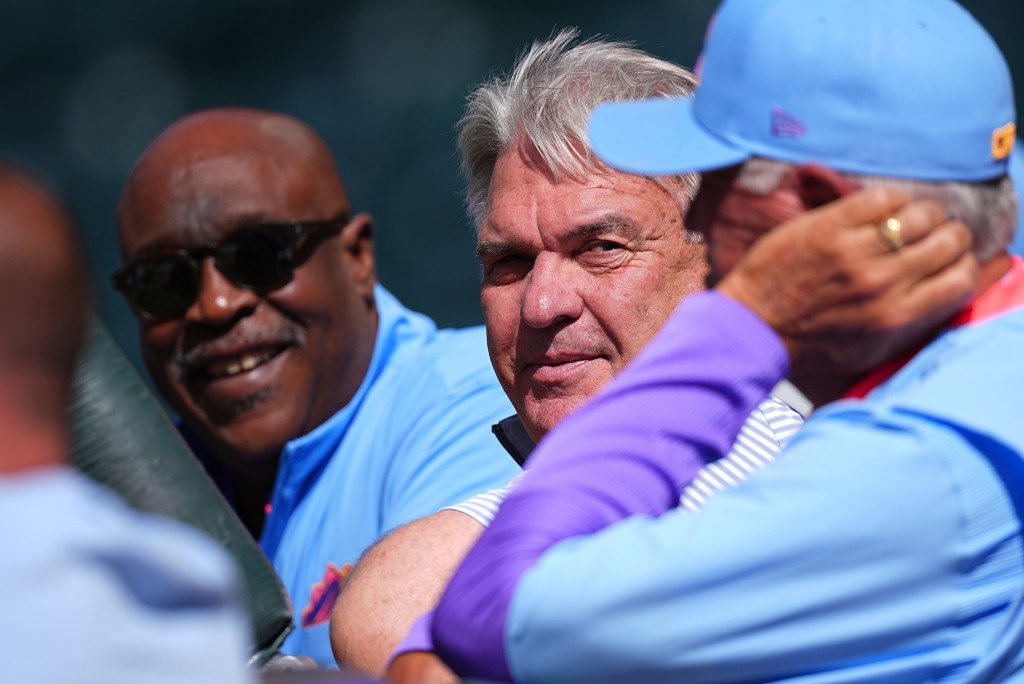
When Bill Schmidt was promoted to Rockies interim general manager on May 3, 2021, he said several key things.
He was interested in becoming the long-term GM. He didn’t believe the Rockies needed “rebuilding.” And he said Job No. 1 was to “Get everybody pulling on the rope in the same direction. Not only the players, but the whole organization.”
Then there’s this: “At the end of the day, I realize we need to win games.”
Schmidt was named the long-term GM on Oct. 2, 2021, but his vision of what the Rockies could become has never materialized.
Now, as the Rockies near the end of the worst season in franchise history and remain on track for one of the worst seasons in big-league history, it’s clear Schmidt’s tenure has been a failure. Colorado entered the weekend with a 40-107 record (on pace to lose 117 games), and the team had a 224-407 record on Schmidt’s watch, a .355 winning percentage that is by far the worst of any Colorado GM.
The Rockies have not publicly commented on Schmidt’s future, but it appears likely that he will be fired or reassigned at the end of the season.
When the club fired longtime manager Bud Black after the team opened the season with a 7-33 record, owner Dick Monfort issued a statement that read, “Our play this season, especially coming off the last two seasons, has been unacceptable. While we all share responsibility in how this season has played out, these changes are necessary. We will use the remainder of 2025 to improve where we can on the field and to evaluate all areas of our operation so we can properly turn the page into the next chapter of Rockies baseball.”
“Unacceptable” and “evaluate all areas of our operation” were key points in that statement, and they surely apply to Schmidt — not just Black and the players.
The following is an analysis of Schmidt’s tenure as GM:
Free-agent signings
Relative to many major league teams, the Rockies have been minor players in baseball’s free-agent game during Schmidt’s tenure. The exception was the spring 2022 signing of Kris Bryant to a seven-year, $182 million contract, the largest in franchise history.
Bryant has played in just 11 games this season and only 170 in his first four seasons with the franchise. He has been worth a minus-1.6 rWAR over that time and hit only 17 home runs. His chronic lower back condition — the team calls it “lumbar degenerative disc disease” — could mean that his career is over. Regardless, the Rockies still owe Bryant $27 million in 2026, ’27 and ’28.
Schmidt initially envisioned Bryant as the Rockies’ “aircraft carrier,” but national baseball pundits almost universally panned the signing immediately after it was reported. While it was Monfort who pushed for Bryant to come to Colorado, there’s no indication Schmidt pushed back on the deal, either.
Schmidt’s other “major” free-agent signings:
• Outfielder Juricson Profar, 2023, one year, $7.75 million.
• Right-handed reliever Alex Colome, 2022, one year, $4.1 million.
• Right-handed starter Jose Urena, 2023, re-signed, one year, $3.5 million.
• Utility player Kyle Farmer, 2025, one year, $3.25 million.
• Second baseman Thairo Estrada, 2025, one year, $3.25 million.
Whether it was because of injuries (Estrada) or poor play (Profar), none of those deals yielded a big return.
It should be noted that Monfort’s desire to sign Bryant to a mega-deal, coupled with his decision to reduce the club’s 40-man payroll from $171 million in 2023 to $122.3 million this season, according to Spotrac, hindered Schmidt’s efforts to build a better team.
The Rockies have rarely been active in free agency, even before Schmidt’s tenure, but the GM’s inability to mine the margins of the market for productive players didn’t help.
Contract extensions
Schmidt, who served as Colorado’s head of scouting since 2007 before his promotion, certainly believes in the players he drafted or acquired. During his tenure as GM, he extended the contracts of several players, most notably left-hander Kyle Freeland and third baseman Ryan McMahon in the spring of 2022, and shortstop Ezequiel Tovar during spring training 2024.
Tovar’s seven-year, $63.5 million extension appears to be a big win for the Rockies and is easily one of Schmidt’s best moves. The other extensions are more questionable.
Three days after signing Bryant, Colorado signed McMahon to a six-year, $70 million extension, revealing Schmidt’s blueprint.
“We don’t have all we need yet, but we have quality pieces,” Schmidt said at the time. “Let’s tie them up and move forward.”
A month later, the Rockies signed Freeland to a five-year, $64.5 million extension. The 32-year-old remains with the team as a steady, veteran presence in Colorado’s historically bad rotation. McMahon was traded to the Yankees in July for prospects. Though he was Colorado’s lone All-Star in 2024, his high strikeout rate and streaky hitting prevented him from ever becoming the player the Rockies envisioned.
The Freeland and McMahon signings ended Schmidt’s most active stretch as a GM. In the fall of 2021, after the Rockies lost star shortstop Trevor Story and right-handed starter Jon Gray to free agency, Colorado brokered long-term deals with right-hander Antonio Senzatela (five years, $55 million) and catcher Elias Diaz (three years, $14 million), and also re-signed first baseman C.J. Cron for two years ($14.5 million).
Dias and Cron were both All-Stars, but the Senzatela extension has aged poorly. A knee injury at the end of the 2022 season and Tommy John surgery in July 2023 cost him dearly, and he’s been bad since his return. This season, the 30-year-old was 4-15 with a 7.15 ERA in 24 games (23 starts), and batters were hitting .356 against him when he was demoted to the bullpen in August. Senzatela has one year remaining on his contract and is set to earn $12 million in 2026.
Reliever Daniel Bard’s contract extension also backfired on Schmidt. In late July 2022, just ahead of the trade deadline, Bard inked a two-year, $19 million contract to stay with the team through 2024. He was a solid closer at the time, and teams were interested in acquiring Bard. But he was also 37 with a history of the yips.
Bard’s control issues resurfaced in 2023 when he posted a 4.56 ERA across 49 1/3 innings while walking more than 21% of opposing hitters. Injuries wiped out the second season of the deal.
Trade or no trade
Schmidt’s first summer as GM included two major decisions. The Rockies did not trade Story or Gray, both impending free agents. Instead, the Rockies offered Story an $18.4 million qualifying offer, which he declined. As compensation, when Story signed a six-year, $140 million deal with the Red Sox, the Rockies received the 31st overall pick in the 2022 draft and selected Florida outfielder Sterlin Thompson, now the club’s 16th-ranked prospect.
The Rockies were hopeful they could retain Gray. During the final week of the 2021 season, they approached him with an offer thought to be three or four years in the range of $35 million to $40 million. He turned it down, entered free agency, and the Rockies got nothing when he walked.
Such inaction at the trade deadline has been a hallmark of the organization. While that’s also been true during Schmidt’s tenure, he has strengthened the big-league roster and farm system by making some solid moves over the last two years.
On the current roster, right fielder Tyler Freeman, closer Victor Vodnik and right-handed starter Tanner Gordon were all acquired via trades. Players on the 40-man roster acquired via trade are right-handers Bradley Blalock, Luis Peralta and Jeff Criswell.
At this summer’s traded deadline, the Rockies made multiple trades for their future, shipping McMahon to the Yankees for two prospects; trading reliever Jake Bird to the Yankees for two more prospects, and dealing veteran right-handed reliever Tyler Kinley to Atlanta in exchange for minor league right-hander Austin Smith.
It remains to be seen if any of those trades will pan out
Draft and develop
Before Schmidt became GM, he had been the point man for many drafts as the head of the scouting department since 1999.
During his tenure, several notable players were drafted, including Troy Tulowitzki, Jeff Francis, Brad Hawpe, Garrett Atkins, Nolan Arenado, Charlie Blackmon, Freeland, Gray, Story and McMahon.
But there’s been a landslide of early-round disappointments in recent years, including second baseman Brendon Rodgers (third overall, 2015), right-hander Riley Pint (fourth, 2016), infielder Ryan Vilade (48th, 2017), lefty Ryan Rolison (22nd, 2018), and first baseman Michael Toglia (23rd, 2019). The jury is still out on outfielders Zac Veen (ninth, 2020) and Benny Montgomery (eighth, 2021).
Catcher Hunter Goodman (109th, 2021) and center fielder Brenton Doyle (129th, 2019) were picked later in the draft but have emerged as pillars of Colorado’s future.
Still, over the past nine years, the Rockies have had five top-10 picks and nine others in the top 42, and those 14 picks have combined for -1.7 bWAR.
Former GM Jeff Bridich had the final say on several of those picks, but Schmidt had the final word starting with the 2022 draft. Early results are solid. His selections include right-hander Gabriel Hughes (10th, 2022) and first baseman Charlie Condon (third, 2024), both of whom could debut next season.
Already on the big-league roster are right-hander Chase Dollander (ninth, 2023), infielder Ryan Ritters (116th, 2022) and Kyle Karros (145th, 2023), and outfielder Jordan Beck (38th, 2022).
Change on the horizon?
When Schmidt replaced Bridich in early May 2021, he provided stability to a dysfunctional front office. There was, however, an expectation that the Rockies would conduct a search outside the offices at 20th and Black for a permanent GM.
That didn’t happen. After a 10-18 start under Bridich, the Rockies went 64-69 after Schmidt took over. That was good enough to convince Monfort and then-team president Greg Feasel to keep Schmidt in place.
“It was what he did over the four months, and then it just kept building, and I mean, really, he didn’t give us a choice,” Feasel said at the time. “I mean, the intent was that we were going to go outside.
“But, I mean, how many times do you need to be hit over the head with a bat? And he was the right guy for us at the right time.”
Three 100-loss seasons later, the Rockies have hit a new low in their 33-year history. Will someone from the outside have the talent, vision and guts to tackle the challenge of a rebuild? Will Monfort and his son Walker, the team’s executive vice president, cede power to an outsider?
Some candidates with ties to Colorado might be considered. Thad Levine, who was in the Rockies’ front office from 1999 to 2005 before becoming assistant GM of the Texas Rangers and GM of the Minnesota Twins, would be a good fit. So would Seattle Mariners GM Jerry Dipoto, who pitched for the Rockies and served two stints in their front office, or perhaps Mariners assistant GM Andy McKay, who was Colorado’s minor league peak performance director from 2012-16 before joining Seattle as farm director.
Whatever happens, front-office changes in LoDo appear inevitable.
Rockies general managers, by record
The Rockies have only had four general managers in their 33-year history, and none of them posted a winning record during their tenure. The best of the bunch, as measured by winning percentage? The very first one, Bob Gebhard.
Seasons
GM
Record
Playoffs
1992-99
Bob Gebhard
512-559 (.478)
1995 NL wild card
2014-2021
Jeff Bridich
428-471 (.476)
2017 wild card; 2018 NLDS
1999-2014
Dan O’Dowd
1,129-1,302 (.464)
2007 World Series; 2009 NLDS
2021-2025
Bill Schmidt
224-407 (.355)
None
Want more Rockies news? Sign up for the Rockies Insider to get all our MLB analysis.